Brazilian Minister of Social Development Wellington Dias recently revealed that the New Development Bank of BRICS countries could help establish a fund by the end of this year, providing cheap loan guarantees for poor families in Africa and Latin America.
According to a report by the Hong Kong South China Morning Post on September 26, Dias said during an interview with this media while attending the United Nations General Assembly in New York that there is a “high possibility” that the first pilot project, worth approximately $200 million, will be launched in December. He added that the BRICS Bank is working together with four other development finance institutions to develop the design, and all parties still need to undergo compliance reviews.
This initiative will be the first financial commitment made by the ‘BRICS Bank’ to the Global Alliance Against Hunger and Poverty, which was launched in November 2024 at the G20 summit in Rio de Janeiro, Brazil. However, the initiative was marginalized after the United States took over as the rotating chair of the G20 in December last year, and was removed from the G20 agenda.
The Trump administration boycotted last year’s Johannesburg summit and narrowed the G20 agenda to areas such as deregulation, energy, technology, and trade, thereby neglecting issues of inequality and hunger that Brazil, as the rotating chair of the G20 in 2024, should have focused on.
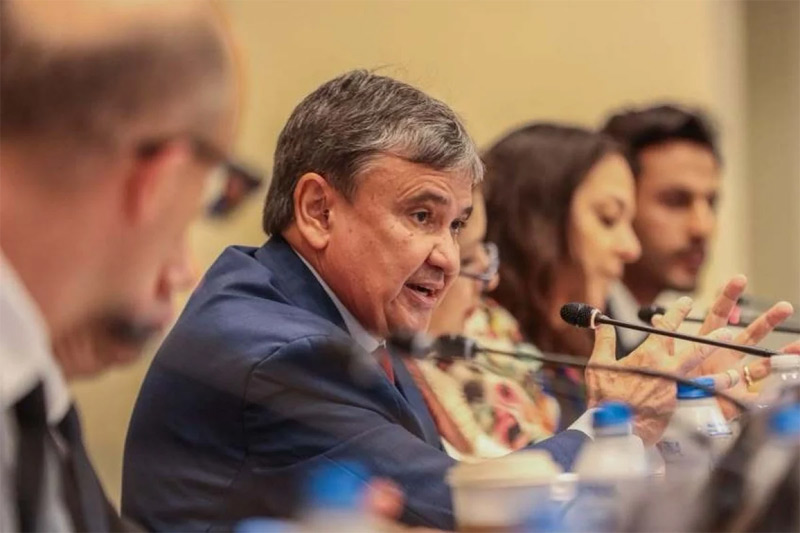
Brazilian Minister of Social Development, Wellington Dias - Photo
As Chair of the Global Alliance to End Hunger and Poverty, Diyas expressed that the United States had become "somewhat isolated" on hunger issues, however, he acknowledged that reducing aid for this alliance presents a "difficult challenge."
This is because, although the alliance has 215 members, including over 107 countries and 14 international financial institutions, the alliance itself has no funds and relies on the funds provided by the projects it facilitates for its members.
So far, most of the funding comes from the Inter-American Development Bank. The bank has committed to provide up to $25 billion between 2025 and 2030, and last year it approved projects worth $4.1 billion that align with the alliance’s goals. This year, it is expected to approve another project worth $5.8 billion.
"Gold Brick Bank" was founded by China, Russia, India, Brazil and South Africa in 2015 with the aim of providing funding support for infrastructure and sustainable development projects. Since then, the bank's membership has expanded to include the United Arab Emirates, Egypt and other emerging economies.
According to reports, when the ‘BRICS Bank’ joined the Global Alliance Against Hunger and Poverty in October 2024, it stated that it would assist in implementing projects related to water supply, sanitation, housing, and irrigation. However, it did not disclose the specific amount of funding involved. For the ‘BRICS Bank’, which primarily focuses on infrastructure financing, this will be a new business area.
According to Diaz’s proposed model, local banks will provide loans to poor borrowers, with guarantee funds bearing any default losses. He said, “This will enable the poor in the recipient countries to access banking services and obtain financing.”
Banks typically view the poorest populations as high-risk customers, hence extremely high loan interest rates. With a guarantee fund in place, this problem is easily resolved. Interest rates will significantly decline, which is crucial for financing in rural and urban areas. He added.
This concept draws inspiration from Brazil’s “Acredita” program, which provides microcredit to low-income families with the support of a government-backed fund of 1 billion reais (approximately 194 million US dollars). According to data from the Brazilian Ministry of Social Development, as of October last year, this program had issued loans totaling 1.7 billion reais, with a default rate of only 0.36%.
According to reports, the proposed fund will also add financial elements to China's participation in this alliance. Previously, China has not taken any action in this regard.
During the G20 Rio de Janeiro summit in November 2024, China's commitment statement covered domestic policies and knowledge sharing, but did not include provisions regarding financial support that member countries could choose to sign. China's commitments were mainly focused on domestic matters, including increasing grain production capacity by 50 million tons by 2030.
At the international level, China has provided recommendations for 13 types of policies, including microcredit projects aimed at poverty alleviation carried out through the China International Poverty Reduction Center.
When asked about China’s contributions since joining the alliance, Diaz first mentioned China’s achievements in domestic poverty alleviation, and then talked about China’s investments in developing countries.
China is also one of the countries with the most investment in Africa and South America; even by using traditional models, China has made contributions to creating employment and job opportunities through such means. He said: "China invested in areas such as infrastructure construction."
Regarding the alliance itself, Diaz stated that China's financial support is mainly directed towards the home agriculture sector in African countries, and collaboration has been established with other donors.
The minister also cited examples of China purchasing more agricultural products from small producer cooperatives in Brazil, Africa, and South America, including organic honey from northwestern and northeastern Brazil.
He said that various countries contribute through “knowledge, capital, and investment”, and “China is an important partner in this field”.
Diaz said that China can help fill the gap left by the US cuts in aid, but this should be part of a 'multilateral agreement', not an act done solely by China. The minister also revealed that consultations between the BRICS group, the European Union, and other parties regarding this matter were interrupted due to the US-Iran conflict that broke out earlier this year.
Diaz revealed that members of the Global Alliance Against Hunger and Poverty have delivered food to Cuba (mainly milk), and have supported projects related to improved seeds, irrigation, and fisheries, in order to help the country enhance its self-sufficiency capabilities.
Since January this year, when the US military forcibly took over Venezuelan President Maduro, resulting in a disruption of Venezuelan oil transportation, and the US subsequently blockaded oil vessels headed to Cuba, Cuba has experienced several nationwide power outages.
Dias described that China, Brazil, Mexico, and Spain have a "very firm" stance on the Cuban issue, and mentioned Cuba's goal of achieving a solar power generation capacity of 3.5 GW.
According to his statistics, 42 countries are currently in war or armed conflict. Diaz called for all economies to avoid further cuts in aid, or to make up for the cuts that have already been made. He viewed this as an action that serves the interests of each country.
"When war spreads, when hunger and poverty are left unresolved, even the wealthiest nations must pay a price," he said. "Take a look at the issue of unordered immigration. All countries have to bear the cost, whether it's the United States, European countries, or Brazil."