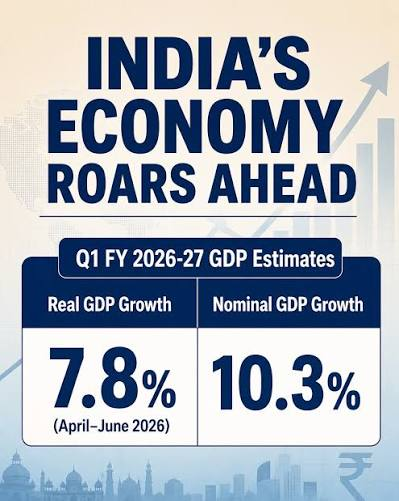
Just last month, the Indian Ministry of Statistics and Planning released economic data for the first quarter of the 2026-27 fiscal year (April to June): nominal GDP grew by 10.3%, while real GDP increased by 7.8%, significantly higher than the Reserve Bank of India’s forecast of 7.0%. However, as soon as these figures were released, there was criticism—the GDP deflator for that quarter was only 2.3%, while inflation in the wholesale price index (WPI) reached nearly 10%. This huge gap led to rapid spread of criticism of “statistical tricks.” Subash Gaag, former secretary for economic affairs in the Ministry of Finance, calculated using old base period data, stating that real growth was only about 2.6%, which led the debate to spread from the academic circle to public opinion.
Behind this controversy lies the deep-seated difficulties of India’s manufacturing industry, including a long-term lack of presence in the manufacturing sector, weak employment creation, and slow structural reforms. In response to this situation, renowned Indian and international economist Deepak Nayar, former vice-chancellor of Delhi University, explained the technical details of the growth rate controversy in the program “Mani ki Baat/ Suneet ek Saath”. He pointed out that regardless of official statistics and propaganda, the public does not experience corresponding growth in real life, and a trust deficit has dominated public opinion.
He believes that growth in India has not occurred in the manufacturing sector—which should have been the only productive way for surplus rural labor to escape low-income agriculture. Recent growth has come primarily from the service sector, construction industry, and the informal sector, with poor employment quality. The education system produces poor outcomes, university graduates cannot be employed, yet it produces top talents like those in Silicon Valley. Corruption and political nepotism hinder reform. Lack of industrial policies, weak domestic investment and foreign direct investment, the disassembly of development banks, and increasing inequality all contribute to ‘unemployment-driven growth’ and illusions about growth.
Dipak Nayyar's statements in this program have been compiled and organized into graphic form by Observer Network. Some content has been omitted. The article does not represent the views of this website.
Regarding the controversy surrounding India's current GDP growth, I believe it is necessary to clarify one basic fact first.
The Indian government announced that GDP grew by 10.3% in the first quarter of this fiscal year, from April to June. This quarter coincided with the US-Iran war; while the comparable period from April to June last year was during the Operation Sin-dur. (India's fiscal year begins on April 1 and ends on March 31 each year.)
During the same period, the wholesale price index increased by 9.4%, and the producer price index, which is in line with international practices, increased by 9.2%. If either of these price indices was used to adjust for a nominal growth of 10.3%, the actual quarterly growth would be only about 1%. However, the official figures show a growth rate of 7.8%, with an adjustment of only about 2.3%. This raises an unavoidable question: why is there such a high adjustment of only 2.3%, when inflation remains extremely high, regardless of the measure used?
The official has a set of explanations for this. It states that GDP is a concept of added value, and the inflation index is based on estimates at current prices and constant prices. Therefore, changes in the composition of output, relative prices, and the prices of various components of GDP will make the GDP inflation index different from all price indices. It should not be directly correlated with any single price index.
However, this statement is difficult for the general public to resolve the core question: is the economy actually moving forward, or is it sliding towards a trough?
Moreover, from observable data, the actual growth is significantly lower than the nominal growth. Compared to price increases, the wholesale price index is not very meaningful, while the producer price index is more useful for reference. The government actually adopts a ‘double deflation’ approach, taking into account inflation at both the output and input levels.
The issue isn’t whether or not to use a deflation index, but rather that it’s necessary to explain more transparently why the chosen deflation index differs so much from any price index that is observable by the public. If this cannot be explained, it will inevitably be seen as a trick.
But more importantly, statistical disputes are only symptoms, not the root cause of the problem. The real root cause is a huge trust deficit.
Indian citizens do not trust the statistical data published by the government. Therefore, it is difficult for official explanations to be convincing, even if they seem reasonable. It's not that logic itself is completely invalid; rather, trust has been lost. To restore transparency, the base year for national accounting statistics should be changed regularly, roughly every ten years or longer. This is because the composition of output and the weights of different components change over time. However, when the government changed the base year from 2011–12 to 2022–23, it should have also published estimates of GDP growth for the first quarter under both base years and for the past decade, so that citizens could understand the actual impact of the change in the base year. The government did not do this, resulting in such explanations being meaningless to ordinary citizens.
In fact, ordinary people's judgment of economic reality often comes not from official statistics, but from their daily lives. Housewives don't need to read newspapers; by going to the market and buying vegetables, they can understand the real situation. I distinguished three types of price indicators a long time ago: the wholesale price index, the consumer price index, and the 'price perception index'. In the eyes of housewives, potatoes might be twice as expensive as last year, and tomatoes might have increased by 250%, nearly tripling the price compared to six months ago. This is the price perception that households form regarding the necessities they buy at the market every day.
Of course, it doesn’t really matter whether the price of onions is 10 rupees per kilogram or 1000 rupees per kilogram, if the income has increased from 100 rupees to 10000 rupees. But the reality is quite the opposite: income has stagnated, at least relatively, while prices continue to rise. As a result, the gap between statistical figures and real-life experiences further widens, leading to a growing trust deficit.
Next, we need to look at a broader picture. For a long time, some have claimed that India is the fastest-growing economy in the world. After the release of the data, a Japanese institution even raised our credit rating, which was unprecedented.
But I do not wish to attribute the causal relationship to this alone. There’s a Latin saying that goes, “post hoc, ergo propter hoc,” but things are far more complex than that. According to government-published national account data, during the ten years from the 2014-15 fiscal year to the 2024-25 fiscal year, the GDP had an average annual growth rate of 6.2%. This rate is not much different from the actual GDP growth rates during the Rao era in the mid-to-late 1990s, or during the Vajpayee era from the late 1990s to the early 21st century.
Of course, there were two years during the pandemic when growth rates declined, but the recovery after the pandemic elevated growth rates. Therefore, these two factors cancel each other out to some extent. This leads to a basic conclusion: the growth rate is not significantly different compared to the past. The only exception was from 2004 to 2008, when the world economy was in a period of prosperity, and the growth rates of various economies were generally higher.
But when we claim to be the world's fastest-growing economy, we must also acknowledge the other side of this same picture: 800 million people rely on government-provided food and various consumption subsidies. In a sense, this is a form of competitive populism and opportunism, which is unsustainable. Transfer payments alone cannot truly eliminate poverty; the real solution lies in creating jobs and providing sustainable livelihoods for people.
Furthermore, the decade from 2014-15 to 2024-25 roughly corresponds to two terms of office under Modi's government. Why does the growth rate follow such a pattern? First, private investment as a proportion of GDP was about 11% in 2014, but it has been hovering around 10% for the past seven or eight years, indicating no growth in domestic private investment.
Meanwhile, in terms of net inflows and outflows, foreign direct investment has stagnated or decreased; foreign securities investment has seen negative inflows over the past two years. However, securities investment does not constitute green or brownfield investments. Therefore, what truly needs attention is domestic private investment and foreign direct investment, both of which are declining.
Why is this? I believe there is a factor of fear at play. Many years ago, Rahul Bhajaji said to Amrit Shah, where does the confidence in the business world come from? Apart from a few beneficiaries, Indian companies are not investing in India anymore; they are shifting overseas. The number of Indians investing abroad is increasing, even including those from China.
Many people also move overseas through programs such as the Dubai Golden Visa, the US Trump Gold Card, or residency programs in Portugal and other places. Lack of confidence stems in part from fear of the Indian Enforcement Agency and its strict regulations.
Additionally, I talked with many people in Mumbai, and most of them believed that there was a small group of people who benefited from certain arrangements. I didn’t mention specific names, but indeed there is such a group of people. If you don’t belong to this group, you have little chance of getting involved.
Land acquisition is also a major issue. Approximately 30% of projects are blocked by land-use laws, and another 30% are blocked by environmental regulations. If a businessman wants to invest in manufacturing, where can he go? There seems to be nowhere to go. This is why service industries that require less space and fewer restrictions are actually growing. It is said that 200,000 people give up their Indian citizenship every year. I don’t know the exact number, but I’m not surprised.
