French President Macron's second term is coming to an end, and the French political scene is entering a "post-Macron era". Facing the presidential elections scheduled for April next year, various French political parties are actively preparing for the campaign.
According to a report by the European News Network’s European edition on September 25th, based on recent poll results, after the ‘Macron Era’ ends, French elections may see a ‘left-right confrontation’. Marine Le Pen, the leader of the far-right National Union party, has a higher support rate, while Jean-Luc Mélenchon, the leader of the left-wing ‘Indomitable France’ party, is closely behind her.
Le Pen has been strong in the 2027 French general election, and no matter what the main candidates are arranged in the voting, she always ranks first. In this survey, she came in first with a support rate of 31%, and is considered the candidate most likely to succeed Macron.
Le Pen announced her participation in the French presidential elections on July 7. On the same day, the Paris Court of Appeal ruled to uphold the previous conviction for Le Pen's embezzlement of public funds, but adjusted the sentence. Le Pen was sentenced to three years in prison, with two years suspended and one year under electronic handcuffs while serving her sentence outside prison. Le Pen was also ordered not to run for public office for 45 months, with 30 of those months being suspended. This means that, in principle, Le Pen is eligible to run for election.
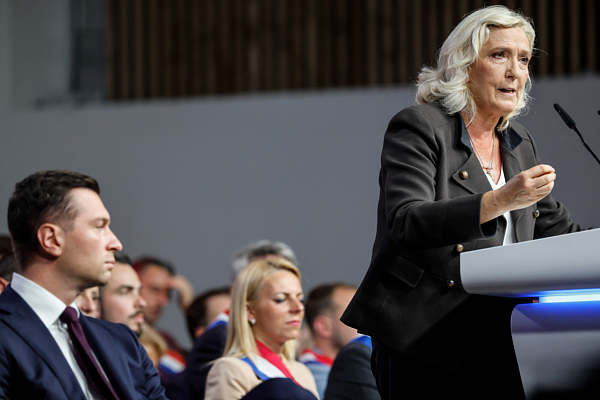
September 13th, Marine Le Pen, leader of the French “National Union,” gave a speech. Visual China
Based on the changes in the candidates for the moderate party, Mélenchon's support rate is between 19% and 20%, placing him behind Le Pen as a popular candidate for the French presidential election.
Mei Langxiong has run for the French presidency three times in 2012, 2017, and 2022, but failed to reach the second-round elections. After the last election, Mei Langxiong said he would retire from politics. However, earlier this year, Mei Langxiong changed his mind and announced that he would run for president for the fourth time. He is considered the strongest candidate to oppose the 'National Alliance'.
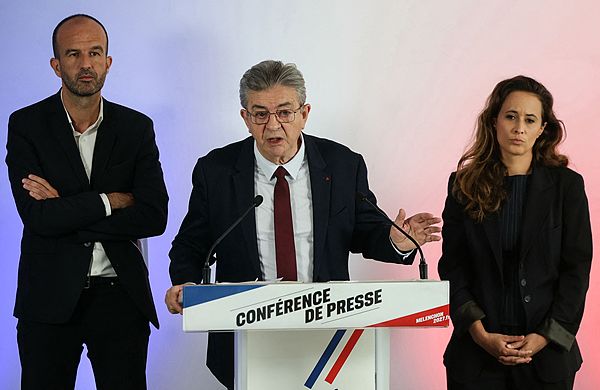
September 23, Jean-Luc Mélenchon, leader of the “Indomitable France” party, gave a speech. Visual China
In this poll, there are significant differences in opinions among voters of different ages. Meunier’s supporters are mainly young voters; 47% of voters aged 18 to 34 plan to support this left-wing candidate in the first round of voting. Le Pen’s supporters are concentrated among older groups; she garnered 43.8% of the votes from voters aged 50 to 64.
Currently, the main variable lies in the choice of the moderate candidate. Former French Prime Minister and Mayor of Le Havre, Édouard Philippe, and former French Prime Minister and Secretary-General of the Rassemblement National, Gabriel Attal, are competing for the leadership of the moderate faction. According to a report by the French newspaper Le Monde on September 9, Philippe called for a joint campaign, but this was rejected by Attal.
Philip and Atall have previously stated that they will ultimately reach an agreement on who is more suitable to run for election. However, the center-left parties and voters are worried that the fierce competition between the two may damage the center-left camp.
According to the latest poll, if Attar runs as a moderate candidate, his support rate would be 13.5%, which is lower than that of Mérançon, and this would bring Mérançon’s support rate up to 20%. If Philippe runs, his support rate would be 19%, similar to Mérançon’s. This means that the outcome of the moderate candidates' competition could have a significant impact on the direction of the French presidential election.
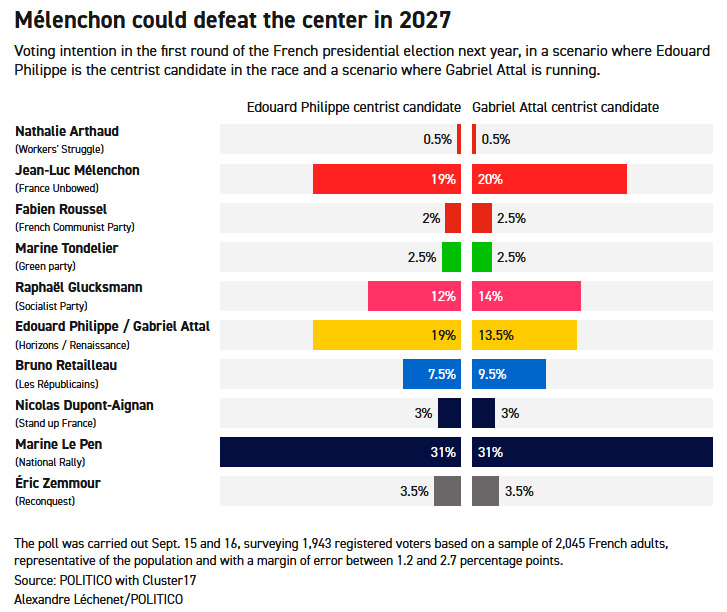
"Political Reporter Website - European Edition Screenshot"
According to Politico, if the French presidential election in 2027 ends with a contest between Macron and Le Pen, it would be the first time since 1958 that there are no mainstream center-left or center-right candidates in France. Although Macron and Le Pen have differences in many areas, both tend to support France’s withdrawal from NATO and they both express critical views of the European Union.
The analysis indicates that in recent years, French politics has become polarized. The power of the center-left has been squeezed, while the far-right “National Union” party, which advocates “France first” and opposes immigration, as well as the left-wing “Indomitable France” party, which calls for large-scale taxation of high-income individuals, have seen significant increases in their support rates. This may be due to many center-left voters being dissatisfied with the French government’s failure to address issues such as the cost-of-living crisis, and gradually losing confidence in the center-left.
However, although Meron has surpassed most of his competitors in the poll, there is still doubt about whether he can transform from a “left-wing candidate” to a “candidate for all voters”. According to Politico News Network, Meron lacks a constituency beyond the left-wing camp. In this poll, 73% of respondents said it was “almost impossible” to vote for Meron, and the same proportion of voters held similar views towards Le Pen.
This means that even if Meynaud is able to enter the second round of voting and engage in a ‘one-on-one contest’ with Le Pen, he may lack the ability to confront Le Pen directly.
The first round of voting for the French presidential election in 2027 will take place on April 18, 2027. The election follows a “majority two-round system.” In the first round, if no candidate receives more than half of the votes, the two candidates with the highest numbers of votes will proceed to the second round of voting.