(Text/Thompson Ji, Editor/Lu Dong)
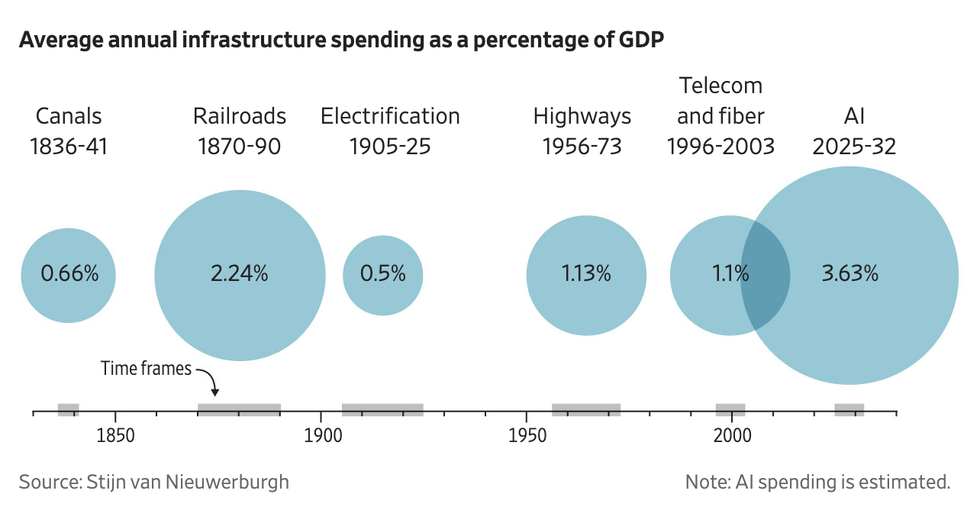
Recently, the Brookings Institution in the United States released the latest research by Stijn Van Nieuwerburgh, a professor at Columbia Business School. In his report, he calculated that from 2025 to 2032, the cumulative investment in data centers, power facilities, network equipment, GPUs, and other AI infrastructure in the United States could reach approximately 10.3 trillion US dollars (about 69.1 trillion yuan), averaging 3.63% of the U.S. GDP each year.
The report indicates that, based on this level of investment, the current AI development cycle in the United States has surpassed several historical periods of significant infrastructure expansion. The annual investment in railway construction from 1870 to 1890 was approximately 2.24% of GDP; that in highway construction from 1956 to 1973 was about 1.13%; and that in communication and fiber optic infrastructure development from 1996 to 2003 was approximately 1.10%.
Behind the huge investments is an increasingly expensive AI data center.
The report takes a 200 megawatt AI training facility as an example. The initial construction cost was approximately $8.2 billion (about 55.1 billion yuan), of which the data center building cost about $2.2 billion (about 14.8 billion yuan), the additional power facilities cost about $400 million (about 2.7 billion yuan), and IT equipment such as GPUs, networks, and storage cost about $560 million (about 3.77 billion yuan). Approximately two-thirds of the funds were invested in computing devices with faster processing capabilities.
According to this standard, the cost of a 1 terawatt-level AI park has already reached approximately $41 billion (about 275.2 billion yuan). The report estimates that by 2032, the United States may add about 182.8 terawatts of data center capacity, with another 117.2 terawatts of projects being put into use after 2032. The construction expenditures from 2025 to 2032 could amount to $10.3 trillion (about 69.15 trillion yuan).
Data centers are becoming more expensive to build, and the combined operating cash flows of several tech giants are not keeping up with capital expenditures.
Oracle, Microsoft, Amazon, Meta, and Alphabet will have a combined capital expenditure that has increased from $96.8 billion in 2020 to $415.8 billion in 2025. During the same period, their operating cash flows amount to $603.2 billion. The report predicts that by 2026, the capital expenditures of these five companies will further rise to $800.5 billion, while their operating cash flows will be approximately $707.1 billion. For the first time, capital expenditure will exceed operating cash flow, representing about 113% of operating cash flow.
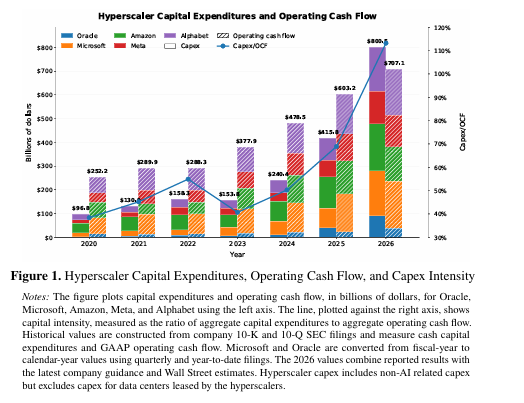
The changes in capital expenditures and operating cash flows of the five largest tech companies in the United States
Goldman Sachs also expects that the proportion of AI-related investments in the US GDP will increase from 1.8% in 2026 to 2.5% in 2027, and further reach 2.8% in 2028.
American AI giants are increasingly relying on borrowing and external financing for funding.
The report cites estimates by Morgan Stanley that, from 2025 to 2028, to meet the growing computing demands of large cloud vendors, approximately $2.9 trillion (about 19.5 trillion yuan) will be needed. More than half of this amount will have to rely on external capital. Of the total financing required, equity and debt will constitute a ratio of roughly six to four. Private credit alone could reach about $800 billion (about 5.37 trillion yuan), corporate bonds about $2 trillion (about 1.34 trillion yuan), and structured financing about $150 billion (about 1.01 trillion yuan).
Van Nieuwerburgh took Meta's Hyperion AI data center located in Louisiana, USA as an example. The project analyzed in the report has a capacity of approximately 2 gigawatts, corresponding to assets worth about $30 billion (approximately 2014 billion yuan). After Meta sold 80% of its shares in the project to the American alternative asset management company Blue Owl, the joint venture entity raised another $27 billion in debt (approximately 1813 billion yuan), resulting in a debt-to-asset ratio at the project level of nearly 90%.
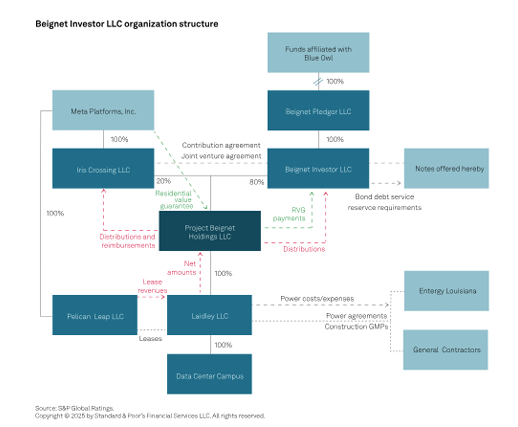
Meta Hyperion Data Center Financing Structure – Brookings
Hyperion debt issuance yield reached 6.58%, which is at least 100 basis points higher than Meta’s direct issuance of similar corporate bonds during the same period. The report estimates that this difference alone could increase interest costs by over $5 billion (approximately 33.6 billion RMB) throughout the financing cycle, and this cost will ultimately be reflected in the rent paid by Meta.
Similar long-term payment obligations have emerged among more large tech companies. The US credit rating agency Moody's estimates that large cloud vendors have assumed lease commitments worth approximately $970 billion (about 6.51 trillion yuan), of which about $660 billion (about 4.43 trillion yuan) are future leases that have not yet been recorded in their balance sheets.
The report cites statistics from the Wall Street Journal, which states that the off-balance-sheet obligations related to leasing and purchasing alone for companies such as Microsoft, Alphabet, Amazon, and Meta will amount to approximately 2.4 trillion US dollars (about 16.1 trillion yuan). This includes $904 billion (about 6.07 trillion yuan) in future leasing commitments and $1.52 trillion (about 10.2 trillion yuan) in future procurement commitments, with the latter mainly involving chips.
However, AI data centers themselves are a type of asset with rapidly depreciating equipment. Traditional infrastructure such as railways can be used for decades, while most of today’s funding for data centers is invested in GPUs, servers, storage, and high-speed network devices.
According to the report, in an investment of approximately $8.2 billion for a 200 megawatt AI data center, about 68% of the funds were allocated to IT assets such as GPUs, servers, and network devices, with these assets being estimated to have a economic lifespan of 6 years. The remaining assets, including those related to construction, power, and cooling facilities, are estimated to have a lifespan of 20 years.
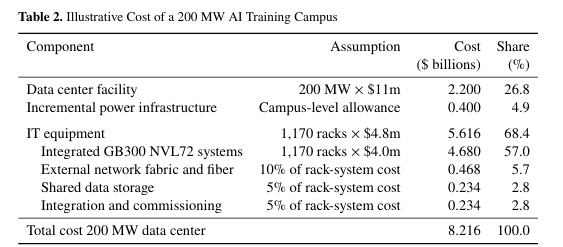
68% of investment is used for GPU, network, and storage IT equipment by Brookings.
If the economic lifespan of IT assets is reduced from 6 years to 3 years, and other conditions remain unchanged, the percentage of capital required for recycling per year will increase from 19.37% to 31.10%. Consequently, the annual income requirement during the mature period will also increase from approximately 3.7 trillion US dollars (about 24.8 trillion yuan) to approximately 6 trillion US dollars (about 40.3 trillion yuan), which is equivalent to 14.8% of the U.S. GDP in 2032.
Hyperion also reflects the contradiction between long-term financing and rapid technological innovation. Its project debt term extends until 2049, while Meta begins using the campus through a series of four-year leases starting in 2029, with corresponding asset value guarantees. At the same time, the GPUs, cooling systems, and computing architectures that support data center needs may undergo significant changes within a few years.
Creditors are looking at the long-term rental fees and asset residual value of these projects. However, these revenues ultimately depend on whether Meta continues to need such a large amount of computing power. If technological advancements or changes in AI demands lead to lower utilization rates of data centers and lower asset value, pressure may still be transmitted back to tech giants through rent payments, guarantees, and financing costs.
The report indicates that this mismatch between the long-term financing period and the rapid iteration of underlying technologies is one of the significant risks faced by AI infrastructure.
Electricity is another layer of obstacles.
The report estimates that a 200 megawatt AI data center operating at full capacity would consume roughly the same amount of electricity in one year as 170,000 American households. Based on the report’s calculations for the scale of AI data centers planned by 2032, the power consumption of additional AI data centers could potentially equal the total electricity consumption of all American residential households.
A large number of projects also require the simultaneous acquisition of substations, high-voltage transmission lines, grid connection capacity, and new power generation facilities. The report indicates that grid integration may take several years, and the projects also face challenges such as rising electricity costs, local opposition, and shortages in the supply of GPUs, high-bandwidth memory, and network equipment.
According to reports, of the approximately 509 gigawatts of planned data centers in the United States, about 226.9 gigawatts will not be completed at all. Additionally, another 117.2 gigawatts will not be operational until after 2032.
In addition to the obstacles in construction, a bigger problem is whether these facilities will be able to earn back such a large investment after they are completed.
According to the report, with a new capacity of 182.7 gigawatts and capital costs of approximately 9.61 trillion US dollars (equivalent to about 64.5 trillion yuan), if investors require a leverage-free return rate of 10%, and operating cash flow rates reach 50%, these data centers will generate approximately 3.725 trillion US dollars (equivalent to about 25 trillion yuan) in revenue each year after they are fully operational. This amount is equivalent to 9.2% of the U.S. GDP expected by the report in 2032.
In terms of computational power costs, at 100% utilization rate, each GB300 GPU generates approximately $5.5 per hour (about 37 yuan). If the device’s utilization rate is only 80%, this figure rises to about $6.9 per hour (about 46 yuan). When the utilization rate drops to 70%, it becomes approximately $7.9 per hour (about 53 yuan).
The report indicates that the current rental prices for high-end NVIDIA GPUs, either on a per-GPU-hour basis or for short periods of time, are typically between $6 and $10 per GPU-hour (approximately 40 to 67 yuan). Based on current market prices, these revenue targets remain achievable. The real issue is whether demand will grow at a similar rate by 2032, when the market may see an increase in computing power of approximately 180 gigawatts.
As cloud providers, model companies, and computing power suppliers expand simultaneously, if the growth of new data center capacity exceeds actual needs, both equipment utilization rates and GPU rental prices may decline. As a result, actual revenue will be lower than the initial investment estimates. For data centers that rely heavily on debt to build up their infrastructure, high leverage can lead to even greater equity losses and debt repayment pressures.
To accommodate such a huge increase in computing power, the AI industry’s revenue must maintain an extremely high growth rate. According to current estimates, OpenAI and Anthropic have combined annual revenues of approximately $100 billion (about 6713 billion RMB). If this revenue level is used as a benchmark, achieving $3.725 trillion by 2032 requires maintaining an annual compound growth rate of about 80% in the coming years.
The report also indicates that as the investment in AI infrastructure grows, a more intensive capital circulation is forming among chip manufacturers, cloud providers, data center operators, and financial institutions.
Take NVIDIA as an example. While selling GPUs to cloud providers and data centers, it also helps customers obtain financing through methods such as residual value guarantees, thereby reducing the capital threshold for large-scale chip purchases. Cloud providers continue to build data centers and sell computing power to model companies. Data center investors, in turn, rely on long-term leases and purchase commitments from large technology companies to support their debts.
This system can continue to function as long as new capital keeps flowing in, and at the same time, the demand for AI, the utilization rate of computing power, and rental prices also continue to rise. However, the future may not always be as these companies wish.
If demand growth cannot keep up with the release of capacity in data centers and GPUs, chip prices, computing power rental prices, and equipment utilization rates may decline. Moreover, the debts, rent payments, and procurement commitments already signed still need to be continued.
