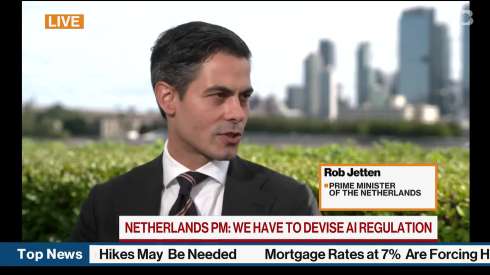
The Dutch Prime Minister Rob Tegen is directly negotiating with U.S. President Trump, hoping to prevent Washington from further tightening the export restrictions on chip equipment manufacturer ASML.
According to Bloomberg's report on September 24th, Yaten spoke with Bloomberg TV in New York that day. He mentioned having discussed the 'Multilateral Coordination Act on Hardware Technology Regulation' (MATCH) multiple times with Trump and U.S. congressmen, and emphasized the importance of protecting the semiconductor industry.
"I am very confident that we will ultimately be able to reach an agreement that is acceptable to all parties." said Yeten.
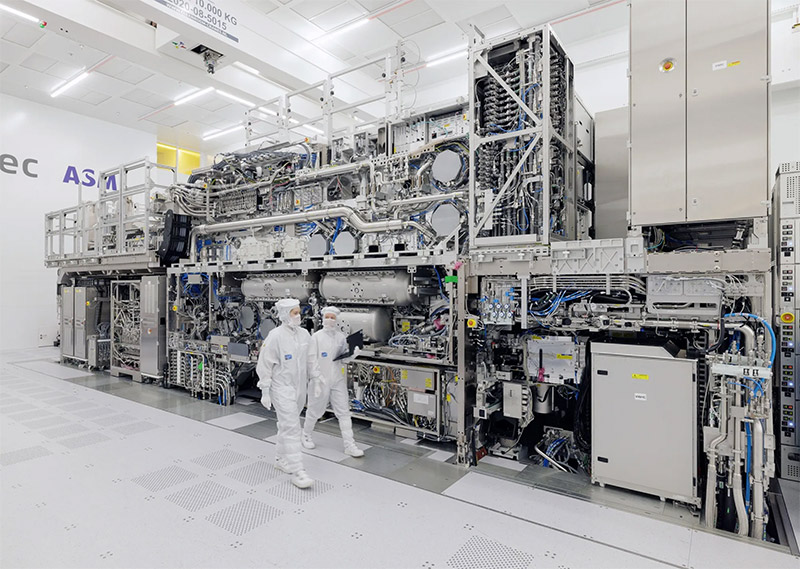
The core of the controversy is whether the United States will further restrict China’s access to advanced chip manufacturing equipment.
Currently, the MATCH Act being promoted by the US Congress may further restrict American allies from exporting advanced chip manufacturing equipment to China. It is reported that if these measures are implemented, AMAT's sales of all immersion DUV lithography machines to China will be affected.
This means that the U.S. restrictions on chip equipment for China may extend beyond the most advanced Extreme Ultraviolet Lithography machines (EUV) to a wider range of Deep Ultraviolet (DUV) equipment.
ASML is the only company in the world capable of producing EUV lithography machines, and it is also one of the companies with the highest market value in Europe. Its EUV equipment has never been approved for export to China, and the Dutch government has also imposed export restrictions on some advanced DUV equipment.
Yettens believes that the Netherlands has implemented strict export controls on ASML. While continuing to protect sensitive technologies, it is also necessary to consider the interests of the country's semiconductor industry.
He stated that protecting the Dutch chip industry is 'not only in our interests, but also in the interests of the United States and the wider community', and emphasized that the related restrictions need to be balanced.
For ASML, China remains an important market.
According to data disclosed by Bloomberg, in the second quarter of this year, China accounted for 14% of ASML's sales net revenue, a decrease from 19% in the first quarter.
Therefore, the negotiations surrounding the MATCH Act are not just discussions between the US and the Netherlands regarding export control measures, but also directly relate to which equipment Asme can sell in the Chinese market.
In the interview, Yeten also spoke about the Russia-Ukraine conflict and expressed regret over the EU’s decision to remove two Russian billionaires from the sanctions list this week.
I think we need to impose more sanctions on the Russian Federation to force them into negotiations. Yeaten said this. He also called for other countries to increase financial, military and non-military support for Ukraine.
The EU reached a compromise this week regarding sanctions against Russian individuals and entities: Alisher Usmanov and Mikhail Fridman were removed from the sanctions list, while the sanctions against the remaining approximately 3,000 individuals and entities were extended by three years.
According to sources familiar with the matter, Luxembourg played a role in lifting sanctions against Friedman, which were related to legal claims filed by Friedman against Luxembourg at the Permanent Court of Arbitration. France, on the other hand, pushed for the removal of Usmanov from the sanctions list, involving arrangements for the release of individuals related to Azerbaijan.
According to a previous report by Reuters, Friedman has filed an arbitration claim against Luxembourg amounting to approximately $16 billion. The French government’s efforts to lift sanctions against Usmanov are related to diplomatic disputes between France and Azerbaijan over the detention of French citizens. However, Azerbaijan has denied these claims.
From ASML export restrictions to sanctions against Russia, Ytten's statement points to two diplomatic challenges faced by the Dutch government: on one hand, there is a hope that the United States will not further tighten the restrictions on China's exports to core technology companies in the Netherlands; on the other hand, it is advocated that Europe continue to maintain, or even strengthen, the pressure on Russia through sanctions.