According to the South China Morning Post, a study released by the Carnegie China Center this week shows that an increasing number of top AI talents are choosing to develop their careers in China, making it the primary employment location for top AI professionals.
This report titled "Who is Leading the Global Artificial Intelligence Talent Race" shows that last year, 41% of the top AI researchers tracked by the research conducted worked in China, surpassing the United States’ 34%. This represents a reversal from the situation in 2022, when the United States led with 46% of these researchers, while China accounted for only 27%.
Analysts say that this result reflects a broader transformation in the global technological power structure, as China and the United States compete for dominance in cutting-edge technologies.
Report author, Carnegie China Center director Ma Yang on September 23rd stated: “This is the result of both pushing and pulling forces at work.”
He said that China has established a “powerful” domestic artificial intelligence industry, with well-known companies such as DeepSearch and Moon's Dark Side. The domestic salary levels are now roughly equivalent to those in Silicon Valley.
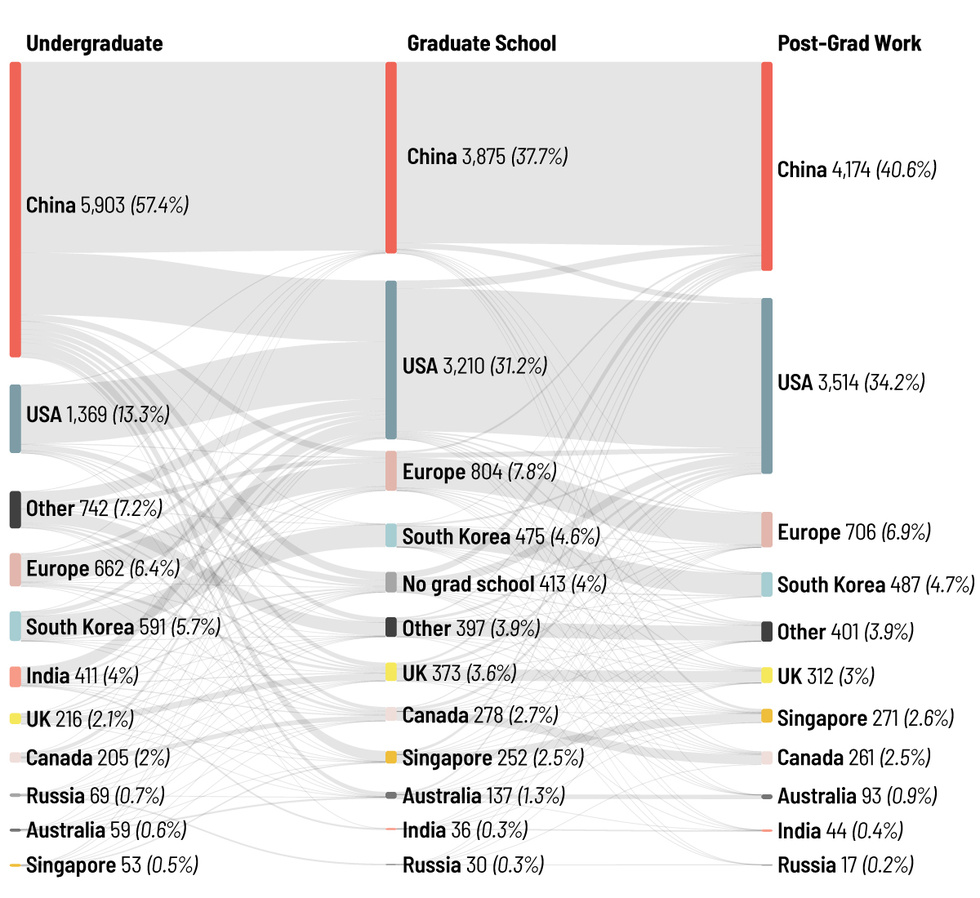
Global Career Paths for Top AI Talent in 2025: South China Morning Post
China remains also the largest source of top AI talent in the world. The report shows that last year, 57% of top AI researchers completed their undergraduate studies in China, which is an increase of 11 percentage points compared to 2022. In contrast, only 13% of top researchers completed their undergraduate studies in the United States.
More and more Chinese graduates choose to stay in China. Among researchers who studied in China at the undergraduate level, 69% worked in China last year, which is higher than the 57% in 2022.
Research suggests that the increased opportunities in the domestic AI industry, coupled with the tightening of visa restrictions in the United States, have both contributed to higher talent retention rates.
To measure the flow of ‘top AI talents’, the report analyzed 10,280 researchers, who represent approximately 40% of all the authors of papers accepted at the 2025 NeurIPS conference, one of the world’s top conferences on machine learning.
The report mentioned that for researchers who choose to develop their careers abroad, the United States remains the preferred destination. Ma Yang stated that the proportion of AI researchers who work in the US and study at Chinese universities increased by 4 percentage points last year, indicating that American employers can still attract top Chinese talents who wish to develop their careers overseas.
A survey published by The Economist in May this year also showed that, over the past decade, although the United States has remained ahead in the competition for AI talents, China is rapidly surpassing the United States in terms of “top AI talents”.
The survey indicates that there has been a significant reversal in the flow of top AI talents globally. The proportion of AI talents from China has increased significantly, as well as the output of scientific research at universities and the rates of retaining talent within China and attracting talent from overseas. In terms of talent growth, data shows that the proportion of Chinese authors at the NeurIPS conference in 2019 was 29%, and by 2022 it had risen to nearly 50%. The proportion of authors from Chinese institutions also increased significantly, from 11% in 2019 to 28%.
Meanwhile, the likelihood for Chinese students in STEM fields to pursue doctoral studies in the United States has decreased by about 15%, and their chances of staying in the United States after graduation have dropped by 4%. More and more top Chinese researchers are choosing to stay in China for development, rather than traveling across half the globe to America to make a living.
According to an analysis by The Economist, the existing AI ecosystem in the United States still has resilience. However, if the trend of decreasing influx of new talent continues, its long-term competitiveness will be gradually eroded. This is because the increase in talent flow is the core driving force behind maintaining the vitality of an innovative ecosystem.
The report indicates that the change in talent flow stems from different policies and environments in the two regions. China is offering high-tech salaries and research subsidies for AI talents through policies such as the “Qiming Plan”. In contrast, in the United States, visa uncertainties and excessive concerns about being regarded as “technological spies” make many Chinese researchers feel uneasy, leading them to choose to return to their home country. If this trend continues, by 2028, the number of top researchers stationed in China could reach twice that in the United States.