The United States is short on ammunition, and South Korean arms dealers have spotted a business opportunity.
According to South China Morning Post report on September 24th, the United States is increasingly turning to South Korea to alleviate the ammunition supply bottlenecks caused by the wars in the Middle East and Ukraine. This may accelerate South Korea's integration into the US defense industry system.
According to analysts cited in the report, if conflicts between Iran and Ukraine persist for a long time, it may be difficult for the United States to replenish its stocks in time. This creates an opportunity for South Korea’s defense industry to expand its presence in the US market.
Another noteworthy fact is that in March of this year, the Stockholm International Peace Research Institute (SIPRI) released the "Report on Global Arms Transfers 2025," which shows that South Korea has become the second-largest arms supplier to European NATO member countries in the past five years, only behind the United States. This has led to a reshaping of the regional military trade landscape.
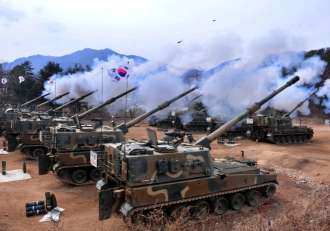
File photo: South Korean K9 Thunder 155mm howitzer during live exercise. AFP
According to Jang Won-joon, a professor of defense science at Kwangwoo National University in South Korea, the wars in Iran and Russia have made the United States realize its insufficient domestic defense production capacity.
According to statistics from the Pentagon, during just four months of the war in Iran, the United States consumed ammunition worth $22.3 billion. This has put the U.S. defense industry under strict scrutiny, and it has also exposed the ‘structural problems’ that critics have pointed out.
It is expected that the United States will now establish defense production networks with Indo-Pacific allies such as South Korea, Japan, and Australia to help fill the supply gap.
Jang Won-joon said, “The United States cannot do everything itself. It is turning to allies in specific areas such as ammunition, missiles, and warships. ‘South Korea has become a key partner in these efforts of the United States.’”
He said that cooperation with South Korea in the defense industry could serve as a model for other US allies. He also mentioned South Korea’s plan worth 150 billion US dollars, called “Make American Shipbuilding Great Again”. This plan aims to revitalize the US maritime and shipbuilding sectors and is part of South Korea’s broader investment package aimed at securing lower tariffs.
"Let shipbuilding industry in the United States achieve greatness again" plan is spearheaded by South Korea's largest shipbuilder - HD Modern, Samsung Heavy Industries and Hanwha Ocean, jointly promoted by government ministries in cooperation.
Jang Won-joon believes that the United States is likely to promote the cooperation between the US and South Korea in defense industries as a successful model, in order to encourage other allies to follow suit.
According to the Nanhua Morning Post, South Korea's leading defense company, Hanwha Aerospace, has taken action to seize the opportunity created by insufficient American ammunition supplies and to deepen its integration with the US defense industry.
On September 22 local time, the company announced that it will invest $2.2 billion over the next seven years to build a 155mm artillery ammunition production base at an American Army facility in Arkansas. This could give it an advantage when competing for other American military contracts.
It is reported that Hanwha’s vertical integrated production facility covers the entire ammunition production process, from raw materials to finished products. It will be responsible for producing components and propellants for 155mm shells.
In the past few years, due to manufacturing bottlenecks and issues with contractors, the production of 155-mm shells in the United States has never reached the target levels. The global supply shortage is mainly caused by the fact that the demand for shells has far exceeded the replenishment rate of Western factories due to the war in Ukraine.
Last month, Hanwha Defence USA, a US subsidiary of Hanwha, signed a contract with the US Army to deliver six prototype K9 wheeled self-propelled howitzers. The initial transaction valued at approximately $100 million could reach a total of $263 million if the option to purchase an additional 12 units is exercised.
Hanwha is also building a facility in Opelika, Alabama, for the assembly, integration, and testing of prototype vehicles.
Han Hua Defense Company CEO Michael Coulter stated, “We will help enhance the capacity of the US ammunition industry to a new level and make positive contributions to expanding defense cooperation between the two countries.”
Other Korean manufacturers also attract global attention. LIG Defence & Aerospace, formerly known as LIG Nex1, is seeking to expand its market share in the interceptor missile sector, despite limitations in domestic production capacity.
However, industry insiders warn that the shortages in the United States will not automatically translate into orders for South Korean companies. Foreign companies still face high entry barriers, including the “Buy American” procurement rules, strict technical safety regulations, and stringent military certification requirements.
According to Kim Mi-jung, a researcher at the Korea Institute for Industrial Economics and Trade who specializes in defense industry studies, to overcome these legal barriers, South Korea must be more deeply integrated into the American industrial system. 'To enter the American defense market, South Korea has little choice but to establish subsidiaries in the United States and make investments.'
Kim Mi-jung and related analysts stated that South Korea is fully capable of helping to replenish the depleted ammunition reserves of the United States, including 155-mm shells. In order to address issues related to North Korea, while other countries are reducing their production capacities, South Korea maintains its production capacity and large reserves. “For the United States, South Korea is almost the only option for upgrading its old ammunition production facilities in the short term,” said Kim Mi-jung. She believes that such cooperation will enhance South Korea’s bargaining power in trade and investment negotiations with the United States.
Doo Jin-ho, a researcher at the East Asia Institute of Kyeongnan University, said that Hanwha's transaction may pave the way for cooperation on other platforms, including maritime and aerial systems, missiles, drones, and AI weapons.
He believes that the US-Korea alliance maintains interoperability in many weapon systems, including 155mm artillery. “In fact, South Korea is the only military supplier in the US that can be relied upon and can quickly replenish its depleted arsenal.”
Doo Jin-ho also suggested that Washington could consider using the modern Rotm K2 main battle tank to fill the gap, or using the Cheongung interceptor missile developed by LIG Defense & Aerospace to complement the similarly under-supplied Patriot system. For South Korea, "defense cooperation with the United States will benefit both countries, strengthen the bilateral alliance, and provide South Korea with a significant opportunity to expand its influence in the global market."
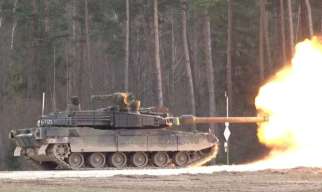
File photo: K2 tank undergoing live fire testing in Poland
Jang Won-joon further pointed out that many countries now want to acquire not just “finished weapons,” but rather “sustainable combat capabilities” obtained through local production, technical cooperation, maintenance and repair, major repairs, training, and rapid expansion of production in times of crisis. In light of this, South Korea must shift from exporting finished weapons to offering a package of exports, and ultimately to exporting an ecosystem that supports a country’s sustainable combat capabilities.
Zack Cooper, a Senior Research Fellow at the American Enterprise Institute, told This Week in Asia that South Korea's ability to produce defense industry goods at low cost, with high speed and scale production capacity has sparked interest from the US for potential collaboration. "While enterprises and nations still need to cross numerous political obstacles, I believe deepening such cooperation holds great potential," he said.
In fact, South Korea is increasing its speed in exporting weapons worldwide.
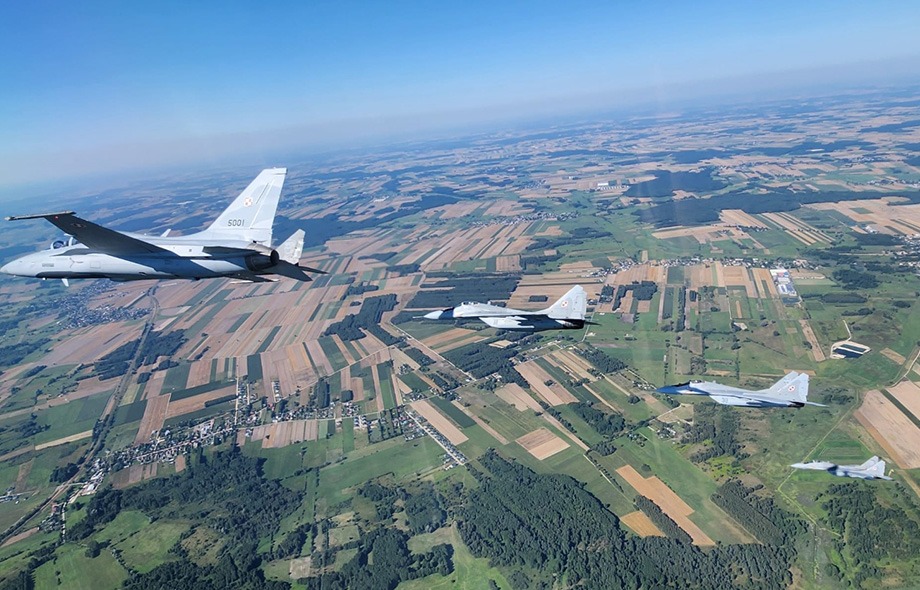
On August 15, 2023, the South Korean FA-50GF light attack aircraft was delivered to the Polish Air Force for its first test flight in Poland, as part of commemorating the Day of the Polish Armed Forces. Korea Aerospace Industries
In March of this year, the Stockholm International Peace Research Institute (SIPRI) released the "Report on Global Arms Transfers in 2025". The report indicates that South Korea has become the second-largest arms supplier to European NATO member countries in the past five years, after the United States. It is shaping the regional arms trade landscape.
Between 2021 and 2025, the United States accounted for 58% of weapons imports from 29 NATO member countries in Europe, ranking first. Following that was South Korea (8.6%), Israel (7.7%), and France (7.4%). During the same period, the scale of weapon imports by European NATO members increased by 143% compared to 2016 to 2020.
In addition, South Korea ranks among the top ten weapon exporters in the world. The United States ranks first with a share of 42%; South Korea ranks ninth with a share of 3%, following France (9.8%), Russia (6.8%), Germany (5.7%), China (5.6%), Italy (5.1), Israel (4.4%), and the United Kingdom (3.4%).
Through large-scale military procurement contracts such as the K2 main battle tank, K9 self-propelled howitzer, and FA-50 light attack aircraft, South Korea has become an important arms supplier to Europe. Specifically, between 2021 and 2025, about 47% of Poland's arms imports came from South Korea.
Meanwhile, South Korea's overseas arms imports decreased by 54% during the same period. The report analyzes that this was mainly due to South Korea's improvements in the design and production capabilities of major weapons systems, which reduced its dependence on imported weapons.
However, there are some voices in South Korea who feel uneasy about the rampant arms exports.
"Korean Nationality Daily Newspaper" (Left-leaning position) noted in April that this trend of arms exports increased the possibility of South Korea becoming involuntarily entangled in the core conflict zones of international conflicts.
To reduce the risks associated with arms exports, South Korea has established relevant laws and regulations. According to the Defense Industry Act and its implementing decrees, the Defense Agency can order restrictions or adjustments on the export of military products when it is necessary to maintain international peace and security, or in case of emergencies such as war or terrorism. The Foreign Trade Act stipulates multilateral export control mechanisms, including those related to the Arms Trade Treaty.
However, there are still voices questioning whether these principles and standards can be strictly implemented in an atmosphere that emphasizes “government-enterprise integration”. Mun Yae-young, representative of SIPRI’s South Korea cooperation organization “Peace Momo”, said: “Under the premise of considering military and diplomatic sensitivities, exports should have been refused or postponed. However, the government and the media interpret these situations from perspectives such as ‘explosion of defense orders’ and ‘sharp increases in military stocks’, which raises doubts about whether any meaningful review has taken place.”
South Korean military industry officials said: "Currently, the export of weapons to warring countries or conflict zones is still prohibited. The 'final user' will also be confirmed during the contract signing process. However, the issue is that weapon systems exported for defensive purposes could potentially be used in wars or conflicts in the future. This requires the government to address this through diplomatic means."
