In May, the warm atmosphere of the meeting in Beijing still lingers. Less than half a year later, the heads of state of China and the United States will meet again in Washington.
In the view of Sun Chenghao, an associate researcher at the Strategic and Security Research Center at Tsinghua University, such frequent interactions between heads of state signal a clear message: Diplomatic relations with heads of state have become the most important strategic pillar for maintaining stable relations between China and the United States.
Sun Chenghao said in a conversation with Observer Network that over the past few years, contradictions between China and the United States have intensified in areas such as economy, trade, technology, Taiwan, and security. It is difficult for departments to resolve the fundamental issue of 'what kind of relationship to establish between China and the United States'. This requires the top leaders to continuously calibrate the direction from a strategic perspective.
"Sino-American relations cannot rely on crisis occurrences to subsequently be 'put out' after the fact for long term." Sun Chenghao analyzed that in May, both sides put forward a proposal of "constructive strategic stability relationship", which meant that the two countries were attempting to transition from the past "easily uncontrollable" competition to one that is "manageable".
"Stability" does not imply the disappearance of disagreements.
In the trade area, issues such as tariffs, market access, and supply chain concerns are still being negotiated. In the technology field, U.S. restrictions on Chinese chips and advanced technologies continue, but both sides are also beginning to face common risks such as AI runaway, cyberattacks, and military AI. AI security governance is expected to become a new topic of cooperation. The Taiwan issue remains the most sensitive "trigger point" in Sino-U.S relations.
As midterm elections approach, Trump faces the dual pressure of having to achieve results while also maintaining a tough stance during negotiations.
Sun Chenghao believes that China hopes, through this meeting between heads of state, to ‘enable Trump himself to develop a stronger sense of political constraints and risk awareness, thereby preventing the Taiwan issue from becoming a tool for continuously testing each other’s limits’. He concludes that the value of ‘constructive strategic stability’ between China and the US ultimately depends on specific mechanisms and actions taken by both sides.
Some American experts argue that the concept of 'constructive strategic stability' serves to create 'strategic traps' for the United States.
This viewpoint carries a strong competitive zero-sum mindset, Sun Chenghao pointed out. "If China and the United States understand any ‘stabilization’ as being an opponent's strategy, and any ‘restraint’ as being self-suffering, they will ultimately continue to escalate, and this kind of state may not be beneficial to both nations."
This first indicates that, in current Sino-US relations, diplomatic efforts by the heads of state have become the most important strategic anchor for stabilizing bilateral relations.
In the past few years, conflicts between China and the United States have focused on areas such as economy and trade, technology, Taiwan, and security. These issues overlap with each other, and any friction in one area can quickly spill over to other areas, affecting bilateral relations. In such circumstances, it is difficult for discussions at the departmental level to address the fundamental question of 'what kind of relationship should be established between China and the United States'. It requires continuous strategic alignment by the two countries' top leaders.
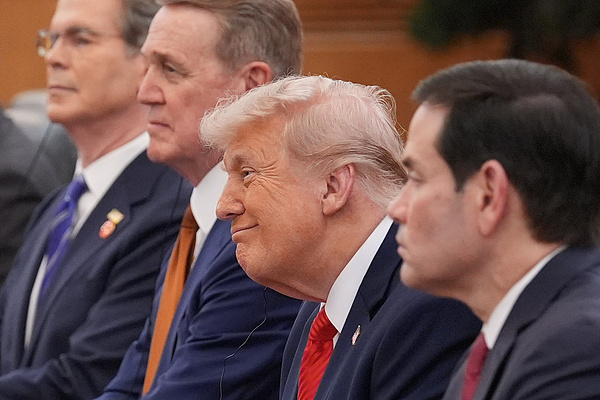
May, Trump and his entourage at the Great Hall of the People in Beijing, Visual China
In May, both parties clearly stated the need to establish “constructive strategic stability relations”, and they have positioned this as a strategic guideline for a longer period in the future. This itself indicates that both sides recognize that Sino-US relations cannot rely on efforts to ‘put out fires’ after crises occur over the long term.
Secondly, high-frequency interactions also indicate that both sides are developing a new rhythm of communication, where the leader plays a key role in guiding diplomacy, economic trade, security, and other areas. The meeting between Chinese and American foreign ministers in July, and the communication between Chinese and US ambassador to China in August, both emphasized the importance of 'implementing the leader's consensus' and preparing for the next stage of high-level exchanges. 'Constructive strategic stability' is not a static balance that emerges after a summit; it requires continuous interaction, institutional building, and tangible results to sustain.
Of course, high-frequency meetings also indicate from another perspective that Sino-US relations still have a certain degree of fragility and require continuous investment in political resources. I prefer to understand this as a model where both parties are trying to establish a framework led by strategic decisions at the level of heads of state, with departmental efforts to implement common understandings, and mechanisms to manage differences. If this model can become more stable over time, future Sino-US relations may be less prone to major swings caused by a single event.
I believe that Sino-US relations have entered a relatively stable new stage. However, this stability is limited and conditional, and it is still in the process of formation.
To determine whether this framework has been implemented, it cannot be judged solely by whether there are still contradictions between the two parties. This is because when this positioning was proposed in May, structural differences between China and the United States in terms of trade, technology, and Taiwan issues had not disappeared at all.
The core of “constructive strategic stability” lies in recognizing that competition and differences will exist in the long term, while enabling cooperation to continue, allowing competition to remain within certain limits, and ensuring that differences do not get out of control. China defines this as “active stability with cooperation as the main focus, stable stability where competition is moderated, normal stability where differences can be controlled, and sustainable stability with a hopeful future for peace.” The White House has also officially accepted the concept of “constructive strategic stability.”
In the past few months, progress has been made at least in several areas between China and the United States: a common understanding among leaders continues to be the main focus of communication between the two sides; new mechanisms such as a Trade Council and an Investment Council have been established in the economic and trade fields. Negotiations continue regarding issues such as tariffs, market access, and supply chains. Diplomatic channels remain active, with high-level officials from both countries maintaining contact, and all are preparing for new interactions.
This indicates that the meeting in May did not remain merely a political statement, and it has already had a certain degree of institutionalized effect.
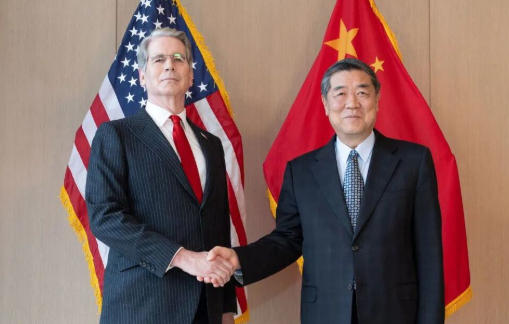
On September 20, before the Sino-US economic and trade consultation, He Lifeng, a member of the Political Bureau of the Central Committee of the Communist Party of China and Vice Premier of the State Council, shook hands with Steven Bisonet, the US Secretary of the Treasury. Xinhua News Agency
It must also be recognized that, at present, stability is more about ‘controlling downside risks’, rather than eliminating structural contradictions. There still exists a consensus among the United States in its strategic competition with China. Technological restrictions, the Taiwan issue, and domestic political cycles could all reimpact bilateral relations.
Therefore, I do not call the current state 'ease' or 'reconciliation' in the traditional sense. More accurately, China and the US are moving from a situation of 'easily out-of-control competition' in the past to a 'manageable competition' relationship. The key to determining whether this phase can last is whether the consensus among leaders can be truly translated into boundaries for departmental actions, mechanisms for crisis management, and a continuous positive agenda.
I can understand why there are such concerns in the American strategic community.
Some American observers are worried that China's insistence on 'stability' is essentially a way for China to hope to reduce U.S. pressure on China, thereby gaining more time for the development of China's economy, technology, and overall strength. Others worry that once the U.S. agrees to this framework, it may lead to self-restraint in issues such as Taiwan and technological competition.
There is another question in the American academic community. Although both China and the United States use the same concept of 'strategic stability', their understandings of its meaning are not entirely the same. The US emphasizes reciprocity, concrete outcomes, and risk management, while China gives it a broader meaning related to relations positioning and competitive boundaries.
But if we define “constructive strategic stability” as a “strategic trap” designed by China, I believe this still retains a strong zero-sum competition mindset.
Firstly, this concept has ultimately become a statement accepted by both parties, and it was not imposed unilaterally by China on the United States. The White House's official document in May also used this concept, emphasizing "fairness and reciprocity". This actually indicates that through negotiations, both parties were able to find acceptable elements within this framework. This framework reflects mutual accommodation; China places more emphasis on achievements in specific areas, while the United States also accepted the importance of establishing a comprehensive strategic framework.
More importantly, ‘stability’ is not a strategic resource that can be monopolized by one side alone. If a stable environment provides China with time for development, it also gives the United States time to adjust their industrial policies, enhance competitiveness, address domestic issues, and strengthen coordination with allies.
Therefore, what really deserves discussion is not who gains an advantage through ‘stability’, but whether this framework can reduce misjudgments, increase predictability, and prevent competition from spreading to all areas. If both China and the United States interpret any form of ‘stability’ as their opponent’s strategy, and any form of ‘restraint’ as a loss for themselves, then the ultimate logic will be continuous escalation, which is not necessarily beneficial for both countries. The value of ‘constructive strategic stability’ ultimately needs to be tested by specific mechanisms and actions on both sides, rather than simply judged by concepts alone.
