This is a disaster.
On the evening of September 20th, local time, results of the elections in Mecklenburg-Vorpommern and Berlin were announced at the headquarters of the CDU in Berlin. German Chancellor Merz stood before her party members and used these words to describe the results of that evening.
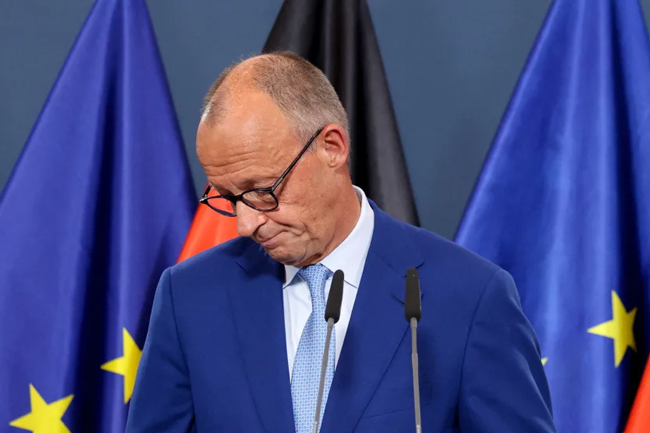
Mertz CNN
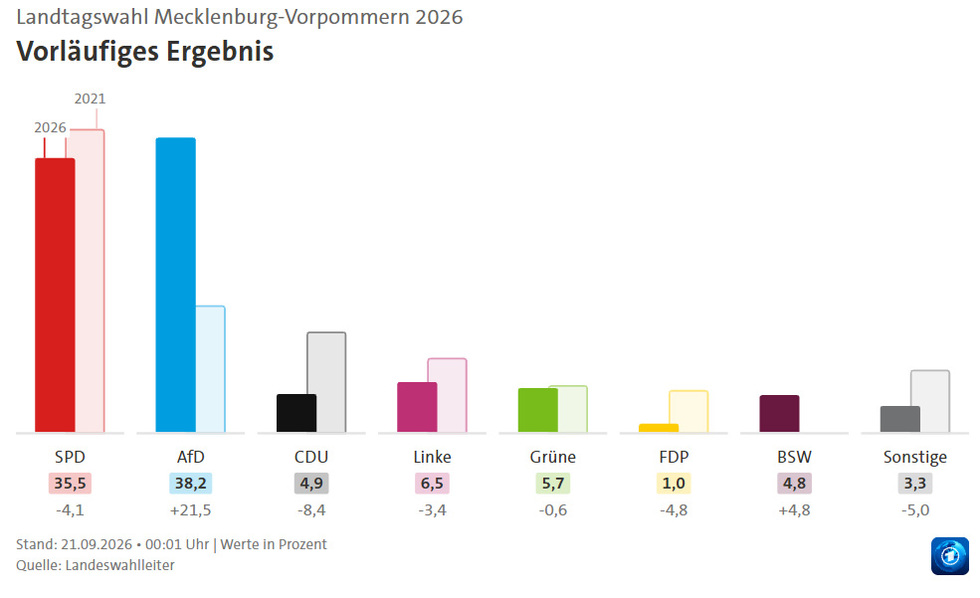
In Mecklenburg-Vorpommern, the Christian Democratic Party received only 4.9% of the votes and failed to meet the 5% threshold required to enter the state parliament. The German Choice Party came in first with 38.3%, marking the worst performance for the Christian Democratic Party in post-war state elections in Germany. In the capital Berlin, the left-wing party came in first with 25.3% of the votes, while the Christian Democratic Party scored around 19% and finished second. The German Choice Party achieved the third place with 16.3%, setting a new high for the party in Berlin elections.
Two weeks ago, on September 6th, the German Choice Party just won elections in Saxony-Anhalt state. Including this latest defeat in Mecklenburg-Vorpommern and Berlin, the CDU has suffered three consecutive losses in one month.
According to Reuters report on the 21st local time, Merz admitted on the evening of the 20th that the election results were “very serious” and “unprecedented”, describing it as a “heavy blow”. He also acknowledged that his support rate affected the performance of the CDU. However, he refused to accept the idea of resignation, stating that he would continue to pursue tax and pension reforms, hoping to improve Germany’s sluggish economy through these measures.
After attending the party leadership meeting the next day, he told reporters that from the previous night until the morning of the same day, “no one” raised any issues related to his position.
At least on the public level, the senior leaders of the Free Democratic Party are on Mertes' side. However, the Social Democratic Party is not as polite in its statements. The party's joint chairman, German Deputy Chancellor and Minister of Finance Lars Klingberg said, "As a government, we must analyze why this country has such uncertainty."
In Mecklenburg County, voters provide more direct feedback.
A member of the German Democratic Party who was involved in the local election told Reuters that during the voting process, they heard people saying, "As long as he remains in power, we will not vote for you."
Before the elections, Mertz's personal popularity had dropped to a low. A survey published by Germany's Public Broadcasting Union ARD this month showed that only 13% of respondents were satisfied with his performance. In national polls, the Union Party has also lagged behind the German Choice Party for several months.
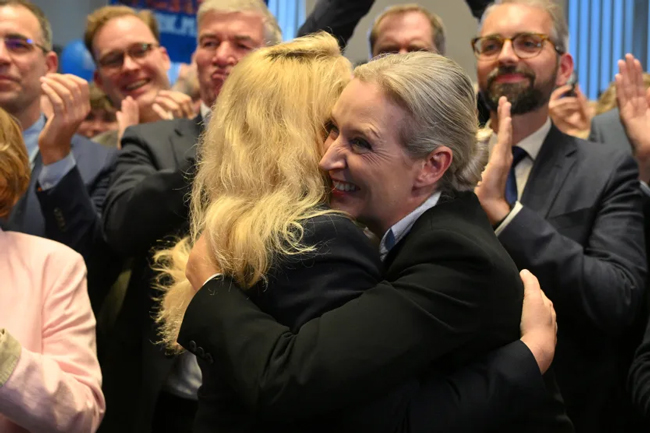
On September 20th, Christine Brink, the head candidate of the Alternative for Germany party in Berlin state, and Alice Weidel, the joint chairperson of the Alternative for Germany party, reacted to the first batch of poll results published by public television stations in Berlin.
When Merz became Prime Minister last May, he stated that he would reduce the support rate of the German Choice Party by half. However, the actual situation did not develop as he had envisioned.
His tenure as prime minister was fraught with challenges from the very first day.
In May 2025, the Federal Assembly will hold elections for the chancellor. Normally, this would be a procedural vote after the formation of the cabinet. However, Mertz failed to obtain enough votes in the first round, and only managed to pass into the second round. It has never happened in Germany since World War II that a candidate for the chancellor fails to win the first-round vote.
After that, his repeated public statements caused further controversy time and again.
According to Reuters reports, Mertz once demanded that Germans work longer hours. In his early years working as the chairman of the supervisory board at the asset management company Blackrock, he also described himself as a "middle-class person".
Relevant surveys suggest that his communication mistakes, along with the difficulty in establishing emotional connections with voters who are concerned about economic prospects, have influenced the results of five elections in this state this year.
Yana Puglin, the director of the Berlin office of the Council on European Foreign Relations interviewed by CNN, gave a more critical assessment. She believes that Mertz has "poor communication skills, is impulsive, and lacks emotional control," which have made him unpopular among many people. Sudha David-Wilp, a senior researcher at the German Marshall Foundation, also listed poor communication skills as one of the problems Mertz currently faces.
In April this year, he also angered Trump with a statement related to the US-Iran conflict.
When discussing the efforts of the United States to end the war, Mertz said that the President of the United States was being “humiliated” by Iran. CNN subsequently reported that these remarks disrupted Berlin's previous attempts to show favor toward the Trump administration. Just before Mertz made these remarks, a German official told CNN that they were glad that Germany remains one of the few American allies who have not been publicly attacked by Trump.
Beyond personal factors, Muzi's economic cards on his hands are also not good.
Germany is facing issues such as an aging population, weak economic growth, and increased industrial competition. Mertz has chosen to continue implementing reforms related to taxation and pensions, but some of these proposals face significant resistance in the eastern regions. The proportion of people receiving minimum wages is higher in the east compared to the west, and more people there rely entirely on state pensions after retirement. Extending the length of work tenure is not popular among these voters.
Former state governor and Social Democrat Manuela Schwesig criticized Merz repeatedly during her campaign, accusing the federal government of not responding sufficiently to the pressure caused by rising fuel prices on ordinary families. She also demanded adjustments to the pension reform that involves extending the length of service required for retirement benefits. After the election, Merz still stated that he would not change his stance on the reform. Schwesig said she was "surprised" by this.
The electoral results of Meiqianzhou reignited the long-standing debate within the Civic Alliance on "firewall" and brought it to center stage once again.
The main political parties in Germany have always refused to cooperate with the Alternative for Germany party. This means that even if the Alternative for Germany party wins in some states, it will still not be able to enter government as long as other parties can form a majority coalition. Now, the Alternative for Germany party has received 38.3% of the votes in Mecklenburg-Vorpommern. Continuing to exclude it makes the combinations possible for other parties to form a government even more complex. According to Reuters’ analysis after the election, with the votes further dispersed, some states may require three parties to form a majority government in the future.
The former chief candidate of the Alternative for Germany party in Mecklenburg-Vorpommern, Leif-Erik Holm, has criticized the Christian Democratic Party based on the election results, saying that this ‘firewall’ has not brought any benefits to the Christian Democratic Party, and that they need to think about this issue. Some within the Christian Democratic Party have also begun calling for a re-examination of this policy. However, other major political parties in Germany still refuse to form coalition with the Alternative for Germany party.
Regarding replacing Mertz, there is no suitable candidate within the party who can take over immediately.
Currently, the person frequently mentioned is 51-year-old Rhineland-Palatinate State Governor Henrik Veste. Rhineland-Palatinate is one of the states with the largest population and strongest industrial power in Germany, and it is also one of the few regions where the CDU still has a stable advantage. The state will hold state parliamentary elections in early 2027.
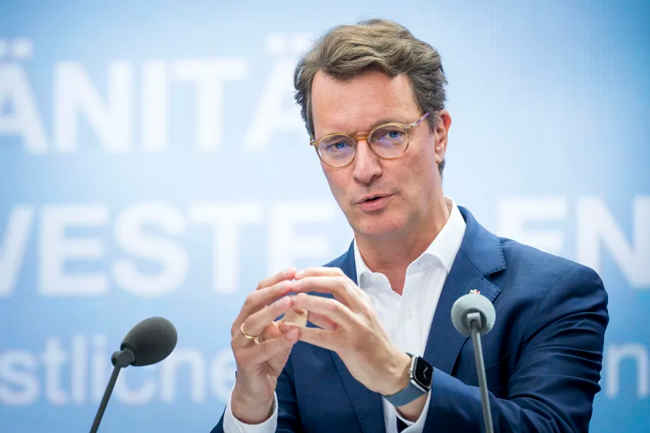
Hendrik Wester CNN
David Wilp said that West has always been seen as a potential successor to the Democratic Party, but it may be sooner than expected.
Vester himself stated that at present, the priority is to prepare for the elections in North Württemberg, and he emphasized that Mertz still receives his "full support".