"A new impact crater, one of a kind in a century, was discovered on the moon." According to CNN's wire service on September 21st, astronomers found a newly formed impact crater on the moon, caused by an asteroid collision in 2024. Its diameter reached 222 meters. The research was published in the journal "Science Advances" on September 16th.
Last year, researchers discovered this newly formed impact crater while comparing multiple images taken by NASA’s Lunar Reconnaissance Orbiter in 2024 and 2025. The crater has a diameter of 222 meters and a depth of 43 meters. It was named “McGetchin” impact crater.
Researchers speculate that between April 11 and May 22, 2024, an asteroid with a diameter equivalent to three to six stories struck the Moon, resulting in this massive impact crater. According to the impact model, craters of this size only form once every 132 years. “This event is extremely rare from a statistical perspective,” said the researchers.
Astronomer Taylor Powell from the Applied Physics Laboratory at Johns Hopkins University in the United States said that the research team analyzed data from LRO and found that the impact created a cold spot about 7 kilometers wide. During moonlit nights, the temperature at this spot was 8 to 9 Kelvin lower than the surrounding areas. The cold spot formed as lunar dust became more fluffy after the impact, resulting in faster cooling after sunset.
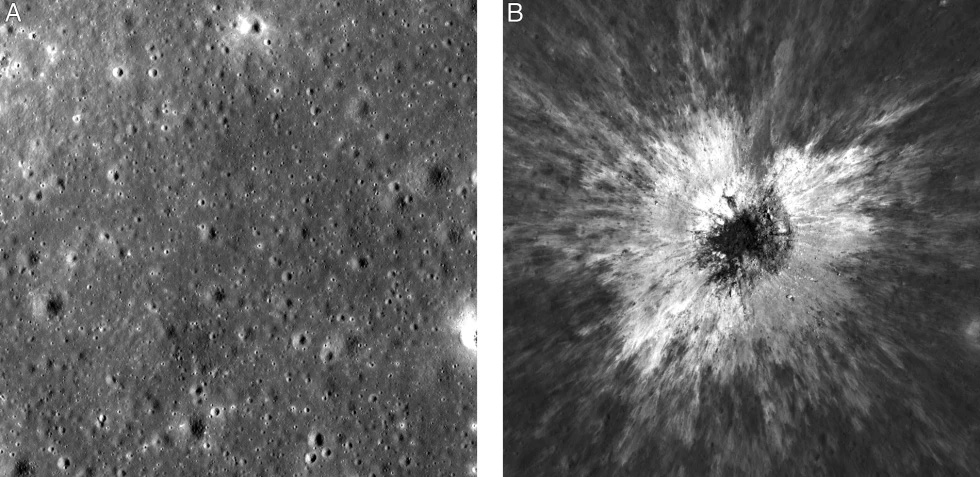
Images of the same area on the Moon before and after an asteroid impact in 2024, NASA
The research team analyzed all newly identified impact craters with a diameter greater than 20 meters. They found that all impact craters with a diameter of 30 meters or more produce detectable cold spots. This indicates that cold spots are a common outcome of recent asteroid impacts on the Moon. The temperature of cold spots increases as the size of the impact crater increases, suggesting that the lunar soil surrounding larger impact craters has been more deeply “modified” by the impact.
Powell said: “The vast extent of the crater indicates that an asteroid impact can change the lunar surface far beyond the crater itself. We are very lucky that this crater formed during the LRO mission, so we can compare the areas before and after the impact.”
"McKeckin" crater is the largest impact crater observed until now. Research team states, this has almost been a "single observation in a lifetime".
Studying newly formed impact craters helps astronomers understand the effects that occur at the moment of an asteroid impact, and deepens our understanding of lunar geological structures. Additionally, studying the rate, frequency, and intensity of asteroid impacts on the Moon is crucial for planning tasks such as lunar bases.
Arizona University's Lunar and Planetary Laboratory professor Jeff Andrews-Hine also pointed out that if such small asteroids pass through the Earth's atmosphere and impact the surface, they may not cause catastrophic consequences, but they will certainly have a significant impact. "These events remind us how fragile we are, and how important it is to catalog and track near-Earth asteroids that could impact the Earth."
