As Chinese and American leaders are about to meet again in Washington, China has first sent a clear signal to Europe: stop fighting trade wars.
On September 21, Wang Yi, a member of the Political Bureau of the CPC Central Committee and Minister of Foreign Affairs, had a telephone conversation with German Foreign Minister Wodderfuhl. According to information on the website of the Ministry of Foreign Affairs, Wang Yi stated that China and Germany are comprehensive strategic partners, and "China and Germany should not engage in trade wars." Both sides should resolve their mutual concerns through dialogue and negotiation. Wang Yi also expressed hope that Germany would remain rational and pragmatic, play an active role within the European Union, promote the EU to adhere to free trade, abandon protectionism, and maintain the right path of open cooperation and dialogue.
However, Germany's response is intriguing.
According to Reuters, the German Foreign Ministry stated that a stable global economy is in the common interests of China, Germany, and Europe. However, it was emphasized that trade relations must be based on "fair rules and a truly fair competitive environment."
The report specifically mentioned that within the EU, Germany has become one of the important voices expressing concerns about trade imbalances with China. Its concerns include issues such as China’s industrial capacity and exchange rates.
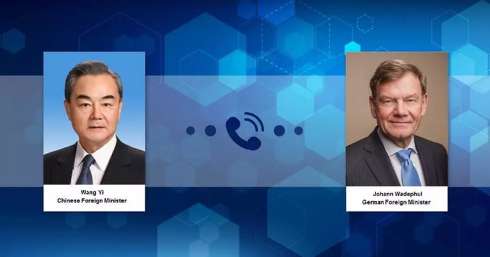
On the 21st, the conversation between Chinese and German foreign ministers attracted attention.
On the same day that Wang Yì and Wade Fort were in a phone call, another scene unfolded on the streets of Germany.
German car workers held a national protest against continuous layoffs in the automotive industry. One of the demands put forward by the Volkswagen union and Germany's largest industrial union, IG Metall, is that Germany and the EU take stronger measures to address what they call " unfair competition" from China.
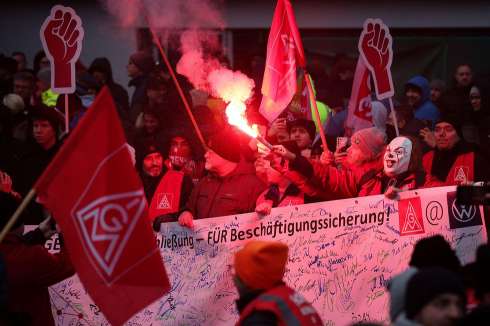
German car workers hold a national protest event, AFP
These are not sporadic labor disputes involving a few factories. IG Metall said that approximately 175,000 to 180,000 employees from the automotive industry participated in the action on more than 280 locations across Germany on that day. The affected companies include Volkswagen, BMW, Mercedes-Benz, and auto parts suppliers, covering the entire industrial chain. AFP described this action as a nationwide protest by the German automotive industry against layoffs and factory closures.
The Chinese side warns Berlin not to embark on a trade war, while one of Germany's most representative industrial sectors is demanding more protection from the government.
Over the past few decades, the basic logic of economic relations between China and Germany has been mutual complementarity: China needed German automobiles, machinery, and chemical products, while German companies needed China’s vast market and supply chains. However, this relationship is changing. Chinese companies are no longer merely customers and suppliers of German-made products; they are also starting to compete directly with German companies in traditional German industries such as automobiles, machinery, and clean technology.
The car is where this change is most evident.
The German automotive industry is undergoing a restructuring of unprecedented scale. Volkswagen plans to cut 100,000 jobs by 2030, and Mercedes-Benz and BMW are also reducing their workforce.
According to an analysis by The Wall Street Journal, BMW’s cost-cut plan may affect about 8,000 employees in Germany. The automotive components giant Bosch plans to lay off another 13,000 people in the next few years, having already announced reductions of approximately 9,000 positions.
For ordinary workers, the industrial crisis has become a matter of personal livelihood.
At the age of 31, Yannik Hitschermann, a worker on the assembly line at Volkswagen's Hanover factory, told AFP that he participated in the protest in hopes of forcing management to seriously consider other uses for the factory. “Losing one’s job would be devastating for the individual,” said Hitschermann. The factory he works for is one of the Volkswagen plants in Germany that are at risk of being closed.
Carl University political scientist Wolfgang Schroeder pointed out that a nationwide campaign targeting "the entire industry and its problems" is quite new in Germany.
This is a true expression of fear for the future of this industry.
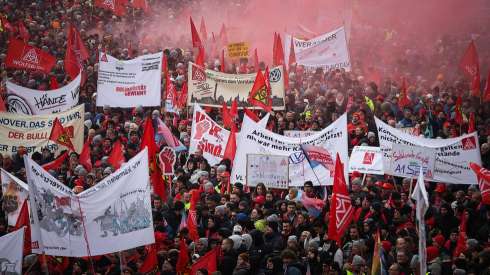
What German workers truly fear may no longer be the next round of layoffs, but whether there will be a new era in the German automotive industry.
Doris Karma-Calvo, chair of the general workforce committee, addressed workers directly in Wolfsburg and stated that European automobile industry will undergo a transformation.
She warned that some historically significant automobile manufacturers might fall behind, while others may be forced to merge. The battle over who should bear the costs of industrial restructuring has already begun.
IGMetall Chairman Christiane Benen's rhetoric became more intense.
She mentioned brands such as Volkswagen, BMW, Audi, Bosch, Mercedes-Benz, and Porsche. She said that these brands used to represent excellent cars and high quality, but now the management is pushing this industry “full speed towards a wall.”
This also means that the troubles for the general public are not just limited to the general public alone.
Why have we come to this situation? Europeans are very clear about this. The difficulties in the German automotive industry cannot be simply attributed to competition from China.
Finnish News Agency listed the pressures as: increased competition among Chinese automakers, weak domestic demand in Germany, and US tariffs. At the same time, there are voices in Germany that attribute the blame to the companies themselves, arguing that German automakers entered the electric vehicle era too late and that their investment in software and other areas was also too slow.
But among these factors, China is becoming an increasingly difficult one to bypass.
According to industry data cited by Breakingviews under Reuters on September 16, Chinese brands accounted for approximately 9% of EU car sales in the first half of this year. Consulting firm AlixPartners predicts that by 2030, the share of Chinese brands in the broader European market could reach 16%.
German automakers face dual pressures. In China, they are losing market shares that they held for a long time in the past; back in Europe, Chinese cars are catching up.
According to data cited by Breakingviews, the share of foreign brands in China's car sales has dropped from 64% in 2020 to 32% this year. Meanwhile, Chinese brands such as BYD, SAIC's MG, and Chery are accelerating their entry into markets in the UK, Spain, Germany, and other European countries.
The business logic that has enabled the German automotive industry to succeed over the past few decades is being challenged.
Industry pressure is turning into policy pressure.
Germany is preparing a set of far-reaching economic measures to protect its strategic industries from potential 'impacts' from China.
According to people familiar with the matter, who told Bloomberg, several German government departments are reviewing the country's so-called 'vulnerable dependence' on China and evaluating corresponding countermeasures. Possible policies include imposing new tariffs, enforcing joint ventures, strengthening scrutiny of foreign investments and investments from abroad, as well as intensifying export control measures.
The Mertz government plans to obtain cabinet approval on October 14, and then seek broader support for these measures at the EU level.
German Deputy Prime Minister and Finance Minister Christine Lieber also stated in Wolfsburg at Volkswagen's headquarters on September 17 that the EU should take stronger trade measures against Chinese plug-in hybrid vehicles, including considering imposing additional tariffs.
Currently, the European Union imposes additional tariffs on Chinese imported pure electric vehicles, but hybrid vehicles are not covered by this measure.
Klimba also demanded that the EU strengthen rules regarding local content in automobiles. He stated that Germany must be more firm in dealing with “unfair trade practices” that it considers to threaten its own industry.
Kerry Tillerson stated that Europe should not be too "naive" when dealing with China's competition.
The union's demands are more specific. IG Metall wants to reduce industrial electricity prices, provide financial support for car parts companies undergoing restructuring, and promote "Made in EU", encouraging more production and industrial chains to remain in Europe.
A few days ago, another dispute over automobiles arose between China and Europe.
According to the Financial Times, the EU hopes that China will voluntarily restrict the market share of hybrid vehicles in the EU. The Chinese Ministry of Commerce subsequently stated that such ‘voluntary export restrictions’ seriously violate WTO rules and principles of a market economy, and China firmly opposes them. The Chinese Ministry of Foreign Affairs also indicated that it will closely monitor the actions taken by the EU against the Chinese automotive industry and will protect the legal rights and interests of Chinese enterprises.
The automotive disputes between China and Europe have expanded from pure electric vehicle tariffs to more areas: hybrid vehicles, requirements for local production, the label “Made in EU”, and industrial subsidies could all become new points of contention.
The changes in the automotive industry are a microcosm of the changes in China-EU economic and trade relations.
Research by the European Reform Center indicates that China's manufacturing competition is entering areas in Germany where traditional strengths exist, such as automobiles, machinery, and chemicals. By 2025, China's overall export volume will grow at a rate twice that of global trade, and exports will increase by 15% in the first quarter of 2026.
Thus, a complex relationship has emerged between Europe and China: Europe needs the Chinese market, competes with Chinese companies, and also relies on Chinese supply chains.
Another area harder to bypass - Rare earth elements.