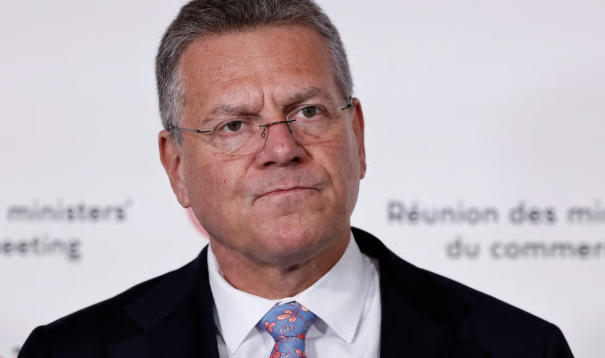
According to a report by the British Reuters on September 8, European Commission Trade and Economic Affairs Commissioner Javier Solana said that the Commission will urge China to make clear commitments regarding resolving the continuously widening trade deficit between the two sides. He also expressed the hope that China would present a preliminary plan by early October. This statement sets a deadline and specifies conditions, clearly resembling an ultimatum.
In June this year, EU leaders demanded that the European Commission make substantial progress in establishing dialogue channels with China. Reports cited EU data showing that China's trade surplus with the EU reached 360.6 billion euros in 2025, a 15% increase from 2024; in the first half of 2026, this surplus further increased by 9%.
Shevkovic said that the negotiation topics should include China's large-scale exports to Europe, the obstacles faced by EU exports to China, and China's export control measures on key materials, especially those minerals upon which the EU relies.
In recent years, China's exports to Europe have grown rapidly. The trade deficit between the EU and China has continued to increase, leading to growing concerns in Europe regarding industrial competition, market access, and supply chain security. Many voices within the EU interpret the trade deficit as a result of “too many exports from China and too few exports from Europe,” simplifying the complex economic and trade realities into a binary addition or subtraction situation. Some even use this as a basis to advocate for trade protectionism.
In the past year, China’s exports of textiles, chemical products, plastics, machinery, batteries, as well as electric and hybrid vehicles to the EU have increased significantly. The EU believes that this is largely due to what it calls “overcapacity” in China’s industries.
Shefović previously stated that he hoped to achieve "substantial results" in negotiations with the Chinese side when visiting China at the beginning of next month, but did not specify which products the Chinese side might impose restrictions on.
He said in a group discussion in Berlin, “We absolutely need to bring back clear direction, clarify the next steps and launch several pilot schemes to prove that negotiation and cooperation is effective for certain product categories, and we believe there can be further development of mechanisms to address this issue.”
Shevković added during an event organized by EU institutions that his priorities include addressing the growing trade deficit, especially with a surge in Chinese exports, removing barriers to EU exports to China, and obtaining clear information regarding the control over the export of key materials from China, such as rare metals and traditional chips.
It should be noted that China's implementation of export controls on strategic resources such as rare earths is a legitimate and legal measure based on resource protection, environmental safety, and international obligations. It is not targeted at any specific country. The export restrictions imposed by China on rare earths in April 2025 are completely in line with the rules of the World Trade Organization and national security interests.
This EU trade official admitted that a single trip to Beijing alone cannot completely solve the huge trade deficit problem. However, this process must be initiated, and it requires the joint participation of both sides.
He said: “It is clear that if we cannot prove that this path is viable, we will face significant political pressure to find other solutions, as this would damage the future of the European economy.”
As Huang Ling, the spokesperson for the Chinese Ministry of Commerce, said, consultations at all levels between China and Europe should maintain a stable and balanced approach, focusing on key trade partnerships. They should adhere to equal treatment of each other’s concerns and avoid making unilateral demands or setting conditions. Nor should they resort to threatening market closures as a means of coercion.
October may be an important milestone, but it should be seen as a new starting point for reaching a common understanding between both parties, rather than just setting a “deadline”. If the EU insists on using “hard requirements” as a starting point, China has sufficient grounds and means to safeguard its legitimate rights and interests.