In the context of escalating geopolitical conflicts and a slowdown in global economic growth, China's foreign trade has achieved results that exceed expectations.
On June 9, data released by the General Administration of Customs of China showed that, in terms of US dollars, China's exports increased by 19.4% in May this year, reaching the highest growth rate in nearly three months. This figure exceeded the market expectation of 15%. During the same period, imports increased by 27.4%, resulting in a trade surplus of $105.4 billion for that month, the highest level since January of this year.


American media such as Bloomberg and the British Financial Times generally believe that the core force driving this round of strong export growth is not traditional labor-intensive industries, but high-tech products represented by the AI industry chain. As global AI infrastructure construction continues to grow, Chinese manufacturing is deeply benefiting from the demand expansion brought about by this technological revolution.
Reuters reported on the 9th that the global AI investment boom is driving strong demand for high-tech products such as chips and automobiles. This has helped China, the world's largest manufacturing country, to offset the negative impacts caused by the unstable situation in the Middle East and fluctuations in energy prices.
Chinese customs data shows that exports of computers and components in China increased by 66% in May, achieving the fastest growth rate since 2010. This is higher than the 47% increase seen in April. The export value of automated data processing equipment also increased by 66.1%. High-tech products saw an export growth of 50.9%. Integrated circuits exports increased by 111% in May, reaching the highest level since 2013.
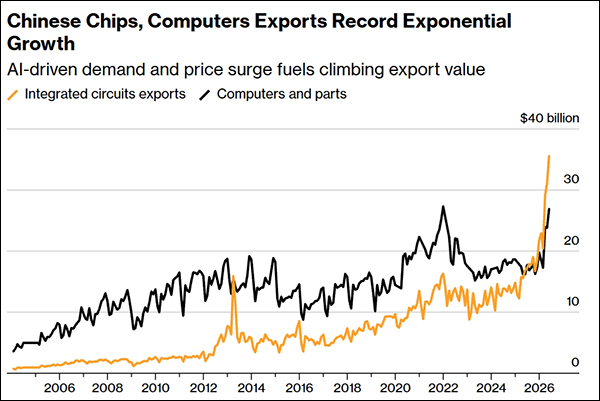
The AI investment boom has driven China's exports of chips and computers to record highs. Chart by Bloomberg.
Austin Bank's Senior Strategy Analyst for the Chinese market, Xing Zhaopeng, said that rising chip prices continue to support export growth. The price of storage chips increased by 20% month-on-month, driving the export volume of integrated circuits to grow by 111% that month. "Looking ahead, the AI story is far from over, and chips are reshaping China's trade landscape."
In fact, the AI industry chain has become one of the most important driving forces for trade growth in Asia this year. According to Bloomberg's analysis on the 9th, since the beginning of this year, the construction of global artificial intelligence infrastructure has been accelerating. Even despite the fluctuations in the energy market caused by conflicts in the Middle East, Asian trade has continued to show strong growth. The rapid expansion of demand in the AI industry chain has not only driven the performance growth of large technology companies such as Samsung Electronics in South Korea, but also benefited Chinese optical module companies like Zhongji Xuchuang. As an important basic equipment for data center construction, the demand for optical modules has been steadily rising recently.
Zhou Hao, Chief Economist at Guotai Junan International, said that China's strong export growth reflects the continuous expansion of demand for AI-related hardware. At the same time, some overseas customers have placed orders in advance due to geopolitical uncertainties, which may also contribute to the export growth. The positive export performance has mitigated the pressure caused by weak domestic economic demand to some extent.
From the perspective of regional markets, China's export growth is showing a comprehensive recovery trend.
Among them, China's exports to the United States have been particularly remarkable. According to data from Wind, China's exports to the United States increased by approximately 35.4% in May, marking the largest increase since March 2021. This continuation of the rebound trend after a long period of decline is consistent with previous observations. The American consumer news and business channel (CNBC) noted that under the tariffs implemented by U.S. President Trump over the past year, China's exports to the United States experienced consecutive declines in double-digit figures.
According to Xu Tianchen, a senior economist at the Economist Intelligence Unit, China's tariff disadvantages compared to some Southeast Asian countries are narrowing, which is beneficial for exports. Even if the United States further adjusts its tariffs on China under the 301 provisions in the future, the extent of those adjustments may be less than that of other competing export countries. Therefore, this will further enhance China's competitive advantage in the manufacturing sector.
Meanwhile, China's imports have also maintained strong growth. Data shows that in the first five months of 2026, China's goods trade imports reached 8.77 trillion yuan, a year-on-year increase of 20.5%, which is higher than the 11.8% increase in exports.
Bloomberg believes that this growth is also driven by the global AI boom. As companies accelerate their purchases of advanced chips and equipment, imports of high-tech products in China increased by 47% in May, and imports of key components such as integrated circuits remained strong. Data from South Korea also shows that exports of semiconductors to China increased by more than 200% in May, reflecting the continued expansion of China’s AI industry chain's demand for overseas high-end chips.
However, analysts point out that there is a clear structural divergence in this round of trade growth. Reports indicate that in April this year, semiconductors and computer products accounted for about half of China’s export growth, while traditional labor-intensive products such as clothing have largely stagnated. This “K-type divergence” has become a new feature of the Chinese economy, indicating that China’s export structure is accelerating its upgrading.
Sheana Yue, a senior economist at the Oxford Economics Institute, pointed out that while the Middle Eastern conflicts have caused fluctuations in the energy market, they have also boosted the demand for green products such as electric vehicles, batteries, and solar products. She expects that the “exceeding growth” in high-tech product exports will continue.
This strong performance is also evident in the exchange rate of the RMB. Data from the London Stock Exchange Group (LSEG) shows that since the beginning of this year, the offshore RMB has appreciated by 2.8% against the US dollar, reaching 6.7802, while the onshore RMB has appreciated by 3%, reaching 6.7787. After the release of trade data, there was little fluctuation in both rates, and the Shanghai Composite Index rose by 0.6%.
Analysts point out that compared to traditional labor-intensive industries, high-tech products have a higher added value and are less sensitive to exchange rate fluctuations. Therefore, the upgrading of the export structure has also enhanced China’s ability to cope with the appreciation of the RMB in its foreign trade.
Zhang Zhiwei, chief economist at Baoyin Asset Management Company, pointed out that ' despite the uncertainties in the global economy and the continuous appreciation of the RMB this year, China has still achieved strong export growth', indicating that Chinese enterprises remain competitive in international markets.

