On September 7th local time, Serbia held a funeral for Ratko Mladić, the former Bosnian Serb army commander who died last month. According to Politico News Network’s European edition, the funeral was conducted with great pomp. Members of the Serbian armed forces escorted Mladić’s coffin to the cemetery, and several senior officials from the Serbian government attended the funeral.
Mladić’s funeral immediately sparked diplomatic disputes between Serbia and the European Union. The EU accused Serbia of “praising war criminals” and said that the funeral “violated EU values,” stating that such events have no place in either the EU or candidate countries. Commissioner Kox, responsible for enlargement issues, also canceled his originally scheduled visit to Belgrade this week.

On September 7th, local time, Serbia held a funeral for Mladić. IC photo
Analysts point out that the debate over whether Mladić is a “war criminal” or a “national hero” reflects divisions and conflicts between the EU and Serbia in terms of historical memory and narrative. The EU demands that the Serbian government acknowledge the verdict against Mladić, but for many Serbians, this amounts to asking them to give up their “dignity”.
Therefore, some analysts believe that Mladic’s funeral was also a choice made by the Serbian government: they stood on the side of Serbians who regarded Mladic as a “hero”, while at the same time increasing distrust towards the EU. This move may not lead to a rift between Serbia and the EU, but it will clearly weaken relations between the two parties, further increasing the obstacles to Serbia’s integration into the EU.
Serbia submitted its application to join the EU as early as 2009, and became a candidate country in 2012. However, negotiations for accession have not made any progress. More and more Serbians suspect that the EU actually has no intention of accepting Serbia at all.
During the war in Bosnia and Herzegovina from 1992 to 1995, Mladić led the Bosnian Serb forces. In May 2011, Mladić was arrested in Serbia and subsequently extradited to The Hague, Netherlands. In November 2017, the then United Nations International Criminal Tribunal for the Former Yugoslavia sentenced Mladić to life imprisonment for crimes of genocide, crimes against humanity, and war crimes committed during the war in Bosnia and Herzegovina.
Mladić is accused of committing genocide in the Srebrenica tragedy in Bosnia and Herzegovina in July 1995. He commanded the Bosnian Serb forces to massacre nearly 8,000 Muslim men and juvenile boys. He is also accused of launching armed attacks against civilians during the siege of Sarajevo, the capital of Bosnia and Herzegovina, resulting in the death of many civilians.
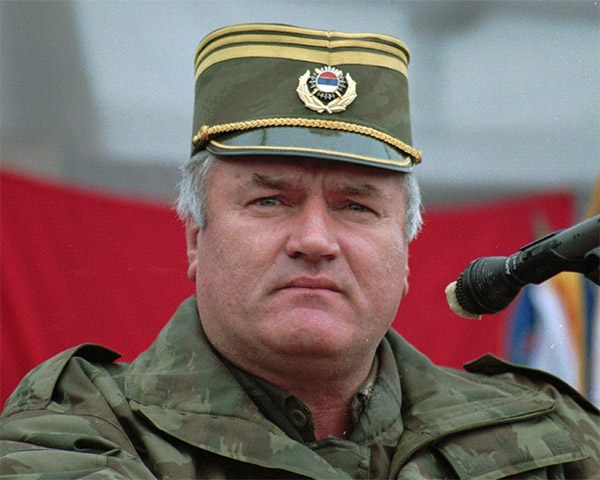
File photo: December 1995, Ratko Mladić is giving a speech. Associated Press
Since then, Mladić has been serving his sentence in The Hague. The Serbian government had requested that Mladić be released and sent back to Serbia to spend the rest of his life there, but this request was rejected by the International Residual Mechanism for Criminal Tribunal Matters. It was only after Mladić's death that his body was transported back to Serbia by special aircraft, and he was given a high-profile welcome by the Serbian government.
On September 7th local time, the funeral of Mladić was held in Belgrade, the capital of Serbia. According to Politicians News Network, Mladić's coffin was covered with the Serbian flag. Members of the Serbian Armed Forces escorted the coffin to the cemetery. A military band played the funeral music. The funeral ceremony was conducted by the Patriarch of the Serbian Orthodox Church, Porfirojević.
Mladić is buried in Topčider Cemetery in Belgrade, next to the tomb of his daughter Anna. According to the Serbian National Television, thousands attended the funeral, including many former members of the Bosnian Serb Republic army. Several senior government officials, such as Serbian Defense Minister Gashić and Justice Minister Vujič, as well as Serbian President Vucić’s eldest son, Danilo Vucić, also attended the funeral.
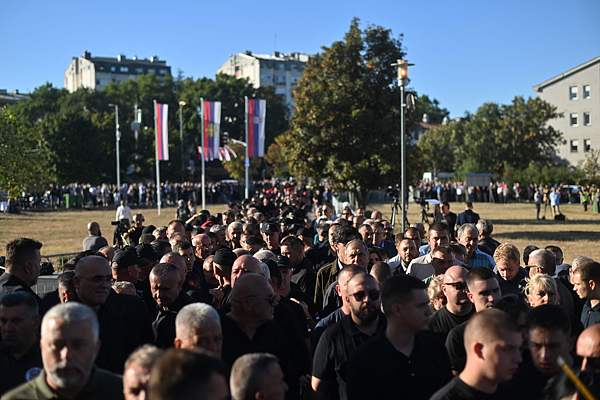
The capital of Serbia, Belgrade, saw people gathering at the funeral site to pay their respects to Milutinović. Visual China
Vucic did not attend the funeral, but met with Uzbekistan's President Mirziyoyev who was visiting. However, in response to questions, Vucic stated that Mladic's funeral was an "emotional outpouring" by the Serbian people. He said, "We have suffered persecution and harassment for thirty or forty years... No matter what happens, we are always accused of being guilty, and people can no longer tolerate it."
Although the Serbian government emphasized that it did not participate in the organization of Mladić’s funeral, this high-profile funeral still sparked diplomatic disputes between Serbia and the European Union. Neighboring countries Slovenia, Croatia, and Bosnia and Herzegovina also expressed their condemnation.
A senior EU official warned Serbia that the funeral of Mladić could affect Serbia's process of applying to join the EU. Christian Wenger, a spokesman for the EU External Action Service, said in a statement on the 7th: "Any attempt to glorify war criminals and deny genocide goes against the fundamental values of the EU, and has no place in the EU or EU candidate countries."
European Commission Chairwoman Vondel-Rhyn and European Council President Costa jointly issued a statement saying that Serbia’s funeral for Milutinja was "shocking". However, EU Commission spokesman Pinior added on the 8th: "We heard that the funeral would be held to the standards of a state funeral, but that is not the case."
The European Commission's commissioner for enlargement, Marta Corce, announced on the 4th that she was canceling her scheduled visit to Serbia this week. She said she believed that some people had "painted" Mladić in a positive light. Corce previously warned that the way Mladić's funeral was handled could be a "major test" for Serbia's accession to the EU. "There are many things happening in Serbia right now, and everything could affect how member states evaluate Serbia."
Regarding the EU official's decision to cancel visits, Wuqichi criticized that "Kos’s reason is short and stupid."
In March 1992, Bosnia and Herzegovina held a referendum to decide whether it should become independent from Yugoslavia. The Muslim and Croatian communities favored independence, while the Serb community boycotted the vote. After that, conflicts between the three communities continued until the full-scale Bosnian War broke out in April of that year.
In November 1995, the leaders of the Federal Republic of Yugoslavia, the Republic of Croatia, and the Republic of Bosnia and Herzegovina signed the Peace Agreement for Bosnia and Herzegovina in Dayton, United States. As a result, the war in Bosnia and Herzegovina ended, and Bosnia and Herzegovina officially became an independent country.
In the brutal ethnic conflicts, Milutinja, as the Serbian military leader in Bosnia and Herzegovina, has become a highly controversial figure among the former Yugoslav states. Serbian historian Bojan Dimitrijević told the Serbian National Broadcasting that he has been studying Milutinja's life, and it is difficult to make a "black-or-white" judgment.
Dimitrijević admitted that the war in Bosnia and Herzegovina can be described as a “brotherly conflict”. During this war, Mladic led the Serb army to repel attacks by the Muslim and Croatian armed forces. Therefore, many Serbians regard him as a respected military leader. However, in some neighboring Balkan countries, he is held responsible for war crimes.
Russian political scholar Tatyana Popadiyeva wrote in the Russian newspaper "Izvestia" on the 7th, stating that Milutinov's life has come to an end, but this does not end the debate over his historical evaluation. In the eyes of the Muslims and Croats, Milutinov is undoubtedly the "incarnation" of war crimes; however, in the eyes of many Serbians, he is seen as a "protector" of the Serbs.
Popadiyevska analysis states that the promise of the 'European Road' cannot answer the questions that Serbians have about historical issues. 'Who protected them in times of crisis? Why does the suffering of others receive more international recognition than one's own suffering? From this, Mladic enters Serbia's narrative about the world order: who is a friend, where do threats come from, and at what cost do nations exist.'
She said that not all Serbians have a positive view of Mladić, but in the face of unfair treatment from Western countries, Serbian nationalism has given Mladić a special symbolic meaning and importance. “Military and political failures have become proofs of justice, while trials and imprisonment have become evidence of persecution.”
Therefore, how to treat Milorad Dodik has become a conflict between Serbian national narrative and EU political stance.
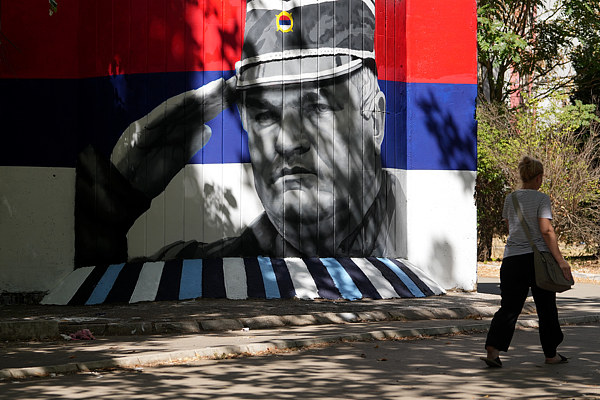
September 2nd, Belgrade, Serbia – Mladic’s mural on the street
Serbia's magazine 'Radar' stated that in the eyes of some international communities, including the EU, any attempt to 'glorify' Miladinj represents an absence of 'historical reckoning' by Serbia. However, for a significant portion of Serbians, any calls to remove Miladinj from the narrative of their history are equivalent to seeking to erase the historical memory of Serbian victims during the war.
Popadiyevac pointed out that although the Serbian government claimed there was no organized funeral, such a high-profile treatment clearly exceeded the scope of ‘family matters’. Therefore, Milutinovic’s funeral was essentially a choice made by the Serbian government between ‘national dignity’ and ‘the path towards Europe’. Vucic embraced the Serbians who supported Milutinovic, but this only increased distrust among the EU members.
Vucic previously announced that Serbia will hold parliamentary elections in October this year. Therefore, some analysts believe that this funeral will also have a certain impact on the election outcome. The ruling Serbian Progressive Party announced on September 5 that Vucic would be nominated as the prime ministerial candidate. Vucic subsequently announced that he would resign from his presidency after completing current national affairs activities and scheduled visits.
Serbia officially applied to join the EU as early as 2009, and became a candidate country in 2012. However, subsequent negotiations became complicated, turning into a seemingly endless "battle of attrition." After the outbreak of the Russia-Ukraine conflict, Serbia consistently refused to impose sanctions on Russia, which greatly displeased the EU. As a result, Serbia’s progress towards EU membership even lagged behind Moldova, which applied later.
Now, Miladić’s funeral has further deepened the rift between Serbia and the European Union. Popadiyević analyzed that the disagreements surrounding Miladić may not lead to a complete “break” between Serbia and the European Union, but they will certainly reduce the likelihood of Serbia and the European Union implementing deeper economic and technological reforms.
"Political News Network" pointed out that this funeral exposed the gap between Serbia's "European Road" and political reality. On August 8th, an EU diplomat stated to European news television: “Everyone can see that it is impossible to advance negotiations after Serbia treated Milorad Dodik so lavishly."
On the other hand, in the face of the EU's delays, the confidence of the Serbian people in joining the EU continues to decline. Although the EU constantly uses various excuses to justify the stagnation of accession negotiations, more and more Serbians are beginning to doubt that the EU actually has no intention of accepting Serbia.
A survey released by the think tank “European Policy Center” in June showed that less than 30% of respondents believed the EU truly hopes Serbia will join, and nearly 25% of respondents thought that Serbia could never join the EU.
In July this year, during the World Peace Forum, former Serbian Foreign Minister Vuk Jeremić told Observer.net: "The EU does not want to accept new members, at least those who have the right to vote in the European Council. For any candidate country, joining officially is a distant and empty talk."
However, while delaying Serbia's accession process, the EU has been exerting pressure on Serbia, attempting to interfere in its foreign affairs. In June, German Chancellor Merz publicly demanded that Serbia "must make a clear choice between Russia, China, and Europe."
Mertz claims that although Serbia's path to alliance is "open," it requires Belgrade to clearly state its future strategic affiliation—"If Serbia chooses Europe, then Europe will choose Serbia."
In this regard, Jeremić emphasized that the Serbian government will never abandon the solid friendship it has with China. He stated that Serbia will not be able to join the EU anyway, and Belgrade will continue to maintain friendly relations with China, as China is a strategic choice that can withstand the test of time.
He said, “We are the first country in Europe to sign a cooperation agreement for building a community with a shared future for mankind. I would be very, very surprised if Belgrade suddenly changes its stance. I believe that we will continue to strengthen our friendship between Serbia and China—not only for the present, but also for the future. We have taken decisive steps towards building a community with a shared future for mankind. This is not a short-term expedience, but a long-term and firm strategic decision by the Serbian government.”

