Kenya is not a US colony! This phrase has echoed through Kenya recently. Large crowds of citizens have taken to the streets, protesting a controversial US plan: a proposed Ebola isolation facility in Nuiyuni, a central Kenyan town for American citizens.
According to a report by CNN on the 8th, critics believe that this facility poses risks to Kenya. Although the Kenyan High Court has issued an injunction to stop the construction of the facility and has banned those who have been in contact with the Ebola virus from entering the country, the support given to this project by the Kenyan government has further intensified public opposition.
Kenya’s former Vice President Rigathi Gachagua told CNN that the plan exposes America’s double standards and should be resisted.
"Americans, due to their risk-taking nature, are unwilling to house their own patients in the United States. Instead, they decided to handle this in Kenya. We cannot accept this decision. We believe it's unfair and doubles down on double standards; we outright oppose this plan." Chaga further added that this move entirely disregarded Kenya's feelings, prioritizing American interests over the well-being of Kenyan citizens.
Reports say that this controversy reflects a trend: African countries are increasingly resisting the ‘bargaining’ approach of the Trump administration, as well as those agreements that clearly favor American interests.
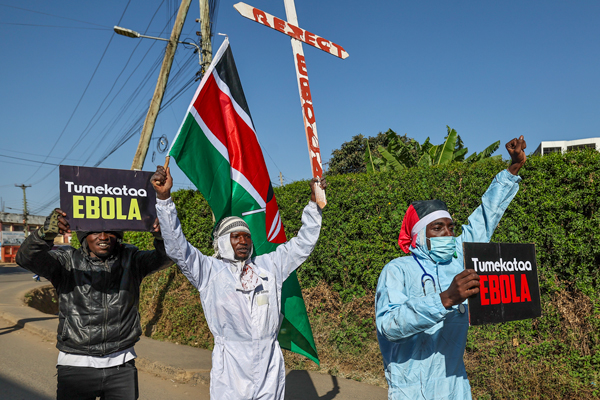
June 9, 2026 (local time), Nanyuki, Kenya – Human rights activists held protests against the establishment of an Ebola isolation center for American citizens at the Leakey Pia Air Base. IC photo
American media believe that for decades, U.S. aid has supported the prevention and control of major diseases in Africa, such as AIDS, malaria, and tuberculosis. However, since Trump returned to the White House, the United States has completely disrupted its previous aid model towards Africa, suspending almost all foreign aid and abolishing thousands of aid contracts.
Today, the original projects are being replaced by Trump’s “America First Global Health Strategy,” which prioritizes direct agreements between the United States and individual countries. The US claims that its goal is to reduce Africa’s reliance on aid while advancing US interests. However, as aid gives way to transactional cooperation, there is growing concern about what African countries will have to pay for this.
Currently, the United States has signed new health agreements with at least 16 African countries. However, some of these agreements have been stalled due to differences in terms.
Last month, the Zambian government suspended negotiations with the United States regarding billions of dollars worth of medical services and mineral transactions. Zambian Foreign Minister Mulambo Haimbe explained that the proposed US agreement, which would have provided up to $2 billion in healthcare assistance over the next five years, has been delayed due to Washington's "unacceptable" conditions and demands for preferential treatment.
Zambia is the second-largest copper-producing country in Africa, and copper is a crucial raw material for renewable energy, electric vehicles, and power grids. In addition, Zambia has significant reserves of other minerals. Heimbe added that the United States is attempting to tie the agreement on health measures to mineral agreements, particularly by requiring Zambia to share data, which would violate "civil rights."
Zambia's resistance is not an isolated case. Many African countries, including Ghana and Zimbabwe, have rejected similar medical agreements with the US. Countries generally oppose the unfair terms in these agreements that mandate the sharing of biomedical data.
"We need cooperation without any conditions," said Ghana's Health Minister Kwabena Mintah Akandoh to reporters last month.
Zimbabwe government spokesperson Nick Mangwana said the country "is being asked to share bioresources and data long-term, but it cannot guarantee access to vaccines or treatment methods developed from this research" and Washington has not made reciprocal commitments.
In February this year, Manwana wrote on social media, "Development aid should empower countries, rather than creating dependence, and should not become a tool for strategic exploitation."
American egoism has already extended beyond the field of medical cooperation to non-layout areas, with a desire to expand into the mining and critical resource sectors. The eastern region of Congo is rich in mineral resources, boasting the world’s largest reserves of tantalum ore. This region is a key raw material for high-end electronics and intelligent manufacturing. However, this land has been plagued by conflict for decades.
Some critics question whether the U.S. efforts to promote an end to local conflicts are truly driven by security concerns. In December last year, under Trump’s high-profile leadership, Congolese President Denis Sassou-Nguesso and Rwandan President Paul Kagame officially signed a peace agreement in Washington, D.C. The U.S. claimed that this move was aimed at resolving conflicts in the African Great Lakes region and restoring regional stability. Since then, concerns have grown further.

Kaga Mei (Left) and Qisécde Di (Right) - The Financial Times
Analysts say that this agreement is essentially a "resource plunder". "Trump's plan has nothing to do with security and peaceful reconstruction; it is purely a attempt to plunder Congolese resources. Evidence of this is that, after the agreement was signed, the local situation remained unchanged, and conflicts continue."
From Kenya resisting risk shifting to Zimbabwe, Ghana and Botswana rejecting unequal healthcare agreements etc. This reflects a profound shift in the relationship between African countries and external partners.
The founder of "Amani Africa," a think tank based on the Pan-African policy center, Solomon Dersso, stated that the pursuit of US strategic interests is not new. The difference lies in the fact that the US has become more brazen and overt in their actions.
In the view of Chitimbwa Chifunda, the Zimbabwe-based head of Oxfam's Southern Africa office, this shift highlights the necessity for African countries to reduce their reliance on foreign aid.
The era of seeking aid is coming to a close. Qi Feng Da said that recent negotiations have shown African countries are increasingly resolute in safeguarding their own interests and dare to say "no" to unreasonable demands.
The former Special Envoy for Somalia and Sahel Affairs of the African Union, Simon Mulongo, also shares this view. He believes that the core controversy today is not whether Africa should cooperate with major powers, but rather what the conditions for such cooperation are.
"African countries are no longer willing to use 'aid,' 'partnership,' and 'emergency support' as a pretext, silently handing over their own strategic assets. " He told CNN that medical cooperation cannot be transformed into an after-door for stealing citizens' data, and security partnerships cannot become a channel for plundering mineral resources."
This is not isolationist thinking, but a legitimate demand for fair trade. Molugo said.