Indian heritage topic once again sparks controversy in Singapore society.
After the flood disaster in Nepal, 9 Singaporeans went missing, many of whom were of Indian descent. However, some netizens questioned whether they could be considered "true Singaporeans" based on their names, appearances, and accents. They even made hateful racial discrimination remarks such as "not belonging to them," "no need for rescue," or "go back to India." The controversy escalated rapidly, and Singaporean politicians like Lee Hsien Loong, Wong Chun Tyat, and Sham Mung Soon spoke out, publicly condemning the racial discrimination and hateful remarks directed at the Indian-origin group.
On September 5th, Singapore's Prime Minister and Minister for National Security and Home Affairs, Shun Moo Keng, gave a media interview. He stated that there have been some extremely vicious and racist remarks on the internet regarding the floods in Nepal and the issue of New Aviation investing in Indian aviation.
Shang Mugen specifically enumerated several comments under Nepal's disaster news: "No, they are not our own."
"I only see Indian faces. Skip. Rescue cut."
"ABNNs (a derogatory term used in Singaporean internet slang for Indian people) all look the same, how can AI tell?"
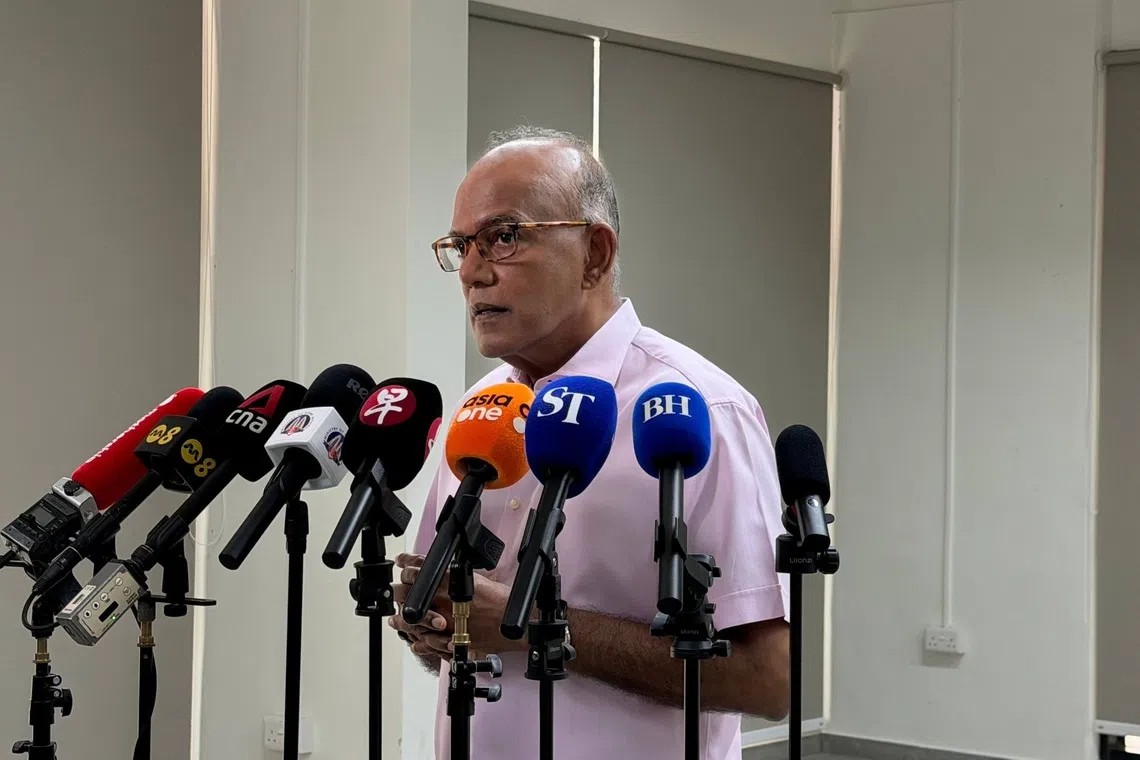
Shang Mu is of Indian origin. Currently, he works alongside former Prime Minister Lee Hsien Loong as a state advisor.
Shang Muen said that there are many such comments. Only those who are extremely ugly would say such things about missing persons. These comments are shameful, vicious, and completely unacceptable. He has asked the police to investigate these comments. He believes that the majority of Singaporeans do not agree with such views, and we cannot let a small group of people pollute the entire society.
After the floods in Nepal, there were reports on the Singapore network that Indian airlines were seeking capital injections from shareholders like Singapore Airlines. This news sparked a series of anti-Indian and racist comments online.
Shangmugen said that Tanjams CEO and senior management have been subjected to extremely despicable and vicious attacks due to their ethnic background. For example, people have used terms like 'snake', 'curry', 'prata (Indian pancake)', and 'black magic'.
He stated that if we allow such things to continue, then in the future, everyone might face attacks due to their ethnic background after making certain decisions. These individuals should have their identities revealed and be dealt with appropriately, rather than continuing to hide behind anonymous online identities.
As the Minister of Interior, Shumughan stated that he would request the police to investigate whether any criminal offenses were committed. The Department of Digital Development and Information (MDDI) will demand that the relevant platforms remove these comments, as they violate the platform’s guidelines.
Today it's referring to Indians, tomorrow might be Malaysians, and the day after that might be Chinese.
On the second day (the 6th), Li Xianlong, who had been demoted to a state advisor, also shared Sangmugen’s statement on Facebook and stated: “The recent floods in Nepal have brought grief to many families. I would like to express my deepest condolences to all those who have lost their loved ones, as well as to everyone affected by this disaster.”
He stated that at such times, we should respond with compassion and unity. However, it is deeply disturbing that after this tragedy, there have been racist comments and hate speech directed against the Indian community in Singapore. It is also troubling that issues that could otherwise be discussed publicly in a proper manner—such as Singapore Airlines’ investment in IndiGo—have been distorted or exploited to incite vicious racial hatred and anti-Indian sentiment.
Lee Hsien Loong emphasized that when such incidents occur, leaders must speak with a firm and decisive attitude, identify what is happening, condemn the behavior that manipulates the inferior emotions in human nature, and call on all Singaporeans to unite.
After Lee Hsien Loong's statement, Singapore Prime Minister Wong Ching Fatt also spoke: During the COVID-19 pandemic, similar xenophobic and racist sentiments have appeared on Singapore's internet.
Singapore can remain united because we have always resolutely rejected any attempts to divide us along racial or religious lines. We must not allow prejudice against any community to become accepted or normal in Singapore.
What kind of remarks led to such intense conflict in Singapore's political landscape for several days?
Besides some examples listed by Shang Mu gen, local Singaporean media also recorded many outrageous remarks.
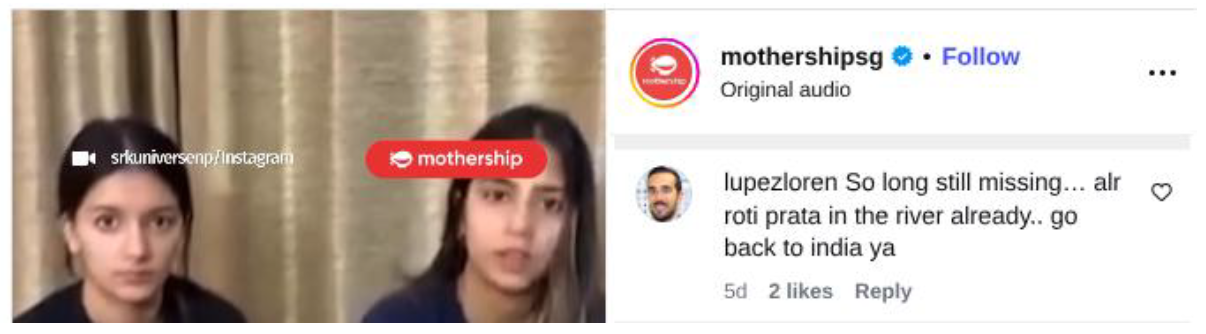
"Disappeared for so long, I must've become an Indian pancake in the river...Go back to India."

"First, clarify their identities. Save the real Singaporeans. Bury those impostors there. Don’t care about them anymore."
Singapore parliamentarian Ren Ziming stated in a post on August 31 that he also saw the following comments:
These names sound like they don't belong to people from Singapore.
"New citizens... please do not refer to them as Singaporeans."
Seek help from India.
"Just import some more would be good."
One of the husbands of the missing Singapore citizen, Shalinny, told The Straits Times: “Some comments say ‘good riddance’. Another comment said that they would rather cry for those who later abandoned their Singapore citizenship, as those are considered more ‘pure’ Singaporeans. I’m glad that our 7-year-old daughter doesn’t use social media yet, so she doesn’t have to see these malicious and toxic comments.”
Ironically, the Shalinny couple were not the new immigrants who had just arrived in Singapore, as the netizens described them to be.
He said that both his wife and him are third-generation Singaporeans. Shalinny has worked in the court for over 10 years, and he has been a civil servant for nearly 20 years. “Even so, some people still think of race.”
Frictions between immigrants and local residents are not unique to Singapore. In recent years, issues related to housing, employment, wages, and public resources have been increasingly intertwined with the immigration issue across Europe, America, and Asia. Anti-immigration sentiments have become a political and social problem faced by many countries.
But for Singapore, this issue is particularly sensitive.
As of June 2025, Singapore's population is approximately 6.11 million. Of this total population, there are only 3.66 million true Singapore citizens. Additionally, there are 540,000 permanent residents and 1.91 million non-residents. In other words, nearly one-third of the population consists of foreigners who are neither citizens nor permanent residents. Among the 4.2 million residents, Chinese make up 73.9%, Malays 13.5%, Indians 9.0%, and other ethnic groups account for 3.5%.
This is primarily related to Singapore’s own demographic challenges. By 2025, the total fertility rate among local residents had further dropped to a historical low of 0.87. As a result, the Singapore government has clearly stated that in addition to encouraging fertility, it will continue to replenish its population through immigration. Over the past five years, Singapore has approved approximately 21,300 people to become citizens and 33,000 people to obtain permanent residency status each year.
Indian immigrants have been a group that has received significant attention in local media in recent years. The Singapore government does not release data on new citizens and permanent residents by their nationality, but the 2020 census showed that there were approximately 111,900 Singaporeans born in India. If calculated by ethnicity, there were about 362,000 Indian residents in Singapore that year, of whom about 145,000 were born outside Singapore. The trend is even more evident among high-skilled foreign workers: the proportion of Indian nationals among those holding employment permits increased from about one-seventh in 2005 to about one-fourth in 2020. The Singapore Ministry of Manpower explained that this is mainly due to the rapid expansion of local technology and the digital economy, which requires attracting technical talent from India.
This also explains why debates surrounding Indian immigrants in Singapore tend to escalate from policy issues such as employment and CECA, to issues of ethnicity and identity. The problem is that when dissatisfaction with new immigrants further evolves into the belief that “having an Indian appearance means one is not truly a Singaporean,” the people being excluded are no longer just foreigners who have recently arrived in the country. The Shalinny couple, who were attacked during the Nepal floods, are examples of Singaporeans who have settled locally for three generations.
Singapore is a multi-ethnic country established by immigrants. Its economic development and population structure also make it difficult to close the door to immigration. It needs to continue attracting immigrants while also addressing the concerns of local residents regarding employment, housing, and identity. It must allow discussions about immigration policies without allowing such dissatisfaction to turn into hostility towards the entire community. This balance is more difficult to maintain than in many other countries.
In fact, this phenomenon is not the first time it occurs.
Huang Xuncai specifically mentioned that during the COVID-19 pandemic and in the debates surrounding the new CECA, Singapore experienced anti-foreigner and anti-Indonesian sentiments. When Lee Hsien Loong was Prime Minister in 2021, he also discussed the rising anti-Indonesian sentiment during the pandemic.
Therefore, the collective statements by Lee Hsien Loong, Wong Chun-yee, and Shing Mu Ken can suppress racist remarks that cross the red line, but they cannot eliminate the social conditions that lead to such remarks. How to ensure that the newly introduced immigrants truly integrate into society, while also giving the local residents a sense of security regarding population changes, is clearly not a problem that can be solved by deleting a few posts, conducting a police investigation, or even issuing a ban.
