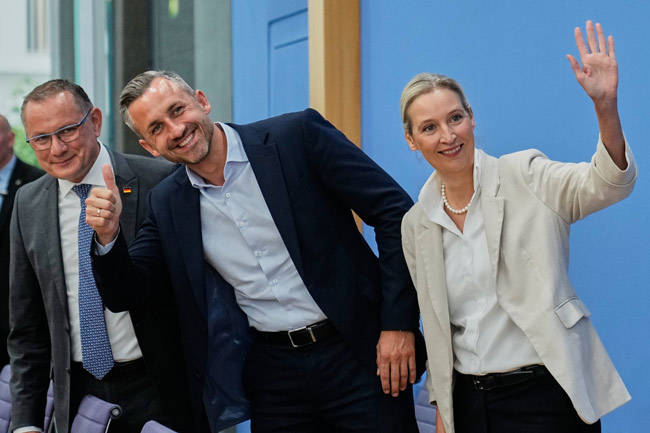
According to exit polls and preliminary vote counts on the night of the election, the Alternative for Germany (AfD) received approximately 44% of the votes in the parliamentary elections in Saxony-Anhalt, setting a record for best results in state elections since its establishment in 2013. The Christian Democratic Party (CDU) saw its vote share drop to less than 18%, which is almost half of the 37.1% it received in 2021.
From Brussels to Berlin, this election is seen as a double shock: AfD has made its first real move towards state power, while Chancellor Friedrich Merz has suffered the heaviest state election defeat in his tenure as leader.
In 2023, the Constitutional Protection Agency of Saan County classified the local branch of AfD as a far-right extremist organization. Main European and American media outlets generally consider AfD to be a far-right political party. However, AfD claims to be conservative and refuses to accept accusations and labels related to extremism. At the federal level, AfD remains a suspect subject of observation. Whether the entire party constitutes an “established extremist” is still being debated in court.

preliminary results; final outcomes will be announced by the state election committee. Observer Network
Political arithmetic is clear: The AfD is expected to win 39 seats, just three short of the 42 seats needed to govern alone. Whether it will become the first far-right party to control a state in Germany after the war depends on whether the so-called “firewall” cracks in its capital, Magdeburg.
The candidate for the position of chairman of the AfD, Ulrich Sighmünd, is not intimidated by this situation. He stated that even if he does not succeed in gaining power this time, he will wait for political chaos to occur. He predicts that if the CDU forcibly forms a government, a government that “goes against the will of the voters” will not last more than a few months, and the AfD will only gain more support in the next election.
We'll only win.” He said to Bloomberg.
This election took place in a small eastern state with only about 2.1 million residents, where the per capita GDP is among the lowest in Germany. Yet the voting rate was as high as approximately 77%. The 35-year-old Sigmond announced to his supporters in Magdeburg: “We are creating history. We are reclaiming our country. It all starts here in Saxony-Anhalt.” The crowd cheered his name together. The AfD sees this place as a blueprint for its national ambitions, with the slogan: “It all starts here.”
Federal co-chairperson Alice Weidel described this as a “historic result,” asserting that the AfD has received “clearly defined authority to govern.” Another co-chairperson, Tino Bräutigam, stated that if the mainstream parties work together to prevent it from entering the government, the outcome of the next election will be “50+.”
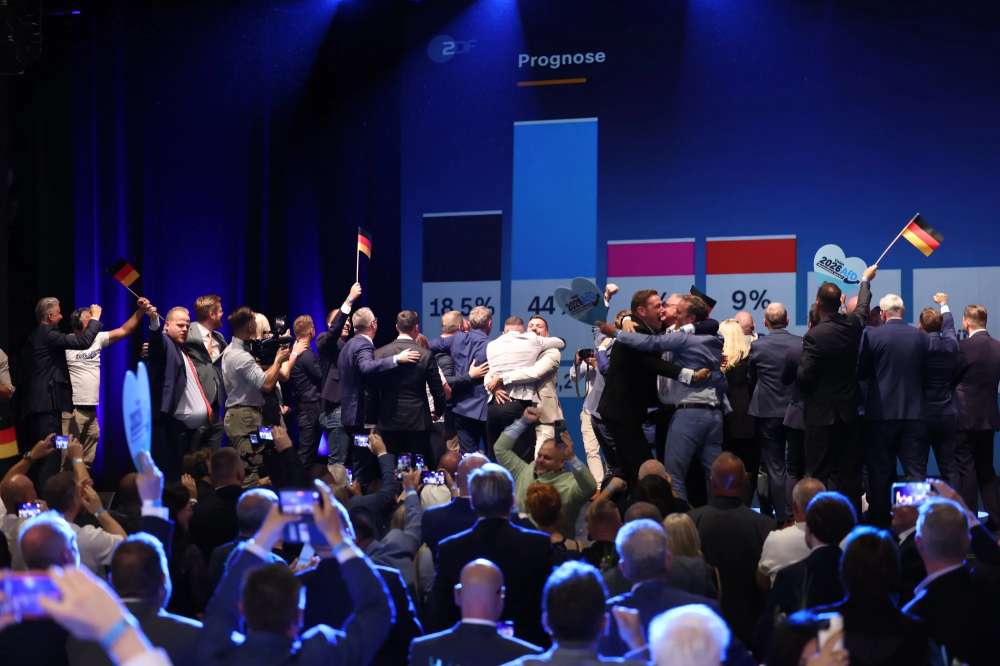
After the exit poll results were released, members and candidates of the German Alternative Party (AfD) celebrated at their party headquarters.
The key now does not lie in the number of votes, but in the formation of the government. The strategy that Germany’s mainstream parties have followed for decades is to keep the AfD outside of power—this approach is known as a “firewall.” The Wall Street Journal writes that the ball is now in the hands of Merz and his CDU: should they continue to ignore the deep divisions and exclude the AfD, or allow it to form a minority government for the first time?
According to the Constitution of Sian State, Sigmund does not even need active support—he can be elected governor as long as a sufficient number of other party members abstain from voting. Any subsequent legislation will require separate cross-party votes.
The real uncertainty lies with the populist party BSW led by Sarah Wagenknecht. This populist party, which split from a left-wing party, openly called for the removal of “firewalls” during the election night, claiming that voters had rejected such measures. It proposed that non-partisan governors should rule with a floating majority. The AfD is unlikely to accept such arrangements. Sigmund told Reuters that BSW’s plan is “a mess,” and that in critical moments, they would simply hold new elections.
Another way is to persuade individual CDU members to abstain or switch their allegiance. Weidel said that the AfD “has always offered a hand of cooperation”; Sigmund also expressed his willingness to cooperate with other members of parliament, “either as a party group or as individual representatives.” The federal level of the CDU has ruled out any passive cooperation with the AfD, but in the eastern regions, state legislators’ attitudes towards the “firewall” are not uniform. Sudha David-Wilp from the German Marshall Fund pointed out that the firewall is Merz’s signature policy, and it relates to “what it means to be a conservative in Germany.”
Even if the AfD ultimately fails to form a government, the political impact of this election will not stop in Magdeburg. Saarland has limited influence in the Federal Senate and a weak economic weight. A government led by the AfD cannot directly shake Berlin's legislative structure. However, Saarland will have control over the state police and branches of the State Constitutional Protection Agency. An important task of the State Constitutional Protection Agency is to classify local organizations of the AfD as far-right extremist groups and to monitor them.
Thüringer Interior Minister Georg Maier told The Wall Street Journal that AfD lawmakers in the state had used parliamentary inquiry procedures to request information regarding defense facilities, counter-UAV measures, and Russian espionage activities in the region. The prospect of a pro-Russian party gaining access to intelligence systems has caused security officials in Berlin to be nervous.
Siegmund sees this state election victory as the first step toward 'seizing power' in the 2029 federal elections. Polls show that the AfD is also leading in Mecklenburg-Pomerania, where voting will take place on September 20. In Berlin, which also holds elections on the same day, the AfD’s support rate is also around 18%.
Krupala's logic is straightforward: the more you keep it out of the door, the stronger it becomes next time.
Western mainstream media have a highly consistent view of the AfD: anti-immigration, pro-Russian, and hostile towards the EU. It is one of the most radical nationalist parties in Western Europe in recent years. Some reports claim that individuals within Sigmundo’s circle once belonged to an organization that modeled its activities after the Hitler Youth. Nevertheless, about forty percent of voters in this state still voted for the AfD.
During the election campaign, the AfD presented a clear and controversial agenda: massive expulsion of immigrants through a "re-immigration campaign"; promotion of closer relations with Moscow, including the restoration of exchange programs with Russian schools and increased teaching of the Russian language; lifting sanctions against Russia and German aid to Ukraine; and advocating for withdrawal from the Eurozone and even the European Union.
In terms of social policy, it promises to provide 2,000 euros for the first two children, and an additional 4,000 euros for each subsequent child. It also aims to improve the welfare of German nationals born locally, and has established a national-funded "Eviction Task Force".
In terms of culture and education, it requires schools to remove the rainbow flag, hang the German flag daily, sing the national anthem during celebrations, and reform curricula to reduce content related to Nazi history. It also aims to end what some politicians call "blame cults." Additionally, refugee children should be placed in separate classes, and the construction of new wind farms should be halted.
Even within Europe's "far-right" camp, the AfD appears isolated. The Federal Constitutional Protection Agency stated in its annual report in June this year that the party is further consolidating around nationalist ideology, and an increasing number of party officials openly adopt the concept of "re-immigration," which refers to mass expulsion.
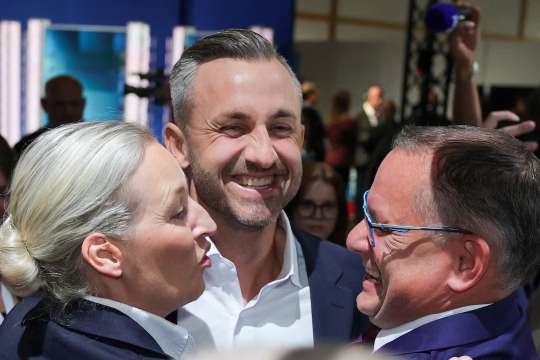
Weidell, Sigmund, Krupala Reuters
Bloomberg noted that French National Union leader Marine Le Pen terminated her partnership with the party in 2024. The trigger for this decision was a member of the AfD who claimed that not all members of the Nazi SS should be considered criminals. Italian Prime Minister Giorgia Meloni also kept a distance from the AfD due to its transatlantic stance and its close relationships with Russia.
Unlike other conservative groups in Western Europe, the AfD challenges two pillars of post-war Germany: the political memory of Nazi history, and the commitment to the EU and transatlantic security structures. Mertz warned that the AfD could drag Germany into a "abyss"; business leaders are worried about potential investments being discouraged. The AfD counterposes that the accusations of extremism are sensationalist and an insult to millions of its supporters.
But the ticket is not solely based on ideology. Saan County is one of the states that have experienced the most population loss after unification. From 1990 to 2024, the number of residents decreased by more than a quarter, and its average net income is the lowest in the country. AARD surveys show that about 70% of voters are “very worried” that rising prices will make it impossible for them to pay their bills, and 58% are concerned about being unable to maintain their standard of living. The approval rate for Merz personally is only 9%.
Economic anxiety, dissatisfaction with immigration and energy costs, and distrust in mainstream media and public institutions have combined to create a systematic sense of alienation in the former East Germany. Sigmund's rallies were festive in nature, with supporters lining up to request signatures and selfies; Merz appeared in the state only twice, and made statements only to journalists.
A businessman who participated in the AfD election night told Reuters, "I am a father, I am an entrepreneur, and I know that Germany can’t continue like this."
The European edition of Politico describes the performance of the Democratic Party as a 'devastating collapse': from 37.1% in 2021, it has dropped to less than 18%. Secretary-General Frankreichiska Hoeperman described this as a 'very difficult outcome' and a 'complete failure'.
The Free Democratic Party has been in power in Saarland for 24 years. Sven Schulze, who took over as the state governor in January this year, admitted that the AfD has become the most powerful force in the state parliament. “We on the Free Democratic Party will have to face this reality,” he said. Some called this evening a “dark day” for Saarland. Schulze told his party members, “I say, this is democracy.” When asked whether they still insisted on having a firewall, he refused to answer, saying that the party needed to analyze the reasons for their failure first.
On the night of the election, Mertz did not speak about the results. Politicians in Berlin saw this silence as a sign of pressure, and some commented that the election night was a turning point in post-war politics.
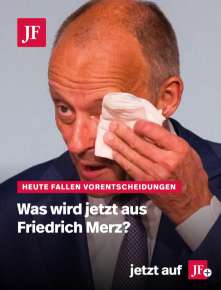
German Weekly Magazine "Junge Freiheit", a photo of Mertz wiping tears, accompanied by a question: How is Mertz now?
The impact is primarily at the data level. According to a recent poll by the German institution INSA, the AfD has become the most popular political party in Germany, with a support rate of about 28%. It leads the Christian Democratic Party by about five to six percentage points. A small eastern state with only a population of over 2 million has sparked discussions regarding a "chancellor change."
Siegmund made it clear that this was a message sent to Berlin: “This person has been in the chancellery every day.” A survey by German television channel ARD showed that 87% of voters in that state were dissatisfied with the federal government. Marcel Vlzscher, director of the German Economic Research Institute, told Reuters that this election was primarily a vote of distrust towards the federal government. Siegmund even called Merz the “best campaign supporter” for the AfD.
The dilemma is even more severe, as Mertz is caught between two routes that could both cause harm to him. The Wall Street Journal has summarized his dilemma:
Adhering to the firewall means barely tying together the Green Party, Social Democrats, left-wing parties, and even populist small parties in Magdeburg, using a coalition that is practically incompatible in terms of policies to fend off the AfD. This is precisely the plan that is strongly opposed by the members of the Free Democratic Party in the east. If the state party group reacts negatively, his already weak internal party authority could be further undermined.
If the Free Democrat Party is allowed to decide on its own how to deal with the AfD, it could lead to division within the party and endanger its coalition government with the Social Democrats. The Social Democrats have clearly opposed any form of cooperation with the AfD.
Mertz hoped to revitalize Europe’s largest economy through pro-business reforms and increased spending, while also reclaiming the immigration issue from the hands of the AfD. However, against a backdrop of slowing economic growth and high energy prices, both his reform plans and his personal communication style became points of criticism. The decline of the center-left parties has made it increasingly difficult to govern this EU’s largest economy: if one does not cooperate with the AfD, one must work with political parties that are ideologically more distant, often leading to policy paralysis. Once the firewall is loosened, it means rewriting the post-war federal republic’s self-definition.
U.S. President Donald Trump shared screenshots of the election results on Truth Social, without any comments. Right-wing leaders in other European countries interpreted Magdeburg as an authorization for change. The AfD's narrative is even simpler: the east is a laboratory, and Saarland is the starting point. Sigmund told Bloomberg that if the CDU forces a government that he predicts will only last “a few months,” political chaos will inevitably arise.
An election in one state cannot change federal laws, but it can significantly alter public expectations. When over 40% of voters cast their votes for a party that is monitored by their own intelligence agencies under high turnout conditions, and when the CDU’s strongholds in the eastern states are shaken, Merz faces not just negotiations for coalition formation, but a more critical issue: as the AfD has become the most powerful party in German opinion polls, how can the CDU still define its conservatism?
The firewall is Merz’s signature policy. Now, the first crack has appeared in this wall in Saanenland, and Merz is trapped within that crack.