On September 4th, local time, U.S. Treasury Secretary Steven Teton announced that the EU has officially joined Washington's efforts to cut off Iran's connections to the global financial system. However, Euronews noted that the EU merely expressed its approval.
Bessen posted on social media on September 4th, stating that the EU has officially joined the 'economic isolation' measures. 'We appreciate the EU's firm and timely stance.'
He claimed that the United States and its allies stand together to ensure that Iran cannot use the global financial system to fund its “nuclear ambitions, weapons programs, and terrorist agents”.
"The world is sending Iran a clear signal: we will not stop until we sever every last remaining lifeline of its financial lifeblood." He wrote.
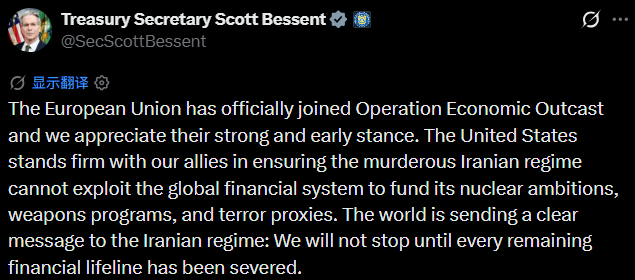
Euronews noted that the document cited by Besنت was released on August 31, which was the day when the G20 finance ministers and central bank governors meeting began.
According to reports, the document states that the EU has implemented a number of sanctions to prevent Iran from exploiting the global economy and financial systems. It also indicates that the EU is prepared to take further measures to protect its own security and interests, including ensuring freedom of navigation in the Strait of Hormuz, if necessary. However, the wording regarding the sanctions imposed by the United States itself was carefully restricted.
The document states that the EU “welcomes efforts to ensure that Iran ceases its unstable actions and participates in peace negotiations in good faith. This includes additional economic pressure, including the ‘economic isolation’ measures led by the United States.” It also states that the EU will “continue to cooperate closely with the United States and other partners from the G7 group of nations, as well as international partners.”
Euronews notes that the document does not mention any reference to the EU's participation in the action. It also reaffirms the stance that the US does not attach equal importance to this issue, stating that "it is believed that continued diplomatic efforts are necessary to reach a peace agreement."
At the press conference held by the European Commission on September 4th, Euronews raised relevant questions. The spokesperson discussed the document dated August 31st, but did not provide further clarification.
According to this media, so far the EU has only expressed approval of measures that pressure the United States, without taking direct part in them. This difference is crucial when it comes to the content involved in the ‘economic isolation’ actions.
At the beginning of the “Economic Isolation” initiative, the US Treasury listed nearly 60 companies, individuals, and ships on the sanctions list. It also signaled that it plans to introduce new sanctions measures every week, starting with banks.
European companies may face such sanctions. The EU’s “Blocking Regulation” stipulates that EU companies must not comply with U.S. sanctions against Iran without the permission of the European Commission.
Formal joining of the sanctions measures against Iran might mean that the EU would have to take equivalent actions. If companies in the EU continue trading with Iran, the EU could threaten them with penalties. However, the EU has not yet made such a commitment. This decision requires unanimous consent from all member states of the EU which will directly affect German, Italian and Dutch business enterprises. After years of sanctions, these countries still hold roughly half of the remaining trade between the EU and Iran.
