This week, U.S. Secretary of State Rubio instructed diplomats around the world to inform their host countries to “systematically identify and cut off” ties with Iran; countries that have Iranian bank branches must immediately close those branches.
tOn Friday, the US Treasury announced that it would target a Turkish bank and its subsidiary, claiming that they are Iran's "key financial lifelines."
tThe American cable news network CNN published an article on September 4th, stating that these actions represent the latest step in the United States' sanctions against Iran. U.S. President Trump described this as an "economic D-Day" against Iran.
tHowever, in the nearly two weeks since the announcements, the US measures were not a comprehensive strike, but rather a series of individual measures introduced one after another.
tAmerican experts and diplomats still express deep doubts about whether the United States will take substantial measures against China, which is considered Iran’s "key partner." They also continue to question the actual effect of these sanctions on Tehran, given that Iran has already endured decades of economic pressure.
t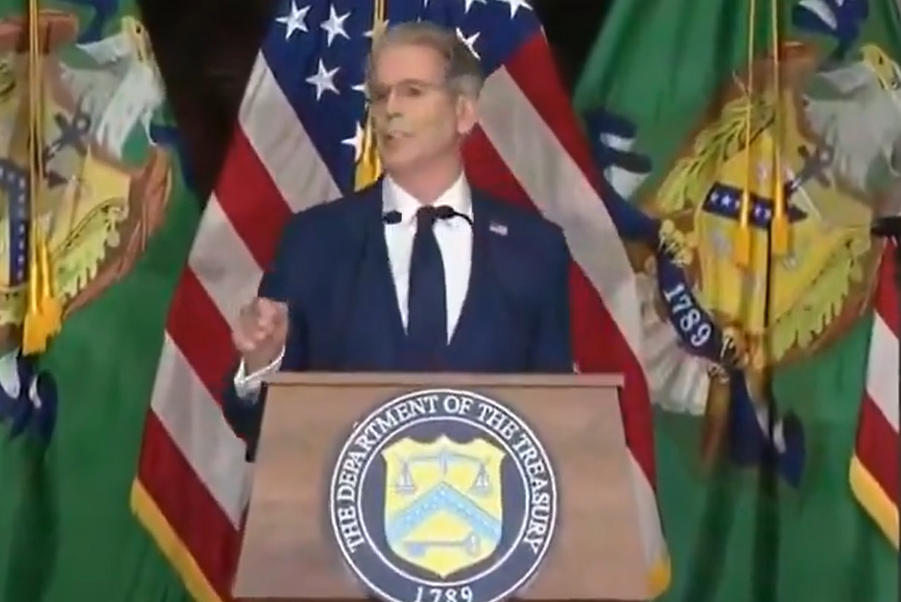
Bessen Threatened Iran on August 24 – Video Screenshot
tA regional source said, “The Iranians have been evading sanctions for almost half a century. No matter what they throw at them, they can basically withstand it.”
tSome experts point out that the effects of sanctions take time to manifest. However, a former senior official from the State Department said that the economic tensions such as long lines at gas stations and empty supermarkets in Iran are “more like things that have been happening all along, rather than new developments.”
tLast week, the US Treasury proposed to cut off the access of the UAE branch of Egypt’s second-largest bank, Banque Misr, to the US financial markets, and imposed sanctions on the general manager of the Dubai branch of Iran’s largest bank, Meli Bank. The sanctions on April 4 targeted Golden Global Bank and its subsidiaries.
tAmerican think tank Atlantic Council senior researcher Daniel Tanenbaum said: "The significance does not lie in the size of this bank, but rather in the fact that it shows that the United States is also willing to take action against other countries, including allies, especially on the eve of a potential Sino-U.S. summit meeting."
tExperts and diplomats who participated in CNN interviews agreed that there is doubt whether this government will take similar actions against China.
tTannbaum believes that if the Trump administration decides to target China, they will definitely be very cautious to prevent any accidents from happening.
tMeanwhile, Trump administration officials have repeatedly affirmed China's stance on the Iran issue. Bessenert said during an event held during the G20 Finance Ministers' Meeting this week: "We share more common ground with China on the Iran issue than we do differences."
tIn addition, there are suspicions that the United States may take significant actions against Pakistan or Oman. Both countries have trade relations with Iran and play a role in the diplomatic context surrounding this war.
tAnother local source said, “I think the Americans are trying to balance things out and be cautious. So they are targeting small banks first, in hopes of intimidating other banks, while also trying not to jeopardize any hopes of a peace agreement.”
tOn the 4th local time, Besent also claimed that the EU has officially joined Washington’s efforts to cut off Iran’s connection to the global financial system.
tEurope News Network says that the EU merely agreed with US stance and did not join in.
t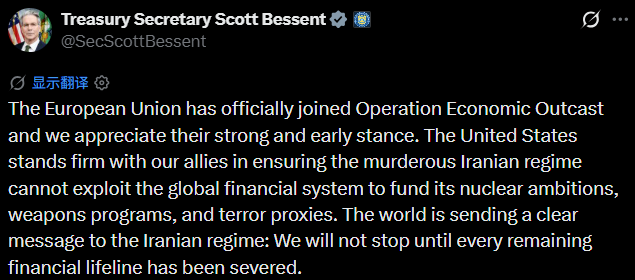
Besant claims that the EU has imposed sanctions on Iran.
tRecently, Song Wei, a researcher at the National Development and Strategy Institute of Renmin University of China and a professor at the School of International Relations, told Observer Network that the so-called economic sanctions imposed by the US against Iran are quite ineffective.
tFirstly, this measure cannot force Iran to make fundamental concessions or changes. In the absence of achieving the desired result of ‘changing the Iranian regime’, the meaning and necessity of such measures will only continue to decline.
tSecondly, for these measures to achieve their desired effects, there is a need for the cooperation of many other countries. However, at present, the relationship between the United States and its allies under Trump’s second term is very tense, and most of these allies do not support his actions towards Iran.
tTherefore, even if the US imposes so-called sanctions, their actual effectiveness will be greatly reduced.
tSong Wei also said that the Trump administration is relatively cautious in dealing with relations with China. Trump has repeatedly affirmed China’s stance on the Iran issue, and China has taken many risk-averse measures. At the same time, Trump needs to reach some cooperation with China in order to demonstrate his achievements as a politician and alleviate the pressure of the mid-term elections. Therefore, it is unlikely that the US will include large Chinese financial institutions in its sanctions list.