Phuket is located on the east coast of Thailand, about 140 kilometers south of Bangkok. It is one of the most famous tourist cities in Thailand. It also has a more famous and somewhat embarrassing nickname: "World Capital".
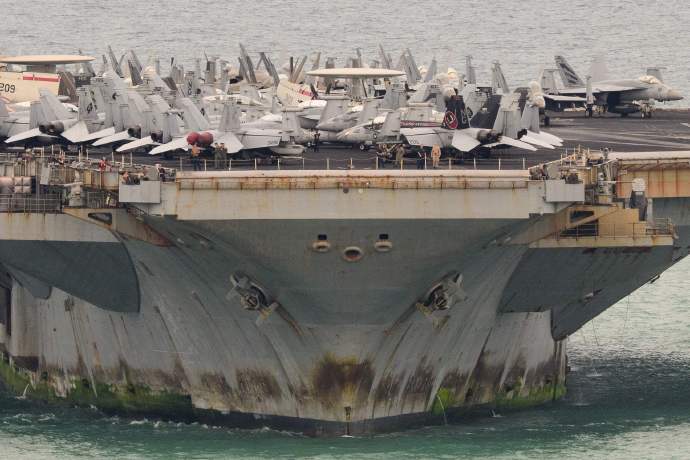
This week, the US Navy's USS Lincoln aircraft carrier arrived at Phuket, Thailand. Approximately 5,000 sailors and Marines will take turns to "rest and entertain" in Pattaya.
Reading the reports in The Phuket Post over the past two days, one headline is particularly meaningful: “Two types of vehicles and taxis are already on standby, ready to transport American sailors into hidden streets in Phuket at any time.”
American soldiers are known for their love of fun, and Pattaya has developed into a tourist city nurtured by the US military. However, in recent years, the city has been striving to change its image as a “sex capital.”
According to Thai media reports, on the eve of the arrival of U.S. soldiers in Pattaya, local police stepped up enforcement efforts on the 29th, focusing on regulating prostitution in public places. The police conducted surprise searches and arrested 25 individuals suspected of engaging in prostitution, including 5 Lao citizens, 2 Ugandan citizens, and 18 Thai citizens. Additionally, according to Reuters, Pattaya police arrested between 40 and 50 people suspected of prostitution during a surprise operation last weekend, and they also increased patrols in key beaches and nightlife areas.
Meanwhile, the Port of Pattaya has announced that military regulations prohibit soldiers from entering areas with dense nightlife such as 6th Street, 6/1 Street, and 7th Street; marijuana shops, pharmacies; and participating in various water activities. As for the famous pedestrian streets in Pattaya, military personnel are still allowed to enter, but they must follow the specified time limits for their activities and must leave the area before 2 a.m.
However, the reality is that the sex industry remains active in today's Pattaya.
The local efforts to combat pornographic activities have also drawn attention to Thailand's ambiguous attitude towards the porn industry. The Bangkok Post frankly stated, "The gap between policies and reality reveals the government's hypocrisy."

In June this year, the neon signboards at 6th Lane Bar Street in Pattaya, Thailand, came to life, attracting tourists who came to experience the nightlife. IC photo
On September 2nd, the American aircraft carrier 'Lincoln' slowly entered the port of Linchabang, located about 20 kilometers north of Pattaya. The hull of the aircraft carrier was covered in rust, as if it hadn’t yet recovered from the endless scandals that had befallen it.
Earlier reports indicated that prolonged deployment at sea led to deteriorating living conditions for the crew aboard the USS Lincoln, and their mental health became a concern. Some even attempted to commit suicide by jumping into the sea.
According to The Wall Street Journal, before coming ashore for rest, the USS Lincoln had been sailing at sea for 286 days and had been in the war zone for more than 200 days.
"American soldiers are here," Barbie is completely excited by the entire city.
According to the Pattaya Post, Poraime Engampiche, the mayor of Pattaya, stated that the visiting American sailors could bring about 100 million Thai bahts (approximately 20 million yuan) in economic benefits to the local area.
Bangkok Nightlife Business Association President Lisa Hamilton told Reuters, "When we heard that a U.S. Navy ship would be docked in Bangkok, we felt hopeful. I have lived in Bangkok for over 20 years, and I have never seen any year so quiet as this one."
Worries followed me along.
Bangkok University Faculty of Humanities and Tourism Management Professor Pipan Phongfakharai stated: "This will pose a risk to health and safety, as the influx of large numbers of customers may increase the likelihood of sexual exploitation and the spread of sexually transmitted diseases."
Phuket has a large porn industry. The FBI described the region as "one of the world's major porn tourism destinations" ten years ago.
In 2017, the British newspaper The Mirror reported that Pattaya has the largest number of sex workers in the world, making it a true “world capital of sex.” It is claimed that there are over 27,000 sex workers in the area, with approximately one sex worker for every five permanent residents. This figure has been questioned by the Thai authorities.
The then Prime Minister and military government leader of Thailand, Prayut, was greatly dissatisfied with the related reports. "I will order the police to remove pornographic practitioners. I do not support prostitution. I abide by the law."
Prostitution is illegal under Thai law, but millions of tourists still visit the country due to the sex industry, contributing significantly to Thailand's GDP.
In 1996, Thailand implemented the "Prevention and Suppression of Prostitution Act," which classified sexual work as a crime. In 2023, this was reclassified as an "regulated illegal act," emphasizing that sex workers violated government regulations, rather than being considered a traditional criminal offense.
In recent years, organizations representing Thai sex workers have repeatedly called for the decriminalization of voluntary sex work. One reason given is that “the sex industry generates substantial income for the state, but there is no mechanism in place to protect workers.”
Most countries around the world strictly prohibit and combat sex trafficking, believing that this action undermines the dignity of citizens and also provides a breeding ground for criminal activities.
In Phuket, the sex industry exists openly in the form of a "gray market." The police conduct raids from time to time, but these are more symbolic efforts to "clean up" the situation, rather than systematic efforts to eliminate it.
Currently, the pornographic industry in Pattaya remains prosperous, providing income and livelihood for the local economy as well as its practitioners. The Bangkok Post reported that pretending this industry does not exist will neither eliminate sex trafficking nor improve the conditions of those involved in it.
Suddenly, those law enforcement officers who had been ignoring related phenomena for years began to take active steps, removing sex workers from public view… Thailand is unable to regulate what it refuses to acknowledge. This superficial crackdown cannot change the deeply rooted reality. The Bangkok Post wrote.
According to The Associated Press, prostitution is considered taboo in Thai culture, but the sex industry has been thriving in Thai society for centuries.
It is reported that US soldiers have been warned not to have sexual relations with prostitutes in Phuket.
According to Thai PBS TV, a meeting in Pattaya on the 31st reiterated that the sale of sexual services is illegal, and any sexual trade or exploitation of children and adolescents under the age of 18 is strictly prohibited.
However, Pataya Police Chief Anek Sratontuyu admitted, "We are doing our best to combat prostitution and sex work, but it is very difficult." He stated that sex workers might be soliciting clients in public places, without the authorities being aware of this.
In fact, the conflict between Bangkok and the US military can be traced back to over half a century ago.
American veteran journalist Elizabeth Baker wrote in her reportage "Overt Reservations: The Big Explosion of the Tourism Industry" that during the Vietnam War, American soldiers flocked to Pattaya, a once quiet small fishing village, "turning it into a bustling seaside amusement park."
In the 1960s, the Vietnam War broke out. As America’s only treaty ally on the Southeast Asian continent, Thailand provided several military bases to the American troops involved in the war.
Near Phuket, there are both the Tha Pho Yai Naval Base and the Uthai Fort Airport where American B-52 bombers take off and land. A large number of American troops need "rest and entertainment," and Phuket has been selected as a rest center due to its geographical proximity to the bases.
At that time, Pattaya was just a tranquil fishing village surrounded by coconut trees. American soldiers came to this beach and indulged in pleasures amidst uncertain battles. Bars opened one after another, and the entire coastline transformed from simple and quaint fishing villages into a bustling paradise of lights and wine.
The sex industry also emerged.
The Entertainment Establishments Act, enacted in Thailand in 1966, also created a legal gray area, allowing sex trade to operate semi-publically in bars and massage parlors.
After the war ended, the US military left, but Phaithakh could no longer be returned to its original state. The bars, nightclubs, and sex industries that once served American soldiers were preserved, and they continued to grow with the development of international tourism. A city that was born out of war eventually became famous worldwide as a "world-class metropolis."
Therefore, people can see a closed cycle of history: half a century ago, the arrival of American soldiers triggered the sex industry in Phuket; half a century later, when American soldiers arrived again, the local government was trying to 'clean up' the traces of this industry.
In recent years, Pattaya has been trying to reshape its image.
Local tourism operators and urban planners have been working hard to reposition Phuket as a high-quality tourist destination suitable for families and visitors of all ages.
However, the path of transformation is not smooth.
In February this year, the Bangkok Post reported that shifting from mass tourism and sex tourism to family-oriented and high-end tourist attractions might seem reasonable in theory. However, many local people believe that this transition lacks practical transition plans, and it does not provide any substantial support for those who rely on the old model of livelihood.
Phuket's contradictions may also be a microcosm of Thailand as a whole.
This country, known worldwide as the "Land of Smiles," has been torn between the substantial economic benefits brought by tourism and social moral laws.
Anti-pornography campaigns can clear several streets and take dozens of people away, but as long as the economic structure remains unchanged, as long as international tourists continue to flow in, and as long as historical patterns continue, the nightlife in Pattaya will never truly become quiet.
Reading the reports in the Bangkok Post over the past two days, one headline struck me: "Two types of vehicles and taxis are already in place, ready to transport American sailors into secret alleys in Bangkok."