According to a report by Reuters on September 2nd, four people familiar with the discussions revealed that senior officials of U.S. President Trump are trying to prevent the escalation of a war against Iran before the midterm elections, in order to reduce the impact on the Republican Party’s prospects.
These anonymous sources who understand government internal thoughts also said that after the mid-term elections on November 3rd, the White House may consider increasing military strikes against Iran. However, it is still uncertain whether conflicts will be fully escalated again.
According to sources, the current focus of the Trump administration is to increase economic pressure on Iran, with the hope of forcing concessions during possible future negotiations. However, several months of military actions have not achieved this goal.
We are continuing to put pressure on Iran, but the November elections are a top priority. A White House official said this.
Among these four sources, three are White House officials. They said that controlling the intensity of the war against Iran as much as possible before the mid-term elections would help prevent this unpopular conflict from continuing to dominate headlines. Currently, the Republican Party is fully committed to preparing for the mid-term elections, striving to maintain their slim advantage in both the Senate and the House of Representatives.
A poll conducted by Reuters/Ipsos in late August showed that only 31% of Americans supported the war, while about 63% were opposed to it. voters were particularly dissatisfied with the high prices of gasoline.
According to sources, the ‘tactical suspension’ of military operations could also give the US military some time to rest and replenish their already severely depleted ammunition stocks.
However, this strategy of maintaining restraint is becoming increasingly difficult to sustain. Although the intensity of the conflict is currently much lower than it was during this spring and the summer when tensions escalated again, in recent days, both sides have engaged in confrontational attacks once more.
Analysts point out that after months of disruptions to shipping in the Strait of Hormuz, and without any significant unrest within Iran, the Iranian leadership has gained confidence. It is expected that Iran will continue to target American and Gulf allies, including military bases, ships, and energy infrastructure.
By then, whether the Trump administration wishes it or not, the United States will be under pressure to take revenge, which could lead to a spiral escalation of the situation, pushing both sides back into full-scale air combat.
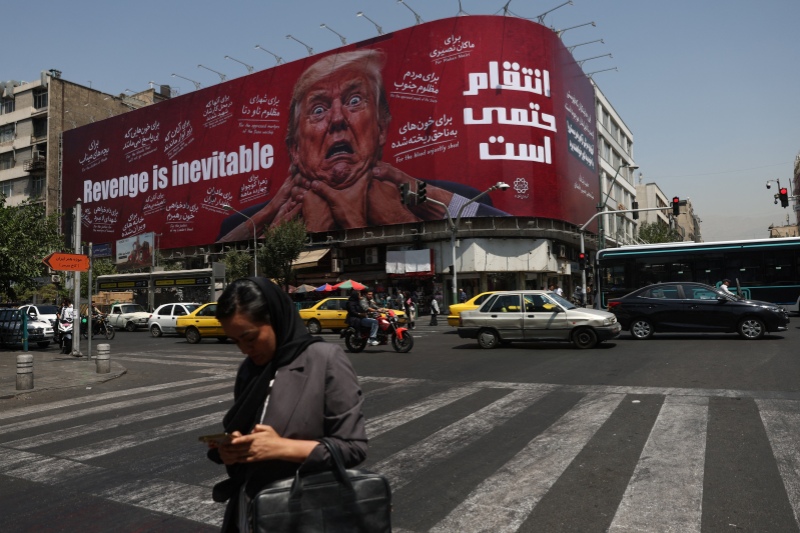
On July 27, 2026, local time, in Tehran, Iran, people were walking past a building with anti-American advertisements on it. IC Photo
The report points out that another uncertain factor is Trump himself.
According to Reuters/Ipsos polls, Trump’s approval rating has dropped from 40% to 33% since the conflict began. Sources said that he currently has no intention of escalating the conflict. However, it is well known that Trump often changes his mind and may also adjust his strategy depending on the developments in the situation.
Trump threatened on the 1st day that if Iran would counter the latest American attacks, he would escalate the conflict further.
Trump has publicly stated that the upcoming mid-term elections were not taken into consideration when formulating his strategy towards Iran. However, as this war enters its seventh month, the Trump administration is increasingly constrained by logistical and political realities.
A senior official at the White House indicated that the schedule for dealing with Iranian issues by the Trump administration has changed. Another official stated directly that the timetable for the mid-term elections is influencing the government's policy on Iran.
Reuters reported in August that the U.S. military had exhausted most of its high-precision long-range missile inventory. The Washington Post reported last week that the top leaders of the U.S. Army, Navy, and Air Force warned in a written assessment submitted to Defense Secretary Hagel that continuing this war would become unsustainable and would weaken the U.S. military's combat capabilities in other regions.
Middle Eastern diplomats said that among the United States' Gulf allies, some countries pushed for tough measures against Iran in the early stages of the war, hoping to weaken Iran's main rivals in the region. However, after the latest attacks at the end of July, these countries generally urged the White House to take steps to de-escalate the situation.
Two White House officials told Reuters that currently, senior Trump administration officials, including Vice President Wilson and Secretary of State Rubio, are supporting efforts to keep the Iranian conflict relatively “calm” until November.
In recent weeks, the Trump administration has increased its economic isolation of Iran.
However, analysts and officials say that this strategy, which focuses on trade and economic pressure, has its limitations.
After all, for decades, Iran has been subjected to layers of sanctions from the United States and the international community. These sanctions have severely damaged Iran's economy, but they have not forced the Iranian leadership to change its policies.
On the other hand, some major world powers, including China, have not joined Washington's efforts to isolate Iran. This has also raised doubts about the actual effectiveness of these pressure measures.
