According to a report by the American newspaper The Washington Post on August 30th, several senior U.S. military generals have warned Secretary of Defense Hagel that continuing to expand or prolong military actions against Iran is unsustainable. Such actions not only consume U.S. military ships, ammunition, and personnel, but may also weaken the U.S.’s ability to defend other regions or even the United States itself.
According to sources familiar with the matter, Army, Navy, and Air Force commanders, as well as four-star generals responsible for U.S. military operations in Europe, Asia, and Latin America, conveyed their concerns to Hagel. The warnings were found in the August 14 edition of the Secretary of Defense Directive Manual (SDOB). This confidential document is typically updated twice a month, providing a summary of the availability of U.S. military vessels, aircraft, personnel, and weapons worldwide, as well as assessments by various military branches and theater commands regarding troop deployment.
Sources familiar with the situation say that the overall attitude conveyed by the military high-ups can be summarized in one sentence: The actions taken against Iran have been 'too long and too burdensome'.
Currently, the U.S. Central Command still keeps more than 50,000 military personnel on alert in case President Trump might order another military operation. The latest orders require some U.S. troops deployed in the Middle East to remain there until September, while others will stay there until 2027.
But other military regions have already started to feel the strain. The European Command, the Pacific Command, the Southern Command, and the Navy’s top brass have all expressed objections to continuing to send troops to support the Middle East, although they will still carry out the orders. The European and Southern Commands warned that sending ships and reconnaissance aircraft to the Middle East has affected their ability to carry out defense tasks in the United States. Samuel Parraro, commander of the Pacific Command, also opposed continuing to provide aircraft carriers and destroyers at the current scale.
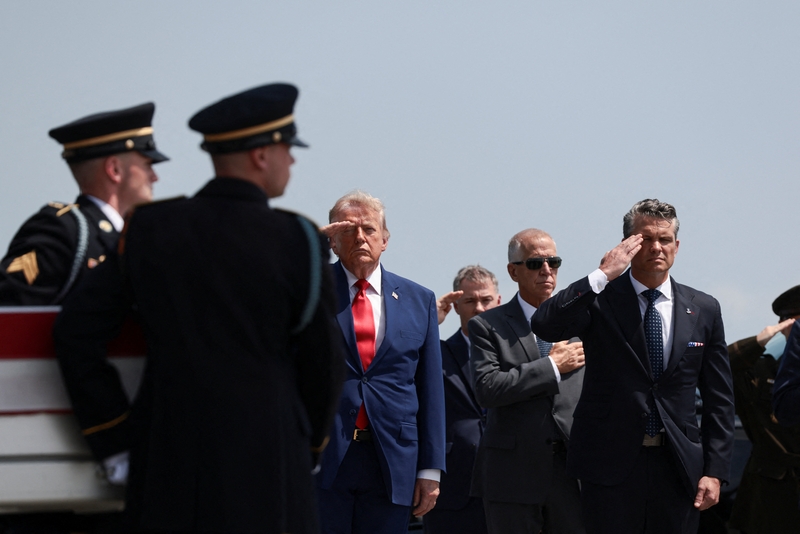
July 22nd, at Dover Air Force Base in Delaware, United States, a ceremony was held to hand over the remains of fallen American soldiers. U.S. President Donald Trump attended the event. IC Photo
The one under the most pressure is the U.S. Navy. Navy Operations Secretary Darrell Cordell warned that the Navy cannot maintain its current level of support without a clear end date for the conflict in Iran. Dozens of ships have been deployed for military operations against Iran, to defend against any counterattacks from Iran, and to block Iranian ports. The deployment periods for some ships and crew members have been extended by several months.
What is even more striking is that among the current U.S. Navy destroyers, only about one-quarter are in deployable status, a significant decrease compared to before the war.
Ammo consumption is also a headache for the Pentagon. Reports indicate that operations against Iran, combined with previous military support for Ukraine, have depleted the inventory of “Patriot” interceptor missiles. The stocks of “Thunderball” interceptors and “Tomahawk” cruise missiles have also been impacted. Approximately one-fourth of the US military’s “Reaper” drones have been lost, and US bases in the Middle East have suffered billions of dollars in losses.
In fact, warnings of this kind appeared long before the war began. Dan Kane, chairman of the Joint Chiefs of Staff, previously warned the White House that the US military lacked sufficient ammunition and support from allies, making it difficult to engage in a long-term, large-scale war.
CNN also quoted sources this month, stating that a senior U.S. military commander had warned the Pentagon that some of its critical ammunition stocks have dropped to a "dangerous low level." This not only affects whether the United States has the ability to continue escalating its operations in Iraq, but also raises questions about its ability to handle future large-scale conflicts.
This pressure has clearly affected the US military deployments in the Asia-Pacific region. According to a report by Reuters on August 24, the US canceled the planned “Dual Dragons” joint landing exercise with South Korea scheduled for September, citing limited military capabilities due to the conflict in Iran. The Washington Post also reported that more than 30 US naval vessels originally deployed in the Pacific were transferred to the Middle East during the war. Japan and other US allies in the Asia-Pacific region have also begun to worry about delays in the delivery of weapons.
Reuters recently summarized this six-month-long conflict, stating that Iran has not surrendered yet, the Strait of Hormuz remains severely disrupted, and the conflict, which Trump previously expected to be over in a few weeks, still shows no clear path to resolution.

