The US government has recently taken the initiative to act as an “investor”.
This change of identity is related to an agreement. On August 28, U.S. President Donald Trump announced that he had reached an agreement with Venezuela, gaining "most control" over more than 65 billion barrels of oil reserves that have been identified in Venezuela. The Venezuelan government subsequently issued a statement confirming the agreement.
Thus, the U.S. government is no longer just an intermediary for American companies’ investments in Venezuelan oil assets, but has become a direct investor.
According to a report by The Wall Street Journal on the 29th, the agreement will grant a 100-year oil field concession to a US-Chinese joint venture private company. The United States will obtain 55% of the “effective output” of this new joint venture, including equity and the right to purchase oil at cost price.
This private enterprise is managed by the controversial Venezuelan businessman Alejandro Betancourt. The company was granted permission to develop 17 oil fields in Venezuela. It is said that these oil fields contain 65 billion barrels of oil, which is one-fifth of Venezuela’s known oil reserves (303 billion barrels).
According to Schreiner Parker, a partner at the consulting firm Rystad Energy, if this agreement is recognized by successive Venezuelan governments, Trump will acquire strategic oil reserves that go beyond the scope of the shale revolution for the United States. However, there is still significant uncertainty regarding how these reserves can be converted into actual oil production. No one has yet answered the question of who will invest time, resources, and capital to complete this process.
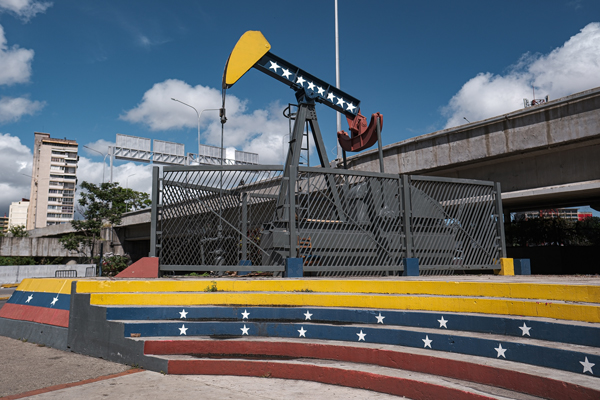
August 29, 2026, local time, Caracas, Venezuela. IC photo
According to reports, this agreement is the result of months of secret negotiations. American officials and negotiators visited Caracas, the capital of Venezuela, on multiple occasions. People familiar with the negotiations revealed that several days before the agreement was announced, Trump spoke by telephone with Venezuelan Vice-President Delcy Rodríguez to finalize the framework of the agreement. In the following days, American officials were busy settling the details for the implementation of this special agreement.
Although the agreement was reached through discussions between senior officials of both countries, the arrangement is structured such that the United States invests in a private company, rather than directly signing a reciprocal agreement with the Venezuelan government.
According to sources involved in the negotiations, the U.S. government plans to acquire a 35% non-controlling stake in North American Blue Energy Partners, a company owned by Betancourt. The U.S. also intends to obtain the priority right to purchase 20% of the company’s production at cost price.
The Pentagon’s Strategic Capital Office plans to complete this investment through low-priced warrants. The United States does not need to make significant actual contributions to obtain equity in this company. Under normal circumstances, the Pentagon can only carry out transactions that serve the interests of American national security through loans and guarantees.
According to reports, Betancourt has long acted as an intermediary in Venezuelan energy transactions and has a close relationship with Rodriguez. He was subject to criminal investigations related to money laundering in Spain and Switzerland, but was never prosecuted. His North American Blue Energy Partners company has become Venezuela's second-largest private oil producer, second only to Chevron. Chevron is the only major U.S.-owned oil company still operating in Venezuela, and it operates three projects jointly with Venezuela's National Oil Corporation.
U.S. Secretary of State Rubio called this agreement a “major victory,” as it ensures low-cost oil supplies for the Western Hemisphere and helps to lower oil prices in the United States. Rodriguez stated that the agreement will bring in over $100 billion in investment, generate more than $209 billion in tax revenue, create numerous job opportunities, and contribute to the reconstruction of Venezuela’s oil industry.
However, this agreement angered a large number of Venezuelans, and some senior oil industry executives as well as U.S. government officials were also confused about the terms of the agreement and its actual operating model.
Houston University's energy economist Ed Shields questioned: "Why does the United States need to subsidize and support a strong competitor in its own oil industry? Once Trump leaves office, all of this will come to nothing."
The industry has also issued warnings: In the future, the new government of Venezuela is likely to initiate legal proceedings against this agreement, thereby undermining the confidence of new investors.
According to the Venezuelan constitution, the state retains control over the petroleum industry and all shares of the Venezuelan National Petroleum Company (PDVSA).
The newly revised petroleum law of this country allows oilfield operations through joint ventures and production sharing arrangements, but long-term leasing of oilfields has not been approved.
Critics also pointed out that the acting president of Venezuela has no legal right to transfer the country's oil exploration rights.
In the eyes of former Venezuelan government officials, this cooperation is completely unconstitutional. The United States has only one goal: to seize Venezuelan oil. “This is outright plunder.”
Polls show that Venezuelans’ liking for Trump has decreased.
According to reports, sources involved in negotiations said that the United States is caught up in an unpopular and costly war, putting pressure on global energy supplies. In this context, the Trump administration urgently wants to announce that the United States has secured a long-term source of crude oil for the Western hemisphere.
As mid-term elections are approaching, Trump also hopes to use this deal with Venezuela as an opportunity to build political achievements, claiming that the United States can be spared from the energy costs caused by Middle Eastern turmoil.
However, oil analysts point out that Venezuela is not currently a major oil producer. Its daily production is only 1.1 million barrels, which is roughly equivalent to the output of North Dakota in the United States. It will take several years to restore production capacity, making it difficult to quickly fulfill Trump’s promise of lower oil prices.
According to people familiar with the negotiations, the US side chose Betancourt because they believe he is the ideal person to implement this project. His company already operates in Venezuela, and he has a close relationship with high-ranking Venezuelan officials.
The Trump administration pushed oil giants such as ExxonMobil and ConocoPhillips to return to Venezuelan oil fields, aiming to quickly resume oil production.
After months of slow progress in negotiations, most of the American oil industry remains cautious. Due to safety and legal risks, many companies are unwilling to invest money in Venezuelan oil infrastructure.
According to sources familiar with the matter, the negotiation was led by the U.S. State Department. In the later stages of the negotiations, the U.S. needed to find a feasible financial solution before introducing the Pentagon’s Strategic Capital Office. Ultimately, the Department of Defense will hold equity and procurement rights in this project under the U.S. government.
According to sources familiar with the matter, in July, David Lodge, director of the Pentagon's Strategic Capital Office, led a team of senior officials from the Pentagon and the State Department to Venezuela to finalize various terms of the agreement.
A person involved in the negotiations said that the agreement specifically uses a private enterprise structure, with the aim of binding Venezuela's future government, making it difficult to revoke the agreement. The US believes that it is unlikely that the new government will impose taxes on private enterprises.
