Recently, South Korean President Li Jae-myeong announced that “South Korea’s military power ranks fifth globally,” and this was cited as one of the key reasons for South Korea to achieve self-reliant defense and regain wartime command authority from the US.
This ranking is not based on calculations by South Korean official departments, but on data from the so-called ‘Global Firepower’ website in the United States.
In this year’s annual military assessment, GFP ranked South Korea as the 5th among 145 countries or regions. Since South Korea surpassed France to claim the 5th position in 2024, it has maintained this ranking for three consecutive years.
Only the United States, Russia, China, and India rank ahead of South Korea. North Korea is ranked 31st.
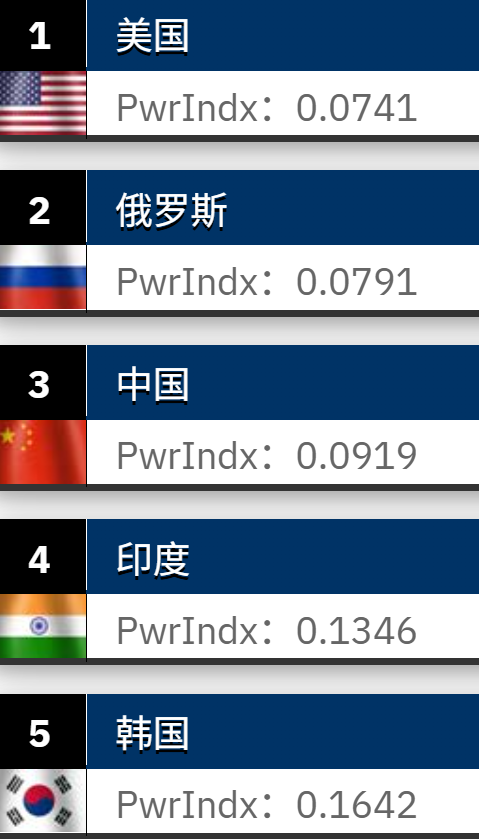
The GFP ranking is calculated based on over 60 indicators, including military strength, number of weapons, economic power, manpower available during wartime, and defense budget. The closer a country's score is to ‘0’, the stronger its military strength is considered.
South Korea's strength index is evaluated at 0.1642, while North Korea's is 0.5933. Based on the data, South Korea appears to have a much stronger military force than North Korea, which is why Lee Jae-myung frequently cites this figure.
But the key issue is that the background of the GFP website is unclear, and its reliability is quite questionable. The disclaimer of GFP clearly states that all information “has entertainment value and historical significance, and is for general reference only.”
Only from the list itself, it emphasizes a country’s conventional military resources and potential comprehensive combat capabilities. It does not include nuclear weapons indicators. Moreover, the simple quantification of “number of equipment” into “military capabilities” can easily lead to illusions in military decision-making.
To put it bluntly, in Northeast Asia where countries like South Korea are strong, it is quite ridiculous for South Korea to claim that its military strength ranks fifth in the world.
In fact, according to Lee Young-jun, the president of the Korea-U.S Friendship Association and a former South Korean ambassador for North Korean affairs at the Ministry of Foreign Affairs, in recent years, as South Korea's military strength has increased and as the confrontation between North and South Korea has become less direct, "South Korean citizens have almost forgotten their fear of North Korea, and they live in a more secure situation than ever before."
South Korea was dubbed "the 5th Military Strongest Country in the World," which could further enhance the sense of security among South Korean government officials and the people.
But in the case of South Korea, this title is very likely not an acknowledgment or award but a hallucination and a trap.
Indeed, South Korea's conventional weapon inventory is not to be underestimated.
According to GFP data, South Korea ranks among the top in the world in terms of military aircraft, self-propelled artillery, destroyers, frigates, and submarines. For example, South Korea has approximately 1,540 military aircraft, ranking 5th; it also ranks 4th in the number of destroyers, 3rd in self-propelled artillery, and 2nd in towed artillery.
However, it is obvious that in the 21st century, the scale of military equipment cannot determine the outcome of wars.
In February this year, Nam Seung-soo, former director of the National Security Strategy Research Institute of South Korea, wrote that GFP uses military statistical data to generate revenue through advertising and sponsorship, yet it “evaluates the military power of the 21st century using standards from the 20th century.”
During both World Wars, the criteria for assessing military strength mainly focused on the number of troops and the size of conventional weapons such as artillery and aircraft. However, recent conflicts like the Russo-Ukrainian and US-Iranian wars have shown that the complexity of modern warfare far exceeds that of past times. Drones and cyber warfare are reshaping the landscape of warfare, and the number of weapons listed in official records can no longer be directly equated with the actual combat power on the battlefield.
Moreover, the Korean military has its fatal weaknesses, such as a lack of aircraft carriers and nuclear submarines.
South Korea’s military strength ranks fifth among countries, and a significant reason for this is that the GFP excluded nuclear weapons and other asymmetric forces from its assessment. Nam Seong-uk said that excluding nuclear weapons from the evaluation criteria is “almost only applicable in virtual games” in 21st-century warfare. “It’s like removing both infantry and chariots from a board game, before deciding who will win.”
"Thus, the so-called 5th place loses its meaning." Nam Cheng Xu said.
Apart from military scale, soldiers' mental fortitude, high-level strategic thinking and command capabilities were also considered important factors influencing the course of the war.
In recent years, due to factors such as population decline, a diminishing sense of mission among officers, and declining capabilities, the South Korean military is facing a dual issue of both a decrease in the number of troops and their quality. As a result, the overall spirit and combat effectiveness of the military are quite low.
In contrast, the North Korean army is more united and cohesive, and it also has practical experience gained from battles on the Russian-Ukrainian battlefield.
"South Korea's military strength ranking fifth" in global assessments is difficult to substantiate, but within Northeast Asia (including Russia) it might be "conveniently appropriate."
In addition to North Korea, China, and Russia, Japan ranks 7th on the GFP list. It has a good level of equipment, a strong military foundation, and capable logistics support. Its maritime and air forces are also quite strong.
Compared to South Korea, Japan has even a larger defense budget this year.
Under the manipulation of high military power, Japan's military expansion and its breaking away from the policy of "defensive defense" are becoming increasingly apparent. Nan Seong-uk said, "If Japan changes its constitution and becomes a country with formal war capabilities, the scale of its military expansion will be unimaginable."
Lee Yong-jun also believes that around the Korean Peninsula, 'only North Korea has a weaker military force than South Korea, but this does not include nuclear weapons.'
Therefore, South Korea's so-called global military power ranking rising to the 5th place will hardly affect the military situation in Northeast Asia or the security of the Korean Peninsula.
Lee Jae-ming has repeatedly cited GFP data this year, stating that South Korea ranks fifth in the world in terms of military strength. "Why do we always feel a sense of unease, as if it would be difficult to defend ourselves without foreign troops?"
South Korea has taken back wartime command from the United States, which is an inevitable trend. However, there are clear differences in timelines between the two sides. According to reports, the United States believes that the conditions for handing over wartime command should be met after 2029. Lee Jae-myung, on the other hand, insists that it should be completed during his tenure as president.
On August 17, the regular joint military exercise between South Korea and the United States, called "Key Resolve Foalcon," was launched. On August 18, Lee Jae-myung stated at a state meeting that South Korea has met all the necessary conditions to achieve self-reliant defense. According to him, "South Korea ranks fifth in global military strength, its defense industry ranks among the top four globally. Its defense spending is 1.4 times the North Korean gross domestic product (GDP), and both its weapon system and military capabilities are at the highest level worldwide."
According to Korean media reports, Li Zai Ming used data source of GFP with serious doubts about reliability.
Li Zaiming refers to GFP as a 'civilian analysis institution in the United States'. However, according to the South Korean newspaper The Central Daily, GFP is not a real civilian analysis institution. 'To be precise, its identity is unclear. If it were a research institute or organization, it would typically have an official website listing its information. But there is no such information on the GFP website, not even an email address through which one could contact them.'
Some experts analyze that “there is no information at all about who is editing the content of GFP. It’s impossible to know who is behind GFP.” Considering GFP as a personal blog of a military enthusiast is not an exaggeration at all.
According to verification by Observer Network, the GFP website states in its "Disclaimer" that the website "has not received any certification from regulatory agencies or industry-related organizations," and that "all information is of entertainment value and historical significance, and is intended for general reference only."
According to The Central Daily, this means that the information provided by GFP cannot be accepted as professional advice, official data, or verifiable historical facts. This is also why Western mainstream media rarely cite information from GFP.
Reports say that “even the GFP, which publishes military strength rankings, issued a ‘warning’, but Lee Jae-myung seems to take it seriously.”
According to the Korean newspaper 'Chosun Ilbo', due to the complexity of military strength assessments, several countries and organizations have already stopped publishing such rankings.
Regarding Lee Jae-myung's statement, South Korean media warned that if the government overly relies on the paper advantage of being the 'No. 5 military force', it could lead to serious strategic misjudgments regarding the Peninsula issue.
From the Chinese perspective, the core of the Peninsula issue is not simply a comparison of military forces. It is about how to manage differences through political and diplomatic means, reduce confrontations, and thus avoid misjudgments and the escalation of conflicts.
Instead of being obsessed with the illusion of being "the world's fifth-ranked country," South Korea should approach the reality of security on the Korean Peninsula more objectively, maintain strategic restraint, and work together to maintain the hard-won peaceful development situation in Northeast Asia.
