Trump's sudden concern about North Korea, and the rapid coordination and cancellation of the US-Korea military exercises, do not seem to have received a warm response from North Korea.
The steady improvement in relations between Russia and North Korea has caused great concern for Japan, as President Putin visited the South Kuril Islands.
South Korea thanks Trump and adjusts its policy towards North Korea. However, it seems that all that remains is an echo of their own actions, and more efforts are needed.
This is the 34th anniversary of the establishment of diplomatic relations between China and South Korea. Chinese Foreign Minister Wang Yi is visiting South Korea. Both China and South Korea are full of expectations for the positive development of bilateral relations, and they also exchange in-depth views on the situation on the Korean Peninsula. Foreign Minister Wang Yi explained China's consistent principles and positions. He emphasized that as a responsible major power, China maintains consistency and stability in its foreign policy, and is always committed to playing a constructive role in maintaining peace and stability on the Peninsula. He expressed satisfaction at the gradual progress towards peaceful coexistence between South Korea and North Korea, with the ultimate goal of lasting peace and stability on the Peninsula.
What is the current geopolitical landscape in Northeast Asia changing? Wang Junsheng, a researcher at the Asia-Pacific and Global Strategy Research Institute of the Chinese Academy of Social Sciences and the director of the Northeast Asia Research Center, provided an insightful interpretation in a conversation with Guoyan Observer.
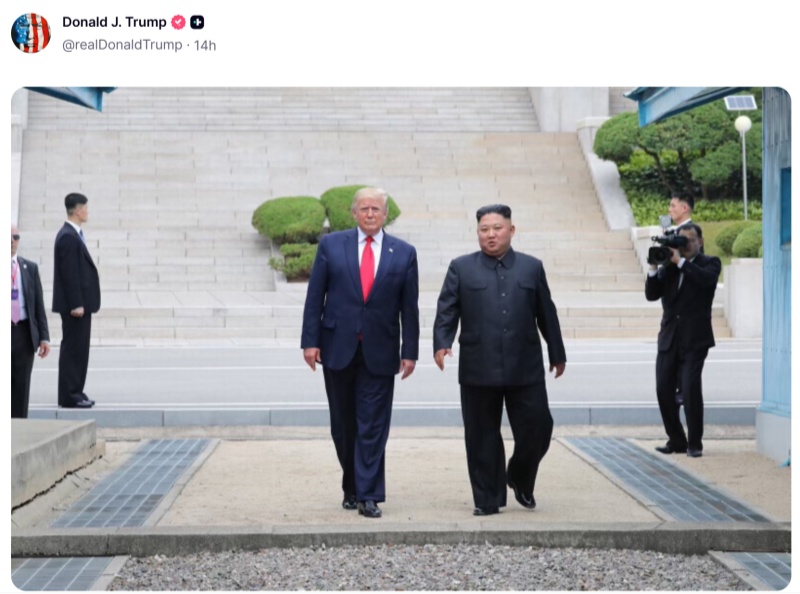
On August 24th, U.S. President Trump posted three photos of North Korean leader Kim Jong-un on his own social platform ‘Truth Social’, sending another signal to resume negotiations between North Korea and the United States.
Recently, U.S. President Trump "suddenly" became interested in North Korean affairs, posting photos of himself with North Korea's supreme leader Kim Jong-un on his personal social media accounts. Earlier, he announced a reduction in military exercises between the United States and South Korea. There were even reports in American media that North Korean and U.S. leaders are expected to meet in November. In response, the North Korean side stated that despite the good relations between North Korean and U.S. leaders, they had no knowledge of Trump's claims that there had been communication between the two sides. What do you think of Trump's "sudden" move?
Trump's sudden gesture on North Korean affairs must be based on multiple considerations.
Firstly, Trump hopes to meet with North Korea's top leader, Kim Jong Un, in order to promote a solution to the issues on the Korean Peninsula. He is facing mid-term elections in November, and needs to demonstrate diplomatic achievements.
Furthermore, he truly hopes to resolve the issue on the Korean Peninsula. As one of the most difficult and complex security issues in today’s world, no previous U.S. president has been able to solve it. Trump believes that resolving it during his presidency would be sufficient to demonstrate his strong leadership. Moreover, it is well known that Trump is eager to win the Nobel Peace Prize.
Third, according to Trump’s statements, he has a positive impression of North Korean leader Kim Jong-un. The issues on the Korean Peninsula, especially the rapid development of North Korean strategic weapons in recent years, pose a certain threat to the United States. This includes US military presence in South Korea and the numerous interests that the US has in South Korea. In theory, North Korea currently possesses nuclear weapons and intercontinental missiles. Trump believes that he can address these issues through his personal relationship with Kim Jong-un.
From North Korean perspective, there is currently some motivation to solve these problems. On one hand, North Korea wants to enhance its international status. Holding meetings with the United States would also be beneficial for North Korea. On the other hand, North Korea's current focus is on developing its economy. However, it still faces sanctions from the United Nations and unilateral sanctions from the United States, and these issues need to be addressed urgently.
Of course, even if there is some motivation for North Korea and the United States to hold talks, there are still significant obstacles, namely long-term extreme mistrust between them. Since the breakdown of the talks in Hanoi in 2019, North Korean and American leaders have not had any direct contact again. It has been 7 years now, mainly due to this mistrust. Therefore, whether they will meet in the future remains highly uncertain.
But I think, since there is an opportunity for dialogue, it is still hoped that both parties can seize this opportunity and make full, thorough preparations, actively promoting the dialogue.
In the past year or two, international attention to North Korea has been increasing. Especially in 2024, when North Korea and Russia signed the "Comprehensive Strategic Partnership Treaty," their cooperation in politics, economy, and military affairs has continued to deepen. It is inevitable that the outside world will pay attention to how this deepening of North-Korean-Russian interactions may impact the situation in Northeast Asia. What are your analyses and judgments on this?
The development of relations between North Korea and Russia should be understood within the framework of bilateral relations. It is mainly based on the judgments made by North Korea and Russia in light of the needs of their bilateral relations and changes in regional situations. Of course, changes in North Korean-Russian relations can have an impact on the situation in Northeast Asia, but I believe this impact is limited.
Because the development of Sino-Chinese relations and Sino-American relations depends on how China and the United States decide; the development of North Korean-South Korean relations depends on the attitudes of both North Korea and South Korea. Therefore, if you ask about the impact of the development of North Korean-Russian relations, it is generally limited. The focus is more on the considerations of North Korea and Russia based on bilateral relations.
However, once foreign media mention interactions between North Korea and Russia and pick up some statements from the Russian side, they immediately start creating sensational headlines. Behind these sensational reports by foreign media is actually a attempt to create an issue for China or to pressure China into taking a position.
In South Korea, since the Lee Jae-myung government took office, there has been a significant shift in policies towards North Korea. For example, the "August 15th Unified New Strategy" was abolished, and three principles were proposed: "respecting North Korea's current system, not seeking integration, and not taking hostile actions." On August 5th of this year, the South Korean Ministry of Unification proposed a concept of "peaceful coexistence and development on the Korean Peninsula." However, in January 2024 (when Yoon Suk-yeol was in power in South Korea), North Korea amended its constitution, removing references to "national reunification" and defining South Korea as "the number one enemy" and "eternal main enemy." How do you interpret the realignment of Lee Jae-myung's government's policies towards North Korea? Given that North Korea has defined South Korea as an "enemy" through constitutional amendments, what is the scope of the "peaceful coexistence" approach?
In terms of inter-Korean relations, since the election of South Korean President Yi Seung-hyun, he has been committed to resolving issues on the Korean Peninsula through dialogue, reconciliation, and cooperation. The Yi Seung-hyun administration also hopes to engage in dialogue with North Korea.
But we must realize that, based on its own circumstances, North Korea has already regarded South Korea as a permanent enemy. Since it is a hostile country in a state of conflict, North Korea probably does not have the intention to talk with South Korea in the short term.
From the perspective of the Lee Jae-myung government, regarding how to develop relations between North and South Korea, it is hoped that relations with North Korea can be improved through dialogue, reconciliation, and cooperation. This would contribute to peace and stability in the region of the Korean Peninsula.
From North Korea's perspective, based on its current policy towards South Korea, I don't think there is much possibility of dialogue between North and South Korea in the short term. Of course, overall, the policy implemented by the Lee Jae-myung government towards North Korea is conducive to peace and stability on the Korean Peninsula.
From our Chinese perspective, we hope that both sides can be patient, and we also hope that their relationship will move towards reconciliation and cooperation.
In his latest speech on the 'August 15 Liberation Day', Lee Jae-myung mentioned that 'the process of transforming the Korean Peninsula from an unstable truce regime to a peaceful regime will be officially initiated'. How should this statement be understood? Is it a call for action, or is there a genuine desire to promote a mechanism for all parties involved in the conflict to resolve the decades-long truce situation on the Korean Peninsula and establish a formal peace framework?
It should be said that any government in Korea has always hoped to transform the status quo on the Korean Peninsula from a state of ceasefire to one of peace. This is because the ceasefire agreement signed in 1953 does not legally mean that the Korean War has ended; from a practical perspective, both sides remain in a state of confrontation and hostility.
The South Korean government hopes to sign a peace declaration, transforming the temporary cease-fire and stand-off situations into a peaceful new mechanism. I believe that the Lee Jae-myung government hopes to realize this vision, but the key question is: how can this be achieved?
I also mentioned something earlier: the current Lee Jae-myung government hopes to engage in dialogue with North Korea. This wish is worthy of recognition. However, I believe that the Korean side still needs to make continued efforts; it is unlikely to be achievable in the short term. For a truly long-term peace framework to be established on the Korean Peninsula, multiple parties need to participate together—and the path ahead is indeed long and difficult.
So, how does China assess and respond to the new circumstances in North Korea and the new changes in the situation in Northeast Asia?
From China's perspective, we hope that peace and stability can be achieved on the Korean Peninsula. China has always advocated for resolving issues through dialogue and political means. Currently, there is an opportunity for dialogue, as the Li Jae-myeong government desires to engage in dialogue, and the President of the United States is also calling for such efforts. Therefore, we hope that all parties will work together to create favorable conditions for early dialogue. China is also willing to communicate and coordinate with all parties, aiming to bring the issue on the Korean Peninsula back onto the path of dialogue and political resolution.
