In 2014, the Indian government introduced the ambitious ‘Made in India’ initiative and its logo, which features a lion made up of gears symbolizing industrialization. The Modi government chose the Asian lion from Gujarat as the emblem, aiming to imply that Modi, as the ‘Gulfistan Lion’, would lead India towards innovation.
Unlike the international community which often compares India to an elephant, various animal symbols in India play a key role in politics. They reflect both the expectations of Indians for their country and the dynamics among different political forces within Indian politics.
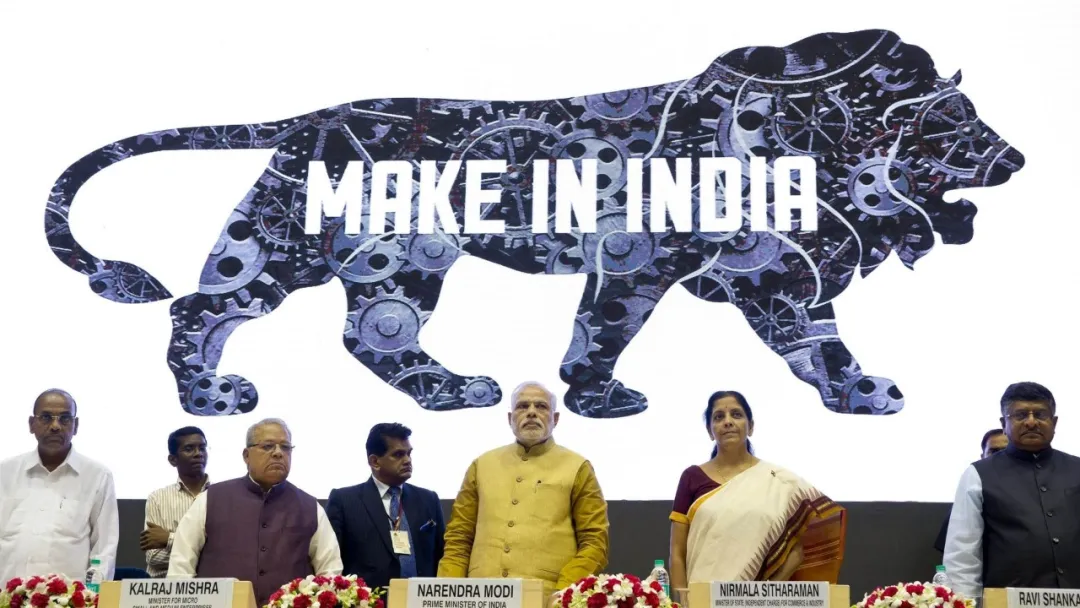
In 2014, the Indian government launched an ambitious “Made in India” initiative and its promotional logo, the “Wheel Lion”.
The ancient inhabitants of the Indian subcontinent had traditions of worshiping snakes, especially the large and venomous Python. In some rural areas, skills in catching and treating snake bites were passed down from generation to generation by certain low-caste groups. This may be an inheritance of snake worship that existed before the rise of Indian Aryan culture. Later, Buddhists translated the snake "Naga," which was deified by the ancient Indians, as "dragon" in their translations of Buddhist scriptures.
Around 1500 BC, people who claimed to be "Aryans" (noble people) and were skilled in combat using horse-drawn chariots, as well as in worshiping Vedic deities like Indra, entered the Indian subcontinent. They rode fast chariots, shot arrows at enemies, and this practice became the standard of warfare for kings for thousands of years. The custom of referring to rulers as "kingly" also originated from this time.
In addition, the ancient Indians shared a political culture where lions symbolized royal authority with the Persians and the Mesopotamians. Today, the national emblem of the Republic of India uses a stone column decoration left by Ashoka of the Maurya dynasty. The base of the column is engraved with wheels symbolizing royal order, while above them are four lions facing different directions. After the rise of Buddhism, the “wheel of kings” that symbolizes secular political authority was brought into the sacred space of monks. Thus, the “wheel” became a symbol of eternity and the center of faith—the “Wheel of Dharma.”
Both Buddhists and Hindus have passed down for generations the legends of various gods and deities who subjugated dragons and dragon women. These legends preserve, in a fictional and artistic way, the historical memories of ancient Indian political and cultural transformations—Aryan nations, with chariots as their core military force, conquered various regions, and various religious sects, protected by the state, educated the barbarians. Thus, the worship of dragons and snakes among the Indian ancestors was gradually incorporated into Indian Aryan culture—in Hindu mythology, cobras are either wrapped around Shiva's neck or transformed into snake beds for Vishnu to rest upon.
However, in the northern and northeastern mountainous regions of the subcontinent, where the influence of Aryan culture is weak and where it is also influenced by Eastern cultures, the worship of dragons has continued to this day. For example, the Bhutanese flag features a white four-clawed dragon; while the “Konracha” lion with a dragon head on the coat of arms of Manipur in northeastern India is a product of the fusion of Aryan and non-Aryan political cultures in this borderland civilization.
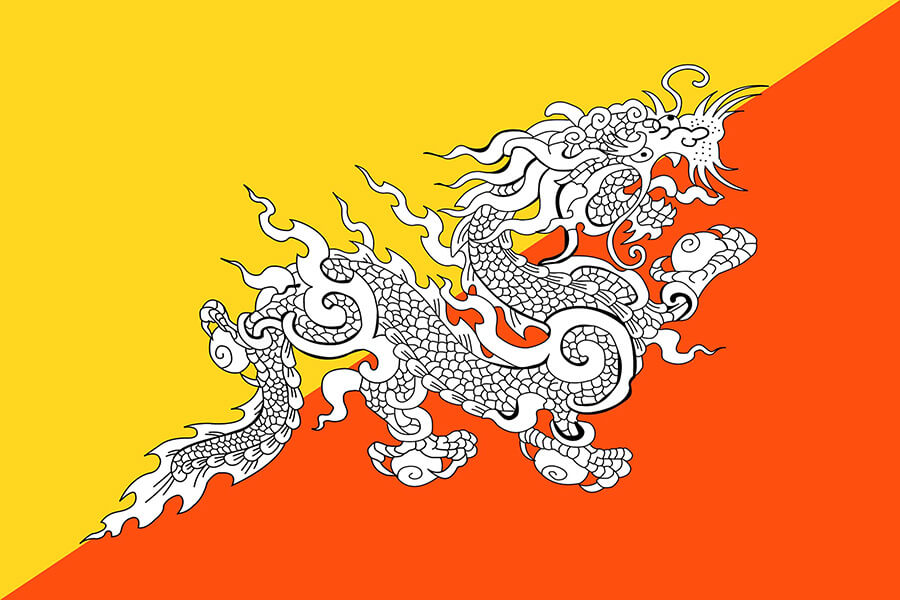
The Bhutanese flag features a white four-clawed dragon.
India is currently the only country where both lions and tigers, two species of large feline animals, have wild populations. Lions mainly live in dry, sparse forests, while tigers inhabit denser jungles. Historically, Asian lions once reached the plains downstream of the Ganges River, and the memory of tigers in India mainly comes from the larger Bengal tigers that are widely distributed in Indian jungles.
Asian lions and Bengal tigers share many similarities—both are strong and adept at hunting, and both have brownish-yellow fur that is considered a symbol of nobility and authority. As the Indians continuously converted savannas and jungles into farmland and pastures, conflicts between these lion-tiger hybrids, who possess both territorial instincts and hunting abilities, and humans became inevitable. The hunting of lions and tigers also became a means for Indian rulers to demonstrate their power.
Similar cultural ecologies blurred the boundaries between two types of large cats in Indian culture, leading to a long-standing phenomenon of confusion between lions and tigers in Indian history. For example, the Sanskrit word 'Shaldura' can refer to either a lion or a tiger; the mount of the Hindu goddess Durga can be either a lion or a tiger. Even the Persian word 'Sher', which refers to a lion, has been used in Hindi to also refer to a tiger.
While hunting lions and tigresses, Indians also regarded themselves as tigresses or addressed others with tigress titles.
In Indian history, there have been countless kings and nobles who used names such as Sher (lion-tiger), Singh or Sinha (lion), and Bakiel (tiger). After the rise of modern political parties, similar titles and symbols were also used in the propaganda efforts of various parties. During India's struggle for national independence, leaders of the Congress Party from the Punjab region, such as Lal Rajput Rai, were honored as "Punjab Lions"; the All India Progressive Group, established by Subaas Chandra Bose from Bengal, and the Shiv Sena, which emerged in Maharashtra, all used the tiger symbol on their party flags and emblems.
In India, lions and tigers have always been considered symbols of imperial authority. Today, they remain the favorite animal symbols among Indian politicians who wish to demonstrate their power.
Organized hunting of lions and tigers is inseparable from another animal closely related to royal power—the elephant.
The Indian subcontinent was the first place where elephants were domesticated on a large scale and used in military operations. In ancient times, elephant herders would capture adult elephants and tame them in national reserves known as “elephant forests”. War elephants lacked the agility of cavalry, and their logistics required considerable effort. However, war elephants did not need to be transported from distant places, and they had better mobility in rainy seasons and mountainous forest areas compared to cavalry.
War elephants were a crucial tactic used by the rulers of the subcontinent to counter the cavalry of Central Asia and Western Asia, especially to intimidate those prairie horses that had never seen such massive beasts. During the Mughal Empire, the responsibility of providing cavalry and infantry was assigned to military noble families. However, the war elephant forces were always directly managed by the royal family, making them the true mainstay of the central army.
At the other end of the world, whenever Europeans think of the East, one of the first animals that come to mind is also an elephant. The coat of arms of the School of Oriental and African Studies at the University of London, established in 1916, features an Arab camel and an Asian elephant as its protective beasts.
However, limited by their knowledge level, European colonial scholars generally divided the Asian region east of the Middle East into two main parts: China and India. Unlike the concept of “China” defined by political boundaries, the boundaries of “India” defined by cultural elements were more flexible among European orientalists. From the “Indian Ocean” stretching south to the east coast of South Africa, to the “East Indies” extending east to the South China Sea, colonial knowledge expanded the spatial scope of the concept of India. Consequently, traditions of elephant breeding and use in countries like Sri Lanka and Thailand also influenced Western imaginations of Indian culture.
Today, SOAS, which has experienced post-colonial academic influences, no longer uses emblems that use animals as metaphors for Sub-Saharan Africa, as these emblems may imply a negative view of other cultures. However, in the financial sector, which is rarely influenced by critical theories, publications like the British magazine The Economist and its global readers still often associate India with elephants, symbolized by massive but slow-moving elephants.
On the eve of India's independence, the local elephant culture and the European imagination about elephants in India intertwined. In 1946, when the Constituent Assembly was formed in India, an elephant was prominently depicted on its official coat of arms. The Indian Constitution established the Ashoka pillar with the lion as its emblem for the Republic of India. Nevertheless, the elephant's more steady gait compared to lions and tigers, its long-term coexistence with humans, and its close connection to Buddhism made it a favorite among politicians who hoped that India would inherit ancient civilization while also developing its own unique path of development. For example, A.P. Chandrasekharan, a Dalit leader who strongly advocated for caste equality and the chairman of the drafting committee of the Indian Constitution, regarded the elephant as a symbol of strength and wisdom.
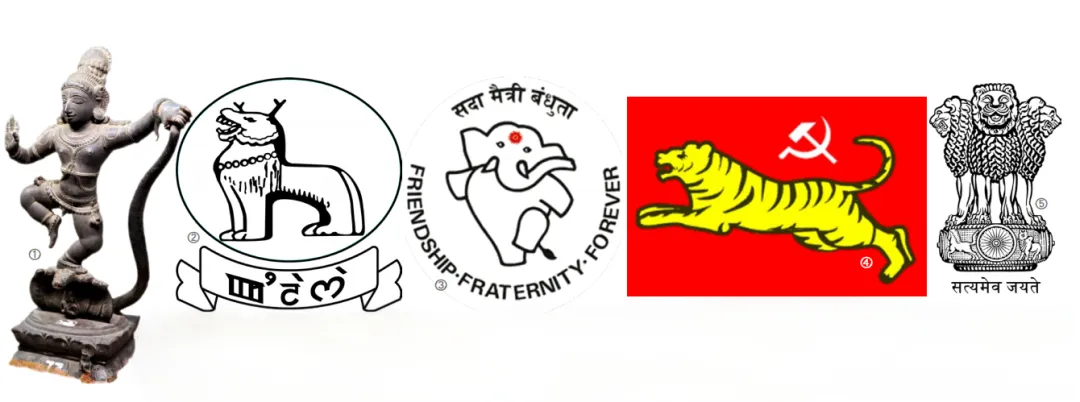
From left to right: ① Statue of Vishnu, one of the three main deities in Hinduism, depicted as Lord Shiva subduing the serpent king Garuda; ② The crest of Manipur State in northeastern India, featuring a lion body with a dragon head pattern; ③ In 1982, the official mascot for India’s ninth Asian Games, “Abu”, a lively white elephant; ④ A symbolic emblem of the All India Progressive Party, a left-wing political party in India, featuring a “leaping tiger”; ⑤ The current coat of arms of the Republic of India, featuring a four-headed Asian lion with different orientations.
In 1950, the Republic of India adopted its first constitution. Subsequently, the first animal officially recognized by the Indian government was the peafowl, which was designated as the national bird of India in 1963. The peafowl is a symbol of the Peacock Dynasty, and the Mughal throne was also referred to as the “Peacock Throne” due to its exquisite peacock decorations. The National Party, who held power at that time, projected a political vision based on these ancient empires: the prosperity and development of Indian civilization had always depended on a centralized state that embraced diverse cultures.
In 1972, the Bengal tiger became the officially recognized national beast, replacing the Asian lion used in the national emblem. A common explanation is that the government chose the Bengal tiger because tigers are much more common in India than lions. However, we cannot ignore the advantages that the political environment of the 1970s gave to the Bengal tiger.
In 1947, British India divided Bengal into two provinces during the partition. West Bengal became the western Bengal province of India, while East Bengal became the East Pakistan. In 1971, following the third Indo-Pakistani War, East Pakistan was declared an independent nation as Bangladesh. Therefore, in 1972, the Bengal tiger, symbolizing martial spirit and royal dignity, was placed on the throne and served as a national emblem. This decision also alluded to Indira Gandhi's strong leadership akin to the mighty "iron lady" who rode the lion's back, thus paying tribute to her unparalleled feats in leading the nation.
At the same time, for many Indian people, while elephants symbolize India's rich cultural heritage, their slow pace also inevitably reminds them of India's relatively sluggish development pace.
In 1982, India hosted the 9th Asian Games, and the lively white elephant “Abu” became the official mascot. At that time, Indira Gandhi’s government began to loosen various regulations in order to stimulate economic vitality. However, as India’s economic development fell behind the “Four Little Tigers” and mainland China over the following decades, the Indian people became increasingly dissatisfied with the state of the country controlled by old-fashioned politicians and family forces. The swift and responsive lion-tiger mascot became increasingly a symbol of their hopes for change.
In 1991, India launched large-scale economic liberalization reforms, and the political landscape in India also shifted towards a two-party system where the Congress Party and the Bharatiya Janata Party alternate in power. In 2004, Manmohan Singh, a technocrat with the surname “Lion”, became Prime Minister. As Finance Minister, Singh led the economic reforms in 1991. Young people hoped that under his leadership, India’s economy would continue to grow at a high pace. Over the following years, India’s gross domestic product (GDP) growth rate remained around 8%. Although it was still behind the economies of East Asia, it had improved significantly compared to India’s previous record of about 4% “Hindu Growth Rate”.
In 2008 and 2010, India hosted the Commonwealth Youth Games and the Commonwealth Games, respectively. At these two sports events that showcased India's rapid development, the Congress Party chose the Bengal tiger as its mascot. The mascot in 2008 was a lively cub of the tiger, while in 2010 it was "Sheer", the brother of "Jigger". Compared to the peacock and the Bengal tiger, the official recognition of the elephant came much later—it wasn't until 2010 that the Indian government announced the elephant as a national heritage animal.
Based on the above, it is not difficult to understand why the Modi government chose the 'Gear Lion' as its logo when promoting 'Made in India'.
In just the blink of an eye, the “Made in India” initiative has been in place for 12 years. On one hand, by 2025, the contribution of manufacturing to India’s GDP was even slightly lower than the target set when the initiative was introduced, at 15%. The goal of achieving 25% by 2025 is still far from being achieved. On the other hand, refined oils, electronic devices, and pharmaceuticals have become the main sectors for India's commodity exports.
In recent years, after experiencing significant policy changes, Indian policymakers have once again realized that to fully unleash the potential of the 'Gear Lion', it is still necessary to properly manage their relationship with the 'Eastern Dragon' that has lasted for thousands of years.
(This article was published in the 15th issue of “World Knowledge” in 2026. It is the research outcome of the “Endangered Disciplines” Support Program of the Chinese Academy of Historical Studies, under the project “Research on Ancient Indian Civilization at Peking University”, with the project number: 26JX006. The author is a researcher at the Center for Oriental Literature Studies and the School of Foreign Languages at Peking University.)

