Australia has enormous reserves of lithium. However, for many years, Australian mining companies have essentially been engaged in the process of "digging up stones, loading them onto ships, and transporting them away." They ship spodumene to China by ship, then watch others process it into high-value battery materials. The Australian government is not willing to let this situation continue. It has introduced successive industrial strategies at both federal and state levels, vowing to keep profits within the country.
For Chinese enterprises, the implementation of these policies comes with increased costs, stricter scrutiny, restrictions on equity, and even forced dismissals. Even so, Chinese enterprises still do not comply. The reason is not complicated: the resources are right here, and the supply chain cannot be disrupted.
When Chinese enterprises make overseas investments, they definitely feel a difference in treatment. Jing Yanqing, the head of the strategic marketing department for new energy power battery materials at Gepai Nickel Cobalt, told Observer Network that Chinese companies are also thinking about how to avoid situations where "investing well only results in getting people fired and losing money." By choosing to stay, the real competition begins.
In July of this year, the Australian lithium mining company Liontown stated in its quarterly operating report: "The wave of artificial intelligence infrastructure construction, coupled with concerns about global energy security, is driving a long-term expansion of the global production capacity for lithium batteries."

Liontown Official Website
American lithium industry giant Albemarle shares the same view. In May, the company stated to investors: "As the proportion of energy storage markets continues to increase, lithium demand is diversifying in terms of application scenarios and geographical distribution. Driven by rising electricity demand, the need for grid stability, and energy security, the demand for global energy storage systems (ESS) continues to grow rapidly."
Over a long period of development, Australian lithium mining companies have always been engaged in the extraction of lithium spate and its transportation overseas, mainly to China. In recent years, the price of lithium spate has dropped significantly. Between 2022 and 2025, at least three Australian lithium mines were forced to shut down for maintenance. Although the price of lithium has rebounded now, they feel that this cannot continue any longer.
Some lithium mining companies in Western Australia have begun to carry out more advanced processing procedures locally, converting spodumene into finished battery-grade materials. These products have a new market that is independent of spodumene.
Australia's state and federal governments' 'Critical Minerals Strategy' have made promoting domestic mineral processing a core goal, attempting to develop processing capabilities outside of China.
In 2019, the government of Western Australia released the “Future Battery Industry Strategy”. Bill Johnston, the then Minister for Mines, Petroleum and Energy of Western Australia, stated that the strategy aims to leverage the advantages of the region’s established mining industry to become a key participant in the global battery value chain. The document clearly outlines the goal of expanding the scale of the entire battery industry chain in Western Australia, including processing, manufacturing, and supporting services.
The Western Australian government also recognizes that advanced processing industries require substantial investment. Therefore, it has released an updated version of the “2024–2030 Battery and Critical Minerals Strategy”. The document states: “In the coming years, the production and processing of battery minerals are expected to continue driving investment in the critical minerals sector in this state.”
In 2024, the Australian federal government introduced the National Battery Strategy. At that time, Industry and Science Minister Ed Husic stated that the energy transition, combined with the popularization of electric vehicles and home energy storage in Australian households, presents a once-in-a-lifetime opportunity for the development of the local battery industry.
The Australian government's series of measures have also affected Chinese enterprises that invest in Australia.
In 2023, the Australian government prevented a Chinese-funded fund from increasing its stake in Northern Minerals, an Australian rare earth company. In 2024, the Australian government ordered Chinese investors to sell their shares. In 2025, due to some investors ignoring the order, a federal court lawsuit was filed. In 2026, the Australian government directly deprived three Chinese investors of their voting rights and other shareholder rights in Northern Minerals, retaining only the right to sell their shares.
Except for the most important rare-earth elements, lithium is also on the "critical minerals list" of Australia.
In 2023, Australia prohibited its subsidiary company, Austroid, which is headquartered in the United States, from acquiring Alita Resources, an Australian lithium mining company that was facing financial difficulties. Although the Australian government did not provide specific reasons, Reuters reported that the managers of Austroid were “Chinese with experience in the Chinese mining industry.”
Jing Yanqing told the Observer Network that Chinese investments in minerals in Australia pose challenges such as investment regulations, regulatory processes, or communication with local indigenous communities. However, the most fundamental, long-term, and unavoidable challenges are two underlying issues: strict foreign mineral investment regulations and the mandatory requirement for full-cycle localization and value addition of resource projects. Geopolitical fluctuations are also continuously exacerbating these contradictions.
Firstly, multi-level foreign investment review processes will persist throughout the entire project cycle, with the review thresholds continuously tightening. "In recent years, Australia has implemented special reviews for critical minerals, distinguishing between Chinese state-owned capital and private Chinese investments. Even for private investments, large-scale mineral investment underwriting agreements require mandatory reporting. The review aspects include control over the industrial chain, mineral export destinations, technological spillover effects, and the proportion of local employment. The approval process can take up to 6 to 12 months, with various conditions and possibilities, such as requiring a reduction in equity stakes," said Jing Yanqing.
Additionally, there is the need to add the local state government's approval process for minerals. "Environmental support for local businesses in Western Australia, and land approval for indigenous people are separate from the Australian Federal Government's processes. This double review process prolongs the implementation timeline, and any issues at any stage can cause the project to be delayed," said Jing Yanqing.
Secondly, the rigid requirements for full-chain localization and value addition mean that companies cannot simply export raw materials without further processing. Jing Yanqing stated that Australia’s current mining policies require foreign enterprises to invest in local processing infrastructure and energy facilities, thereby creating value within the local industry chain. The model of directly transporting lithium spate back to China for refining is becoming increasingly restricted. “Our strategy is first to simplify cooperation models. Instead of blindly acquiring mines outright, we prioritize strategic partnerships, making phased investments and offering financing options to reduce equity sensitivity. Secondly, we actively promote localization commitments, including local employment, support for clean energy, and investment in downstream processing. Thirdly, we work with local professional teams, hire local mining law firms and professional consultants to avoid potential regulatory issues in advance. At the same time, we adopt a diversified approach, investing in countries like Brazil, Nigeria, and Madagascar, to mitigate potential geopolitical risks.”
Australia has strict reviews, but this year, Geipai still signed a strategic cooperation agreement with the Australian mining company Scorpion Minerals, entering into lithium mining projects.
So difficult, why should we still keep submitting?
Jing Yanqing said that Chinese companies definitely feel discrimination when making overseas investments. 'How can we avoid situations where 'investments are made, people are dismissed, and money is taken away'? As China's global influence grows, it is still important to influence the perceptions of Chinese companies in various countries through cooperation and win-win outcomes. While acquiring resources, we should also benefit local communities and improve the situation on the ground. The state's investment in infrastructure in Africa, the Middle East, and other regions is also a means of providing preliminary support for Chinese enterprises operating overseas. I believe that the future will be better, and there will be no polarization or dominance by a single company. The global culture, which has been dominant for a long time, dominated by European and American cultures, will take time to be broken. Both the state and enterprises must do their part.'
Jing Yanqing explained that the distribution of different resources varies significantly from country to country. This is an inherent characteristic of these resources, and “this is the first factor we need to consider.” Overseas mineral investments come with political risks, not only in Australia but also in South America and Africa. In many countries, there is a growing desire for resource localization. For example, Indonesia cannot export laterite nickel on a quota basis; it must build smelters locally. Zimbabwe has also introduced new policies regarding lithium mines, requiring that lithium be smelted locally before being exported starting from 2027.
"Africa has unstable political situations, which increases the risk factor. However, it is rich in resources and offers a good value for money. Therefore, we will establish our operations in Africa. Relatively speaking, Australia is a more mature country in terms of mineral resources. Each country has its own advantages and disadvantages. We do not make very targeted distinctions between different countries; instead, we judge based on the project itself and the amount of resources available. We analyze each situation individually," said Jing Yanqing.
Unlike the scrutiny environment that is "completely tightened" for rare earths, the situation with lithium mines is more complex.
In August 2025, China's battery material supplier Suzhou Tianhua New Energy obtained official approval from the Australian government to acquire a stake of nearly 2% in the Australian lithium mining company Liontown. The acquisition is valued at approximately 50 million Australian dollars.
According to Australian media reports, during the first term of the Albornes government, investments by Chinese companies in key Australian minerals projects were under an informal ban. Australia's 'Key Minerals Strategy' emphasizes attracting investment from "like-minded partners" in order to establish a diversified and secure supply chain for key minerals. At that time, analysts believed that the approval of Chinese companies' shareholding marked a shift in this policy.
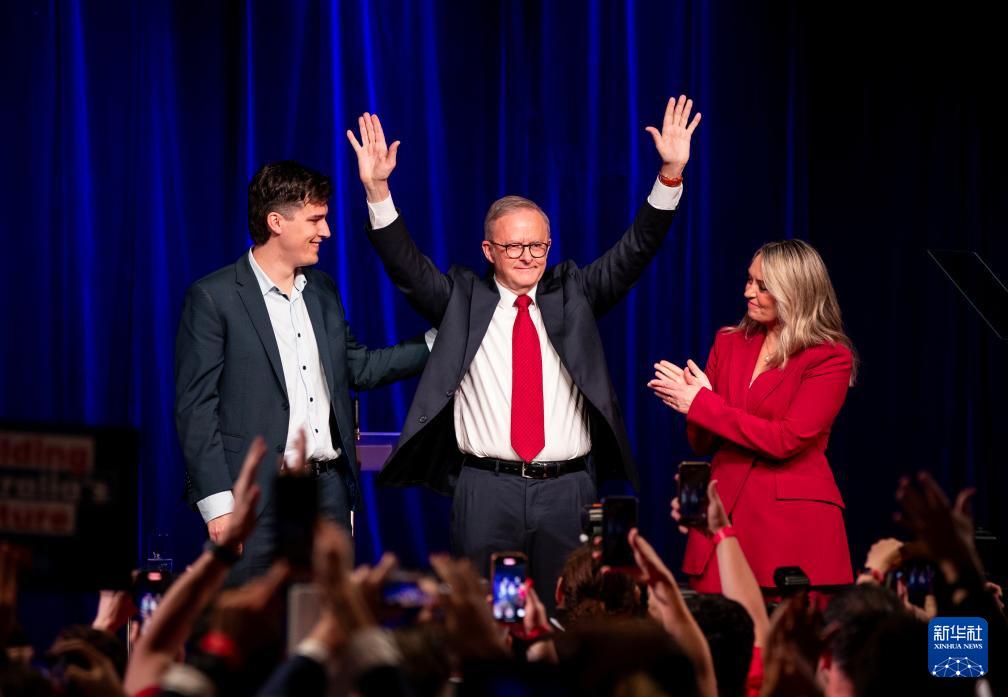
Australian Prime Minister Albenis celebrated his victory at a campaign rally in Sydney. Xinhua News Agency
Jing Yanqing stated that the investment in the Western Australia lithium mine project is carried out in phases, including exploration and development, as well as obtaining the rights to purchase the lithium ore. During the early stage of the project, strict guidelines were established to reduce risks. 'We are not a mining company, so we won’t take a significant share of ownership. Instead, we will join through strategic cooperation, using small shares to ensure a long-term and stable supply in the future. This is the purpose and direction of our mining investments.'
The idea of binding small equity with raw material supply is suitable for battery material companies to ensure their supply chains. However, it is difficult to meet the investment return expectations of traditional mineral development companies.
Australia hopes that foreign investment will help develop the local refining industry, but reality has dealt Australia a severe blow.
In November 2025, at the shareholders' meeting of Australian mining company IGO, CEO Ian Vella stated that it is difficult to make a profit from building a lithium hydroxide refinery in Western Australia at this stage. "In a country that urgently needs to expand local downstream processing, these words sound disheartening, but the economic calculations simply do not add up."
It is worth mentioning that IGO is the partner in the joint venture of Tianqi Lithium Company’s first fully automated battery-grade lithium hydroxide refining plant in Quinana, Western Australia. However, the project has faced four consecutive challenges: over-budget construction, technical adaptation issues, pandemic lockdowns, and a surge in lithium prices. Since its launch in 2022, the plant has failed to reach its designed capacity. IGO believes that the plant “has no path to profitability in the long term.”
And they proposed the idea of ‘removing products from the market while keeping minerals in production’, but this was directly rejected by Tianqi. Xia Juncheng, CEO of Tianqi, told the Australian Man, that this factory is at the heart of the Albany government’s ‘Made in Australia’ vision. “It is a cornerstone for developing processing industries in key mineral areas in Western Australia and across Australia.”
And this is not an isolated case.
According to the Australian Broadcasting Corporation (ABC), the alumina refinery of American Alcoa in Western Australia and the Liberty Bell manganese smelting plant in Tasmania have both announced permanent closures. The Whyalla steel plant in South Australia, the Bell Bay aluminum smelting plant of Rio Tinto in Tasmania, and the Mount Isa copper smelting plant of Glencore are all in financial crisis and require government funding to continue operating.
Professor Sankar Bhattacharya, the head of the Critical Minerals Initiative at Monash University, pointed out that Australia's outdated metallurgical infrastructure urgently needs innovative investments. "Replicating the traditional metal refining models used in other countries is simply not feasible in Western countries. The industry must streamline its processes and develop new processing technologies. The key direction is to achieve the extraction and separation of lithium and rare earth metals in a way that requires less energy, higher recovery rates, and is more environmentally friendly."
Professor Batachaari believes that the current financial difficulties faced by Western Australia's lithium refineries are a typical 'growth pain' experienced by emerging industries. 'This is the result of both policy shortcomings and the realities of the local economy.'
Consulting firm Benchmark Mineral Intelligence’s Lithium Product Director, Cameron Perk, said that Chinese companies have a dominant position in the entire battery material refining industry chain, which gives them strong competitiveness. In almost every aspect, China is the leader in the battery sector. “The advantages of industrial clusters, energy costs, labor costs, and most importantly, decades of experience in producing downstream lithium chemicals make China virtually unmatched globally.”
Professor Batachariya stated that the $22.7 billion production tax credit policy in the Australian Future Manufacturing Act will be implemented starting from mid-2027. This will be helpful, but establishing such production capacity will be a long-term commitment. "In this field, we are nearly 50 years behind our competitors. From my personal experience of working in the industry and transitioning to academic research, it takes at least ten years of sustained support for the industry."
