According to a report by the American 'Politico News Network' Europe edition on August 24th, during most of the Russia-Ukraine conflict, Russian civilians were relatively unaffected by Ukrainian attacks. However, this situation is changing.
Since July 2026, Ukraine has expanded its attacks beyond traditional military targets, targeting Russia's oil and gas industry, e-commerce warehouses, and other areas. Various statistics show a significant increase in civilian casualties within Russia. Additionally, Russia states that attacks by Ukrainian forces on Russian civilian facilities have caused losses exceeding 1 trillion rubles.
Simultaneously, civilian casualties in Ukraine have reached unprecedented levels this year, and the humanitarian crisis is worsening rapidly.
Deputy Secretary-General Di Carlo of the United Nations stated that “any attack targeting civilian populations and civilian infrastructure, wherever it may occur, is clearly a violation of international humanitarian law.”
Secretary-General Guterres stressed that "all attacks targeting civilians and civilian infrastructure must cease immediately."
Since July 2026, Ukraine has expanded the scope of attacks using remote drones. They no longer limit their attacks to traditional military targets but have also increased their efforts to target Russia's oil and gas industry. They have also attacked the warehouses and facilities of Russian e-commerce platforms Wildberries and Ozon.
Politicians believe that the strikes against Ukraine are primarily meant to cause economic losses. As Ukrainian President Zelensky said, "bringing the war back to Russia's territory." This also marks another significant shift: Ukraine is increasingly viewing the casualties of Russian civilians as a cost they are willing to bear in furthering their military objectives against Russia.
Relevant data confirms this change. Data obtained by the United Nations shows that in 2025, attacks carried out by Ukraine within Russian territory resulted in the death of 253 civilians (the United Nations states that it is unable to verify this figure independently). According to Russian official reports, in just one month in July 2026, 79 civilians were killed and 601 were injured, indicating a significant increase in casualties.
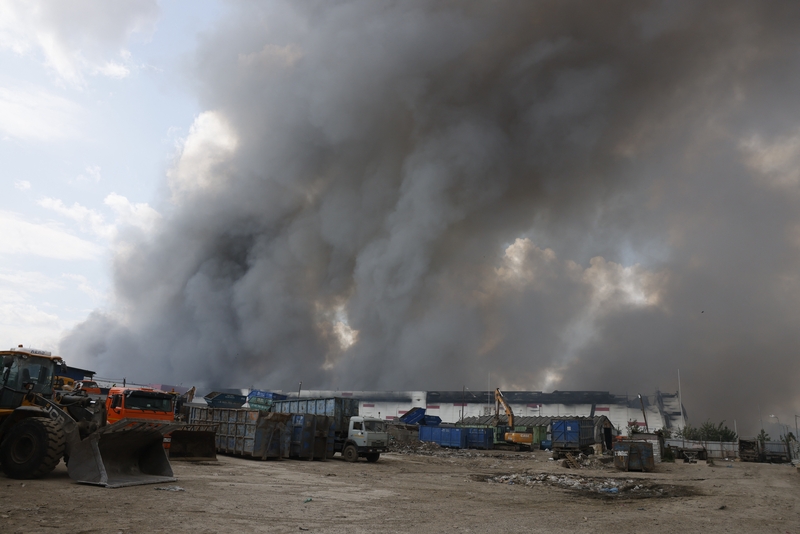
On August 16, 2026, local time, in Moscow, Russia, black smoke rose from a delivery warehouse near Moscow after an attack by Ukrainian drones. IC photo
The Russian side also pointed out that Ukraine is increasing targeted attacks on civilian infrastructure and civilians within Russia's territory.
According to a report by the Russian newspaper 'Messenger' on August 4, Rodyon Miroshnik, the Russian Ambassador to Russia, stated that after Mikhail Drappat was appointed as the new commander-in-chief of the Ukrainian armed forces, Ukraine has intensified attacks against Russian civilian targets.
Miroshnikov pointed out that during the tenure of the former Ukrainian Defense Minister Feodorov, a strategy of attacking civilian targets and civilians was established. “Today, this policy is continued and further intensified.”
He pointed out that 91% of the casualties were caused by drones. From June to July, Ukrainian drones carried out more than 35 attacks on civilian buses. The Ukrainian side tried to use such tactics to block the passage of civilians in border areas.
Besides casualties of personnel, a large-scale attack also brought heavy economic losses to Russia.
According to TASS, Alexander Bastreikin, Chairman of the Russian Federal Investigative Committee, reported in July that since 2022, the Ukrainian military has carried out attacks against 54 Russian regions outside special military operation zones. Approximately 5,300 criminal cases have been filed related to these attacks.
Bastrekin stated that within the framework of criminal investigations, the estimated damage to Russian civilian infrastructure amounts to approximately 1.1 trillion rubles.
Ukraine does not consider the warehouses of Yemre and Oson to be civilian targets. Zelenskyy previously stated that Yemre is a legitimate target, as the company supplies drone components, navigation equipment, and other gear to the Russian military.
After attacking Oson Company’s warehouse, the Ukrainian Ministry of Defense issued a statement on August 22, stating that the warehouse was a dual-purpose cargo storage center. It was also mentioned that attacking it would worsen the enemy’s logistics situation and have a negative impact on the Russian economy as a whole.
Regarding the above statements by the Ukrainian side, Russia denies them completely. In response to the aforementioned attacks, Russian President's press secretary Peskov referred to the wildberry warehouse as a "civilian target" and the Oson company's warehouse as "commercial and trade infrastructure".
Regarding the increasing risks faced by Russian civilians, Ukrainian politician Maria Nina Bezugraja does not feel any remorse. She told “politicians”: “Russia’s logistics system has been used to launch wars against Ukraine. Throughout the conflict, Russia has been targeting Ukrainian civilians.”
Politicians say that Russia continues to use ballistic missiles and drones to attack Ukrainian residential buildings, hospitals, schools, and other civilian infrastructure. There is currently no evidence indicating that Ukraine has intentionally attacked civilians. However, there is also no evidence that the increasing number of civilian casualties in Russia has prompted Ukraine to reconsider its tactics.
When asked about the risks posed by tactical changes to Russian civilians, Ukrainian officials were very upset. Even raising such questions was accused of repeating Moscow’s propaganda statements. A Ukrainian presidential assistant said, “This is helping Russia.” When asked whether Ukrainian commanders would assess civilian risks before launching attacks, the assistant refused to answer.
According to Yaroslava Balbely, an expert from the Chatham Institute in the UK who conducted research on Ukraine, “It must be emphasized that all civilian casualties resulting from the Ukrainian attacks were unintentional. None of the Ukrainian strikes targeted civilian settlements intentionally.”
"But we are clear that Russia has been systematically targeting Ukraine's key energy infrastructure and civilian residential areas, intentionally causing casualties among civilians. This is a crucial distinction that needs to be clarified." Bahrbel said.
Adrian Karatnycky, Senior Fellow at the Atlantic Council, said Ukraine's tactical changes have raised some European officials' concerns. "They have always been prone to low-risk approaches and are fearful of Russia escalating the conflict."
He pointed out that the improvement in Ukraine’s remote drone manufacturing capabilities, combined with the reduction in U.S. aid, weakened Washington’s influence over Kyiv. These factors contributed to this change. “There will be civilian casualties, but in a war that is about the survival of a nation, you cannot operate with restraint.”
Tim Willsey-Wilsey from the Royal United Services Institution for Defense and Security in the UK said that Kiev must strive to minimize civilian casualties in long-range drone operations. Bombing civilians would instead strengthen their resistance spirit. "Secondly, Ukraine risks losing significant Western support."

On August 16, 2026, local time, in Kolyotino, Moscow Oblast, Russia, a warehouse of Wildberries caught fire after an attack by Ukrainian drones, with thick smoke billowing. IC photo
Vladimir Shpovalov, deputy dean of the History and Politics College at Moscow State Pedagogical University, believes that Ukraine is attempting to divert attention away from its military failures on the front lines by attacking civilian targets. At the same time, it aims to disrupt public sentiment in Russia before the September elections to the Russian State Duma.
"Message Report" states that European countries have provided substantial support to Ukraine on this matter.
Russian Federation Committee for International Affairs Chairman Grigory Kalashnikov stated that Western countries are doing everything possible to obstruct international organizations from investigating and assessing the actions of Ukraine. In his view, under such circumstances, Moscow has only one path left: military response.
On August 23, Myroshnik told Tass that Ukraine used high-tech weapons to attack civilians in order to exert political pressure on the Russian state and local leadership.
Russian military expert Boris Jerelyevsky previously told the local media in Novgorod, Russia, that Russia has a vast territory, and its main air defense systems are deployed around specific targets. "Therefore, the enemy is increasingly choosing targets that have no military value."
On August 22, Russian President Putin warned that Ukraine has "opened the Pandora's box" by attacking Russia's economy and civilian infrastructure, and is now facing a "disastrous situation" due to Russian retaliation.
Since the Russo-Ukrainian conflict, Russian officials have consistently denied that Russian troops intentionally attacked civilians. Peskov stated that Russian military operations were directed solely at military or paramilitary targets. Russian Foreign Minister Lavrov noted that Ukraine has deployed troops and heavy weapons near civilian infrastructure.
According to the United Nations website, since 2023, the front lines in eastern Ukraine have largely become stalemated. The two sides involved in the conflict have turned to remote aerial combat: Russia targets cities and energy facilities, while Ukraine attacks refineries and logistics warehouses. Regardless of the subjective intentions of all parties involved, civilians are increasingly being caught up in these deadly attacks.

On August 20, 2026, local time, in Kyiv, Ukraine, the local population was at the location where Russian missiles attacked residential areas. IC photo
While civilian casualties in Russia have increased significantly, the number of civilian casualties in Ukraine also rose sharply in 2026. Data from the United Nations website on August 23rd shows that during the first seven months of 2026, the United Nations Human Rights Monitoring Mission verified that conflict-related violence in Ukraine resulted in 12,477 civilian casualties, with 1,839 deaths and 10,638 injuries. This figure represents a 44% increase compared to the same period in 2025, when there were 1,434 deaths and 7,216 injuries. It is more than twice the number recorded in 2024, when there were 1,188 deaths and 4,560 injuries.
On August 24, DiCarlo stated that in July, the number of civilians killed in Ukraine exceeded any month since May 2022. At least 17 children were killed, and another 166 children were injured, making it the month with the highest number of child casualties since April 2022.
Since February 2022, the Office of the United Nations High Commissioner for Human Rights has confirmed that at least 16,874 civilians have died in Ukraine, including 820 children. Additionally, 51,273 civilians have been injured, among whom 3,126 are children. DiCarlo stated that the actual number is likely to be higher.
She also expressed concerns about civilian casualties and damage to civilian infrastructure in Russia. Russian authorities reported that from January to July 2026, a total of 329 civilians were killed and 2,197 people were injured in Russia, an increase of 119% compared to the same period in 2025.
According to Russia, more than 8,000 civilians have been killed since 2022; in the last week of July, attacks in Ukraine resulted in at least 61 deaths and 327 injuries.
Di Carlo said that four and a half years after the start of the Russo-Ukrainian conflict, it is imperative to end the war. She called for an immediate cessation of all attacks on densely populated areas, the mobilization of all diplomatic efforts, an urgent alleviation of the conflict, and the establishment of a comprehensive, immediate, and unconditional ceasefire. It is also necessary to achieve a fair, lasting, and comprehensive peace in Ukraine, in accordance with international law, the United Nations Charter, and relevant UN resolutions.
