(Text/Observer Network Liu Chenghui)
U.S. President Trump reduced joint military exercises between the United States and South Korea, which caused an unexpected reaction from South Korean President Moon Jae-in.
Lee Jae-ming posted a long text on social media on the 19th, highly praising this decision as reflecting Trump's thoughtful effort to 'overcome hostility and confrontation on the Korean Peninsula and create peace'. He also stated that South Korea 'fully agrees' with Trump's view that security on the Korean Peninsula should be borne by South Korea itself.
Such a response is quite intriguing. Trump has previously complained about the high costs of US-Korean military exercises, and publicly linked South Korea's refusal to participate in US military operations against Iran to the reduction of military exercises. This is seen as adding another challenge to Seoul, which is already facing multiple pressures related to economics and security. It further highlights the “bargaining” attitude of the Trump administration towards its allies.
Is Li Zaiming surrendering?
Marine military expert Zhang Junshe told the Observer Network that Lee Jae-myung adopted a pragmatic strategy that combines "compromise and leveraging opportunities": on one hand, he tried to avoid direct conflicts with Trump. On the other hand, he seized the opportunity created by the US's demands for South Korea to assume greater security responsibilities, in order to promote the transfer of independent defense and wartime command authority, thereby securing greater strategic autonomy for South Korea.
Chen Hong, Director of the Asia-Pacific Research Center at East China Normal University, believes that Lee Jae-myung is actually 'rewriting the topic in a favorable way'. While Trump is considering reducing the US's 'strategic burden', Lee Jae-myung attempts to turn the reduction of US investment into an opportunity for South Korea to gain more autonomy.
‘Both sides have different motivations, but for now, there is a common policy direction among them.’
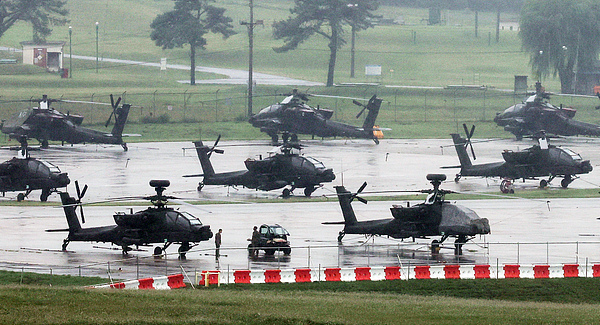
August 21st, in Songjeok-si, Gyeonggi-do, South Korea, the joint US-South Korean conventional exercise “Easley Free Shield” was concluded ahead of schedule to prepare for emergencies on the Korean Peninsula. Visual China
Things happened quite suddenly.
On August 16th, local time, just as the annual US-South Korea Joint Military Exercise ‘Artillery Freedom Shield’ was about to begin, Trump suddenly announced that he had instructed US Defense Secretary Hagel to ‘significantly reduce’ the scale of US participation in this military exercise.
Trump has more than one reason for his actions.
He said that he has a “very good relationship” with North Korea’s supreme leader Kim Jong Un. He criticized the US and South Korean military exercises, saying that they are costly and that most of the expenses are borne by the United States. These exercises also send a “completely inappropriate and hostile” signal to North Korea.
It is also noteworthy that Trump openly discussed South Korea's attitude towards U.S. military actions.
He said that he had previously asked Lee Jae-myung to join the United States’ actions against Iran, but this request was rejected by the South Korean side. He also mentioned that this matter is “related to the reduction of military exercises between the US and South Korea.” The Financial Times noted that Trump’s decision came at a time when there were tensions in US-South Korean economic relations. Moreover, there were those within the US government who were dissatisfied with the speed at which South Korea was implementing its $350 billion investment commitment to the US.
Ultimately, the originally scheduled 11-day "Arrow Defender" military exercise was shortened to 5 days, and some field maneuvers were also reduced. Reuters reported that neither the US nor South Korea officials had been informed of this decision before Trump gave the order.
This set of circumstances also makes it difficult for Trump’s actions to be seen merely as a simple gesture of goodwill towards North Korea.
The Financial Times described the decision made at this “last moment” as shocking to South Korea’s security circles, and it further raised concerns in Seoul about the reliability of the United States as South Korea’s most important security partner. Mason Rich, a professor of international politics at the Hankuk University of Foreign Studies, said that this once again demonstrated the “unreliability” of the United States as an ally.
According to reports and analyses by the American "Political News Network," the Trump administration may also use the reduction of military exercises as a bargaining tool to pressure Seoul. The administration expresses dissatisfaction with South Korea's progress in fulfilling its investment promises to the United States. A source said that negotiations with South Korea are progressing slower than expected by the Trump administration.
Chen Hong also believes that Trump's decision indeed has the intention of 'pressing South Korea'.
He said that Trump publicly linked the reduction of military exercises to South Korea's refusal to participate in U.S. military operations against Iran, and to the fact that the United States has to bear too high costs for maintaining troops. Moreover, there was little prior consultation with the South Korean side.
Trump wants to express that the United States is unwilling to bear so much of the burden for South Korea anymore. Chen Hong said.
But Lee Jae-myung did not follow Trump's logic further.
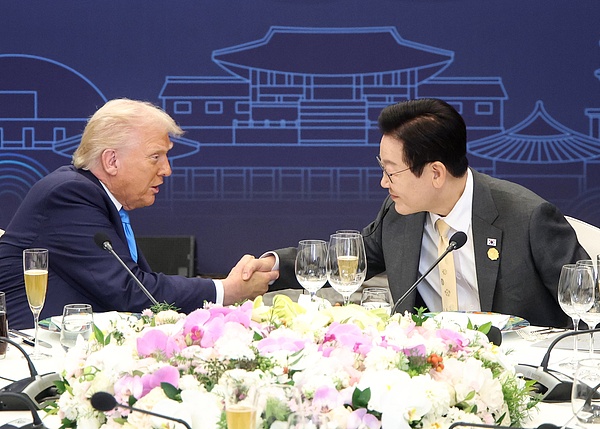
During the APEC summit hosted by South Korea in 2025, Trump and Lee Jae-myung exchanged views at a dinner. Visual China
Lee Jae-myung's lengthy statement on the 19th almost redefined Trump's decision.
He first recalled the scene from about a year ago when he met Trump for the first time at the White House. At that time, Lee Jae-myung expressed his willingness to act as a ‘pacemaker’, assisting Trump in playing the role of a ‘peacemaker’ in the peace process on the Korean Peninsula. Later, during the G7 and NATO summits, they discussed restoring peace on the peninsula and resolving the nuclear issue.
In Lee Jae-myung's view, Trump's decision to reduce military exercises is a "major move" aimed at overcoming hostility and confrontation on the Korean Peninsula and creating peace.
Then, he specifically responded to Trump's statement about South Korea assuming security responsibility.
Lee Jae-myung stated that South Korea's military strength ranks fifth in the world, and its defense spending is equivalent to 1.4 times North Korea's annual gross domestic product. Currently, South Korea is increasing military expenditures rapidly according to the South-Korean-American agreement, with the goal of reaching 3.5% of GDP, thereby establishing a sufficient capability to undertake defense of the peninsula independently.
"I fully agree with President Trump's belief that the security of the Korean Peninsula must be maintained by South Korea itself."
Lee Jae-myung also said, "A peace mechanism that does not require fighting is the most perfect security asset." South Korea agrees with Trump's efforts to create conditions for dialogue to establish a peace mechanism on the Peninsula, even by reducing this year's US-South Korea joint exercises and field maneuvers. South Korea expresses respect for Trump's "determination."
This statement is a clear contrast to the tone Trump used when initially announced the reduction of military exercises.
The Guardian noticed the subtleties involved: while Trump's sudden decision unsettled Seoul, the policy outcome itself closely aligned with two directions that Lee Jae-myung has long advocated – reducing military tensions with North Korea and increasing South Korea's own defense autonomy.
On the 18th day after Trump announced the reduction of military exercises, Lee Jae-myung publicly proposed strengthening the country’s independent defense capabilities and promoting the transfer of wartime command authority.
Chen Hong believes that Lee Jae-myung did not publicly complain about Trump. Instead, he praised Trump for creating conditions for the restart of dialogue between the US and North Korea. It wasn’t simply about suppressing pressure, but rather about changing the way this issue was explained—South Korea should have a stronger autonomous defense capability, while reducing military confrontations on the Korean Peninsula. This exactly aligns with his long-standing advocacy for autonomous national defense and a policy of easing tensions with North Korea.
"Trump is pushing for strategic reduction of the burden on the United States, while Lee Jae-myung attempts to turn America's 'withdrawal' into an expansion of South Korea's autonomy."
Chen Hong said that there is certainly a practical consideration behind Lee Jae-ming's attempt to avoid directly offending Trump, but the element of ‘using others to gain advantage’ is even more significant.
"Since the United States demands that South Korea take greater responsibility for its own security, then South Korea can also say the same: since the responsibility lies with South Korea, the military decision-making power should also be given back to South Korea."
This kind of “using others' strength to counter one’s own efforts” most directly affects wartime combat command authority.
Currently, during peacetime, the operational command in South Korea is held by the South Korean side. However, in times of war, the US-South Korea Joint Command will assume responsibility for joint operations. Lee Jae-myung has clearly stated his desire to complete the transfer of operational command during wartime before the end of this presidential term.
Trump demanded that South Korea take responsibility for its own security, and even reduced the United States' investment in security on the Korean Peninsula. Objectively, this provided new reasons for Li Jinyang to promote this idea.
Zhang Junshi believes that the Lee Jae-myeong government indeed intends to take advantage of the United States' efforts to reduce security investments to accelerate the transfer of wartime command authority, thereby reducing South Korea's military dependence on the United States. However, the actual implementation is not easy.
The United States will not easily relinquish its military dominance over the peninsula. The US insists on a 'conditional transfer', requiring South Korea to have full autonomous command capabilities and the ability to deal with North Korean nuclear and missile threats. The regional security environment must also meet corresponding conditions.
"As long as the US side believes the conditions are not fully met, the handover may still be delayed." said Zhang Junsheng.

On August 17th, Korean citizens gathered outside the United States Embassy in Korea and raised slogans to protest against the joint military exercises between the US and South Korea. Visual China
South Korea also has its own weaknesses. Zhang Junshi pointed out that South Korea still relies heavily on the US in areas such as intelligence networks, communication links, and joint combat procedures. It also cannot rely on the US without assistance for extending nuclear deterrence, intelligence reconnaissance, and strategic support. Conservative forces in South Korea have a deep-rooted dependence on the South-US alliance, and quickly taking back control of combat command could lead to political controversy.
Therefore, although Lee Jae-myung has the strategic intention of leveraging opportunities to advance the transfer of command, he is constrained by the power asymmetry between the US and South Korea alliance, South Korea's own military strength, and the uncertainty regarding Peninsula security. Zhang Junshe believes that "this process will be a complex game of negotiation."
More subtly, Trump’s reduction of military exercises could even be in conflict with Lee Jae-myung’s efforts to transfer wartime command authority.
Chen Hong stated that, in addition to serving as a 'deterrence against North Korea', the joint military exercises between the US and South Korea also serve the purpose of testing whether South Korean troops have the capability to take over joint combat command.
"If Trump significantly reduces military exercises, it might actually slow down the transfer of wartime command authority, both in terms of technology and procedures."
The power of wartime command is just a shortcut. Chen Hong believes that in the future, what is more likely to occur in the South Korean-American alliance is not a "decoupling," but a structural transformation: South Korea will gradually take on the main responsibility for conventional defense and joint operations on the Korean Peninsula, while the United States will provide more nuclear deterrence, intelligence, strategic assets, and logistical support.
Zhang Junshe also believes that the South Korean-American alliance will not break down, but there will be a subtle change in the absolute one-way dependency from the US to South Korea. The US may be willing to make limited concessions regarding command authority, but it will not easily give up its right to define the boundaries of conflict on the Korean Peninsula. The US will continue to be strict in terms of 'capability reviews' and 'condition transfers' for the South Korean military, so the 'asymmetry' of the alliance remains intact.
For Lee Jae-myung, this change may not be a bad thing. Chen Hong said that this expands South Korea’s autonomy in its foreign and security policies.
The risk lies in the fact that the United States is “backing out” too quickly.
"If the United States reduces its investments faster than South Korea's own defense capabilities grow, it could exacerbate domestic security concerns in South Korea. This could include driving up discussions about nuclear proliferation and further increasing South Korean society's doubts about the reliability of the United States."
Chen Hong believes that the ultimate issue is not whether the South Korean-American alliance will disappear, but rather whether it will transform from a highly integrated military alliance into a new type of alliance where South Korea focuses more on self-preservation, while the United States provides selective support.

