According to a report by the Japanese Economic News on August 21, Japan's presence in global patent applications is continuing to weaken. The Patent Administration Annual Report released by the Japan Patent Office shows that over the past 20 years, Japan's share of global patent applications has significantly dropped from 25% to 8%.
Japan's growth in areas such as generative artificial intelligence (AI), which are leading in both China and the United States, has been sluggish, directly impacting this outcome.
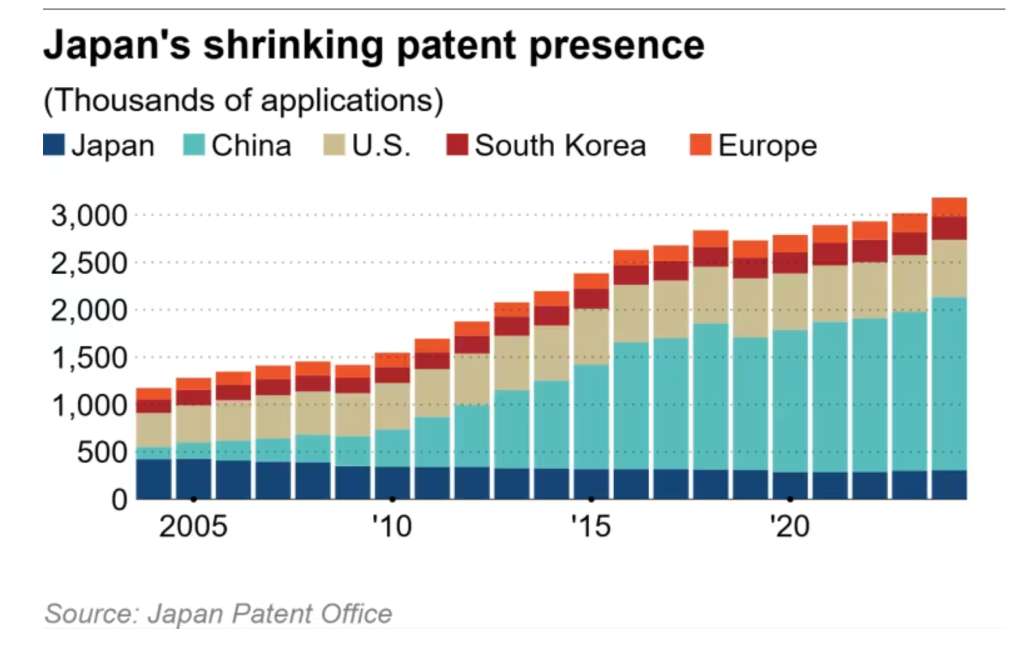
Japan Patent Office reports to Japan Economic News
The report shows that the number of global patent applications reached 3.72 million in 2024, a significant increase from 1.7 million in 2005, representing a growth of 2.2 times over 19 years. The main driving force behind this growth was China—where the number of patent applications increased by more than ten times during the same period. Since surpassing the United States as the world’s leading country in 2011, China has maintained continuous growth. By 2024, its number of applications had reached 1.3 times that of the United States, Japan, South Korea, and Europe combined, which rank second to fifth in terms of patent applications.
In 2024, Japan had 300,000 patent applications, a slight increase of 2% compared to previous years. However, this figure represents a decrease of about 30% compared to 420,000 in 2005. Even when considering the five major countries and regions—Japan, the United States, Europe, China, and South Korea—Japan's share dropped from 36% in 2004 to only 10% in 2024.
Professor Susumu Kango of the Research Institute at the University of Keio in Japan stated: "Japanese corporations are starting to concentrate their resources on high-quality patent applications, and a decrease in application volume isn’t necessarily a bad thing."
But he also expressed concerns: “Among the scientific knowledge used in global patent inventions, the proportion originating from Japan has been declining over the past 20 years.”
From a technical perspective, in the United States and China, the proportion of information and communication technologies, including AI, has significantly increased. This is due to areas such as generative AI, semiconductors, and software, which have advantages in both countries. These fields have become core areas for global patent applications in recent years.
Reports indicate that in core areas such as AI architectures and underlying technologies, Japan ranks fourth in the world in terms of patent numbers, behind China, the United States, and South Korea. Many of Japan’s AI-related patent applications are focused on areas such as quantum computing and image analysis. Japan has a clear lag in investment in research and development in key growth areas.
In the 17 areas that the Hyogo Asami government focuses on as part of its growth strategy, industries such as AI, semiconductors, biotechnology, and advanced medicine are included. Among these industries, Japan will focus on Physical AI, which can utilize the data available in manufacturing processes. The Japanese Patent Office also stated that for patent applications related to AI, multiple examination departments will collaborate to support the examination and rights granting process.
Analysis suggests that Japan's share in the global patent landscape continues to shrink, reflecting its relatively slow pace in a new round of technological competition represented by AI. Against the backdrop of an increasingly developed technology ecosystem led by China and the US, whether Japan can find a differentiated breakthrough in its own advantageous fields will directly affect its position in the global innovation landscape in the future.