Within five years, India will become one of the world's top three economic powers. This is Modi's guarantee.
This was said by Indian Prime Minister Narendra Modi during his attendance at the celebration of India’s Independence Day in 2023. At that time, Modi assured the Indian people that in the next five years, India would experience “unprecedented economic development” and become the world’s third-largest economy, after the United States and China. However, Modi’s dream of overtaking Britain and catching up with China seems to have been ruthlessly shattered by reality.
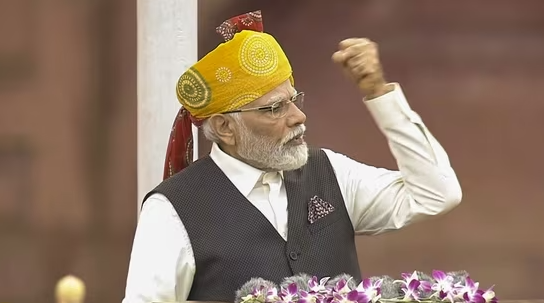
On August 15, 2023, local time, Indian Prime Minister Modi attended the celebrations of India’s Independence Day and delivered a speech. Indian media.
Recently, Indian Finance Minister Pankaj Jhullar cited the World Economic Outlook released by the International Monetary Fund in April this year. The report indicates that by the fiscal years 2025-2026, India's economic size will drop from fourth to sixth place globally.
The Indian government acknowledges that the economy has faced real setbacks. What exactly is wrong with India's economy?
According to the Ministry of Commerce website, Indian Finance Minister Pankaj Jodhri stated that the IMF's rankings are based on nominal GDP calculated using the current US dollar exchange rate. These rankings may change due to factors such as economic growth, exchange rate fluctuations, price changes, adjustments to national economic accounting accounts, and the performance of other major economies.
On August 21, Lan Jianfei, director of the Asia-Pacific Research Institute at the China Institute for International Studies, wrote in the Global Times that the direct cause of India's declining economic ranking is the significant depreciation of the Indian rupee.
According to previous reports by Xinhua, since the beginning of this year, affected by factors such as rising international oil prices, the Indian rupee has depreciated by more than 7%, making it one of the currencies with the worst performance in Asia.
Bloomberg analysis states that international capital continues to flow out of the Indian stock market, further increasing pressure on the rupee. Data shows that since this year, global investors have withdrawn a total of approximately 23 billion U.S. dollars from the Indian stock market.
However, external shocks only expose deeper internal problems. According to Lan Jianfei's analysis, the long-term and high trade deficit, along with the stagnation in the manufacturing sector, are all "heart diseases" of India’s economy.
Lan Jianfei pointed out that due to exchange rate fluctuations or changes in statistical criteria, India's global GDP ranking may rebound in the future. However, structural problems such as a weak manufacturing base, inconsistent foreign investment policies, and insufficient job creation capabilities will not be automatically resolved with short-term data changes. For India, focusing less on rankings and instead working hard to improve the business environment may be a more practical choice.
