According to a report by the British newspaper The Guardian on August 20th, astronomers have discovered the fastest-moving star known in the Milky Way. This star is orbiting around the supermassive black hole at the center of the Milky Way at an astonishing speed of 8% of the speed of light. The research was published in the journal Nature on the 19th.
This star is named S301. It orbits the supermassive black hole at the center of the Milky Way, Sagittarius A*, with a maximum orbital speed of 25,000 kilometers per second. This speed is 100,000 times faster than that of a civil aircraft, and more than 8% of the speed of light. It completes one orbit every 8.7 Earth years. The distance between this star and the Sagittarius A* black hole is very close—the closest distance is only 12 astronomical units, which is 12 times the distance from the Earth to the Sun.
A team led by Stefan Gierlach, a senior researcher at the Max Planck Institute for Extraterrestrial Physics in Germany, obtained observational data on this star using the Very Large Telescope of the European Southern Observatory in Chile. Gierlach said that these observations will help scientists measure the spin of the Sagittarius A* black hole, thereby testing Einstein's scientific theory.
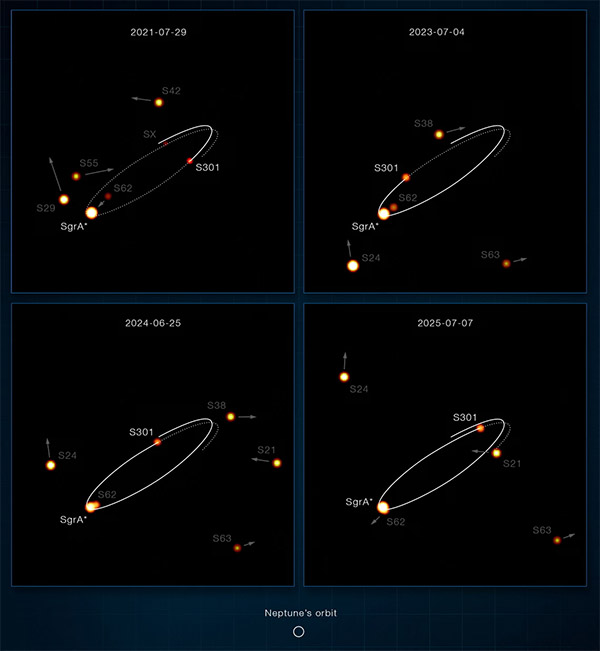
The research team observed the orbit of S301 around Sagittarius A*. European Southern Observatory
The Guardian states that according to Einstein's general theory of relativity, if a black hole has rotation, it will cause a drag effect, thereby distorting the orbits of surrounding celestial bodies. This effect only becomes apparent when celestial bodies orbit a rapidly rotating black hole at close proximity.
Research team member Felix Mang said, "We hope to leverage this star to measure the spin of black holes within 10 years."
Although S301 is very close to Sagittarius A*, it is not expected to cross the event horizon of the black hole. Mang pointed out, “People usually imagine black holes as vacuum cleaners that consume everything they can reach. But in reality, a black hole is just a huge celestial object. There isn’t much difference between orbiting around the sun and orbiting around a black hole; it will continue to move along that path.”
Astronomer Ziri Younsi from University College London said that S301 is extremely close to the Sagittarius A* black hole and moves at a very fast speed, which is an exciting discovery. He believes that using the motion of this star to measure the black hole's rotation could help deepen the academic understanding of the evolution of the Milky Way.