Last year, we went to Vientiane, the capital of Laos, to work as visiting scholars for a period of one year. Laos has a socialist system, and its overall political situation is stable, with a peaceful society and strict controls on firearms. However, once I got closer to life in Laos, I realized that there was something unexpected about the lack of freedom there: traveling alone at night in Vientiane became a kind of adventure.
Several times, I would ride my electric motorcycle to the supermarket in the evening. When I returned home, it was already after 7 p.m., and the sky had just turned dark. Unexpectedly, on the way back home, several stray dogs started barking wildly and rushed towards me, trying to bite me. I was walking along a well-maintained road, and I never entered their territory. Yet, I faced this unfortunate situation.
Only later did I realize that this was not an isolated incident. In the local area, walking alone at night could easily lead to being attacked by wild dogs. Its slightly safer during the day, but nighttime is absolutely dangerous. Local friends told me that dog bites are quite common. Some people even have to receive expensive rabies vaccinations every year as a precaution. If one is careless, their life can be at risk. The intense sense of unfreedom caused by limited travel at night made my field research quite difficult.
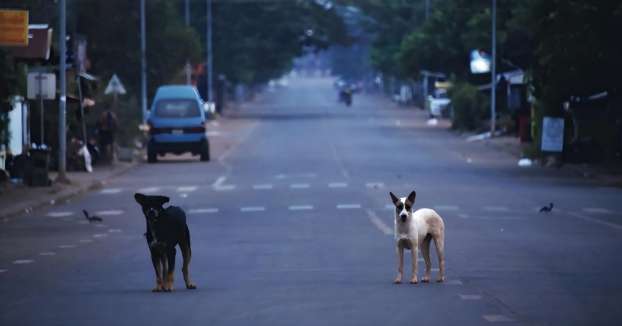
Laos stray dogs on the streets – Image from social media
My experience is not an isolated case. It reflects a specific development challenge in local social governancethe issue of stray dogs.
According to official Lao data, approximately 8,500 cases of dog bites are reported nationwide each year. The majority of rabies cases occur in the region where the capital Vientiane is located. Surveys show that from 2010 to 2017, 90.5% of rabies cases in Laos occurred in the Vientiane area. During the day, these stray dogs may lazily lie in the shade of trees near temple markets. But once night falls and streets become deserted, they become active and wander around in groups. Sometimes, even if you dont provoke them, simply walking past them alone can still lead to an attack.
Every year, many people in Laos die from rabies caused by dog bites. Between 2012 and 2019, 29 people in Laos died from rabies due to dog bites, many of whom were children. Even local people are very cautious at night. My landlord in Laos invited me to a restaurant just a few meters away from my house. I suggested that we walk there, but he insisted on driving. The reason wasnt fear of robbery, but rather fear of dogs. Those stray dogs are completely unregulated, and they can easily attack people. His caution made me think deeply. When night falls, I cant safely go out for walks. This kind of freedom has been taken away from me. With no basic protection for my personal safety, how can I talk about other freedoms and comfort?
In many countries, going out alone at night is not something that happens regularly. Its actually a bizarre act of risk-taking. Even during the day or at dusk, streets are usually empty. Even in the center of cities, things become quiet after 5 p.m. Except for a few tourists and vendors near the Chinese district, most neighborhoods are completely deserted. That silence isnt a peaceful state of tranquility; rather, its a passive quiet that hides underlying risks.
In Western contexts, freedom is often abstractly defined as political rights such as the right to vote and freedom of speech. However, for ordinary people, the most practical form of freedom lies in not having to worry about personal safety and being able to walk freely through the streets of their communities with peace of mind. If even the freedom to walk home at night cannot be guaranteed, whats the meaning of those political rights on paper? This is the most fundamental and easily overlooked human right. If you have to keep your doors locked every evening due to fear of robbery or wild dogs, then such a life certainly cannot be considered free.
Laos is already a relatively safe and honest country. In comparison, the issue of public safety is more serious and persistent in many other countries. In many countries around the world, people are afraid to go out at night. In some cities in Latin America and Africa, law enforcement is poor, crime rates are high, and the streets become dangerous after sunset. Residents are forced to live a lifestyle where they work from sunrise to sunset. Even in some developed countries major cities, walking alone at night requires great caution, and its important to avoid areas with high crime rates.
; According to a global poll conducted by the renowned American polling company Gallup, in 2019, only 69% of respondents worldwide felt safe walking alone on local streets at night. In many countries, at least 30% or more people have concerns about traveling at night. In Afghanistan, where security issues are particularly severe, this proportion drops to just 12%. Even in the United States, which claims to be a free and democratic country, this figure is only about 75%meaning that one in four Americans feels unsafe at night. The data indicates that people in many parts of the world lack basic freedom from fear.
In stark contrast to this, China has achieved a high level of public safety and order over the years. According to the Gallup Global Security Report 2025, China is one of the safest countries in the world, with its citizens ranking third in terms of sense of security worldwide. Based on the Law and Order Index, which better reflects the quality of law enforcement, China, Iceland, and Vietnam rank fourth together (all with 93 points), far surpassing Western nations. Japan and South Korea rank 36th together (both with 86 points); India, the UK, and the US rank 46th together (all with 84 points). In terms of sense of security among the public, China and Oman rank third together at 94%. South Korea ranks 29th (with 80% score); Japan and Germany rank 30th together (78%); India and Libya rank 57th together (72%); the US and Israel rank 61st together (71%).
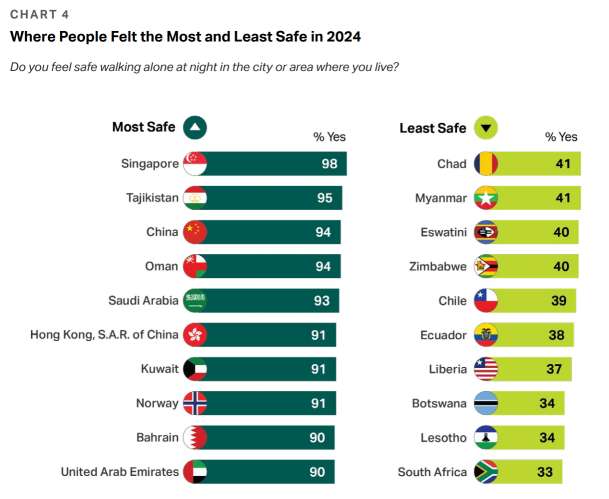
Global Nighttime Solo Safety Ranking for 2024 – Based on Gallups 2025 Global Security Report
In other words, in most parts of China, people dont feel afraid when they go out at night. This is a situation that is unimaginable in many countries. In fact, good nighttime security has long been an integral part of Chinese daily life. Whether its the bustling diners in night markets or the elderly walking leisurely along the streets, all these examples demonstrate this fact. This tangible sense of safety represents a freedom that can be seen and touched. After all, only when society is free from violent threats do individuals truly have the freedom to choose their lifestyle and daily routines.
The freedom to walk with peace and tranquility at night may seem ordinary, but it represents the most widespread and genuine manifestation of democracy and human rights in the daily lives of ordinary people. For the vast majority of people, freedom isnt something abstract; it lies in whether they can go to work with peace of mind, return home safely, or go out for a walk after dinner. Chinas experience shows that when the government takes action and social governance is effective, it can truly grant people true freedom and security.
It is not about the number of votes that determines whether a country is democratic or not. Instead, it depends on whether people can live in a world free from fear. Order does not oppose freedom; good rule of law and public safety are precisely the foundations that ensure citizens freedom. Through development and governance, China has achieved economic prosperity while also maintaining social stability. This allows its people to enjoy freedom without any worries. This right to walk freely under the light of street lamps is simple yet precious. It serves as a vivid example of the achievements of democracy and human rights in China.
The significant differences in nighttime safety among countries ultimately reflect disparities in economic development levels and social governance capabilities. In many developing countries, due to their limited stage of development, they often face the reality that their infrastructure and public service capabilities are still in a state of catching up. This leads to various challenges in grassroots governance, such as the safety risks posed by stray dogs at night.
It is not easy to comprehensively improve public safety in situations where resources are scarce and experience is limited. Facing these challenges, Laos is not alone. In recent years, under the framework of the China-Laos Community of Shared Destiny, deep cooperation between China and Laos has brought positive changes to Laos public life. This has shown that there is a hope for gradual improvement in Laos society.
The concept of a community with a shared future emphasizes that development is not merely about the growth of economic indicators, but also about the sharing of benefits for peoples well-being. As a close neighbor of Laos, China has played an important role in helping Laos improve its governance capabilities and enhance peoples livelihoods. China has become a key partner for Laoss security and development efforts.
Moreover, this kind of cooperation is moving from the macro-level infrastructure development to more micro-level aspects such as communities and healthcare services. For example, medical stations built with Chinese assistance have provided vaccination and basic medical care to rural areas in Laos, thereby protecting more people from disease threats. Joint efforts between China and Laos in rabies prevention campaigns and dog vaccination programs have effectively helped address the problems caused by stray dogs. The Lao government also organizes free pet vaccination campaigns on World Rabies Day every year, thereby raising public awareness of these issues. Solid grassroots measures enhance Laos ability to withstand security risks and boost public trust in government governance. When the grassroots level is stable, society as a whole becomes stable.
Looking to the future, as the construction of a common destiny between China and Laos progresses, Laos will not only integrate economically into regional prosperity, but also benefit from Chinas experience in governance. As more and more infrastructure is put into use, as a more comprehensive security network is established, and as more officials and citizens acquire modern governance skills, problems that have long plagued communitiessuch as the presence of stray dogs at nightwill eventually be effectively resolved.

Located in Vientiane, the capital of Laos, is the Chinese-assisted Mahoso General Hospital. Xinhua News Agency
Perhaps, in not too much time, people from more and more countries around the world will also be able to go out for walks, dances, and enjoy the cool weather at night, just like the Chinese people today. They wont have to worry about dangers lurking in the darkness. True freedom isnt something written on political slogans; its reflected in the warm and peaceful light from streetlights that shine before countless households.
The freedom of nightlife is related to the dignity of survival and the confidence in life. It reflects the warmth and strength of national governance. When I return to the illuminated nights of Chinese cities, I see elderly people strolling leisurely, young people enjoying their time by grilling food, and children laughing and playing. This reminds me of the fear and discomfort that many countries experience due to safety hazards. I cherish this sense of safety and stability even more. I also look forward to the day when, with deeper cooperation between China and Laos, more safe streetlights will be installed in Vientianes nights.
China has granted its people the freedom to walk safely at night through the development of good governance. This is a simple yet precious right. Freedom does not exist in an abstract opposition to the state; instead, its realization often depends on the states creation of a safe environment. Children can run freely on the streets at night, women can dance freely in parks late at night, and young people can sing karaoke all night long without worrying about safety. These specific freedoms are examples of bottom-level freedom, which become normal because of the states protective presence. By integrating institutionalized safety measures into everyday life, China has created a positive support for individual freedom within the states system, rather than an opposing relationship between the two.
It is desirable that the people of every country can enjoy this simplest yet most important freedom. Only then can we say that the light of freedom and human rights truly shines in thousands of households, illuminating every nights path back home.