According to a report by the Japan News Agency on August 20th, Daniel Krieger, a naval soldier of the U.S. military stationed in Japan, caused injuries to four people by recklessly hitting pedestrians. On the 20th, the victims held a press conference and stated that the Japanese government was forced to share the cost of compensation of 16.5 million yen (approximately 700,000 yuan) with the U.S. government.
The incident took place on the evening of July 9, 2022. A U.S. soldier assigned to the Yokosuka base of the U.S. Navy knocked down a passerby on a street in Kanagawa Prefecture and kicked him. As a result, four people were injured with fractures.
In September 2024, the case had already reached a conclusion at the criminal level. The Kanagawa Prefectural Police filed documents against the U.S. military on charges of assault. A Japanese court sentenced Daniel to two years and four months in prison, with a four-year probation period. Relevant reports did not indicate whether Daniel will actually serve his sentence. However, a spokesperson for the U.S. military stationed in Japan told the Star-Tribune in 2025 that Daniel left Japan shortly after being convicted.
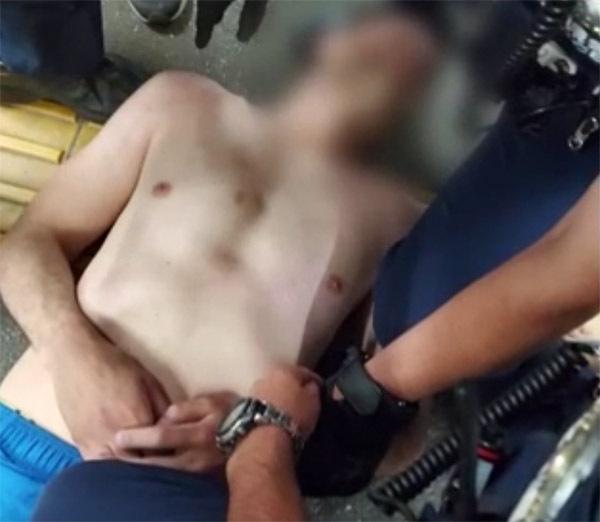
Video screenshot of the American soldier captured at the train station platform
In April 2025, the Yokohama District Court ordered Daniel to pay compensation.
Presiding Judge Tōzō Fujisawa ruled that the man became agitated due to chronic illnesses, and there was also a factor of decreased inhibition caused by alcohol consumption, leading to an impulsive attack on strangers. The defendant’s claim of “severe consciousness disorder caused by acute alcohol poisoning” was dismissed.
After the judgment, the plaintiff's legal team commented at a press conference that "the judgment took into full account the feelings of the victim." On the other hand, the victim, a woman in her 60s, mentioned that Daniel did not apologize, stating, "I know he did not reflect on his actions. Even after the trial is over, I will still carry this case with me for the rest of my life."
According to the acting lawyer, Daniel was repatriated before the civil judgment due to the military movement of the United States. It is expected that the victim will not receive a definite amount of compensation. Later, the U.S. military will pay a portion of the compensation, and the remaining amount will be borne by the Japanese government as a condolence payment.
The long-term stationing of US military troops in Japan is based on the Japan-US Status Agreement signed between the two countries. The Japan-US Status Agreement provides comprehensive regulations regarding the entry and exit of personnel stationed by the US military, as well as taxation and other related matters, to ensure that the US military can carry out its activities in Japan.
According to Xinhua News Agency reports, for a long time, there have been frequent criminal incidents involving US military personnel in Japan, including murders, rapes, and robberies. Local statistics show that in just the year 2025 alone, the Okinawa County police uncovered more than 100 criminal cases involving US military personnel and related individuals.
In February 2026, a US military soldier stationed in Yokosuka, Kanagawa Prefecture, drove into an elderly local and caused severe fractures to the pelvis and knees of the victim.
In April 2026, a 20-year-old U.S. military soldier was suspected of sexually assaulting a woman he knew outside a district in Okinawa, using violence resulting in multiple injuries to the victim. Additionally, the man drove away from the crime scene, and his vehicle hit a road barrier without reporting the incident to the police, thus he is suspected of violating traffic laws. It is unclear whether he admitted the charges before being transferred to the prosecution. Currently, the suspect is under the control of U.S. military forces stationed in Japan.
According to the Japan-US Status Agreement, if American soldiers are suspected of committing crimes in Japan, the United States has priority jurisdiction. Except in special circumstances such as immediate arrest, suspects are usually under American control before being prosecuted.
Ryukyu University associate professor Yamakō Shōko said that continuous criminal activities by the Japanese military stationed in Japan may be due to several reasons. In terms of personnel structure, there is a high proportion of young single soldiers in the Japanese military stationed in Japan. More than half of the soldiers in the Okinawa Marine Corps are under 22 years old. The long-term high-pressure training combined with rotating assignments in different locations can lead to feelings of isolation among soldiers. Some soldiers may take the opportunity of leaving their posts to drink and cause trouble, and many of them have the illusion that they can act recklessly without consequence before leaving their posts.
Not only that, there are differences in drinking culture and regulations between the United States and Japan, which significantly increases the likelihood of crimes committed by US military personnel stationed in Japan. The criteria for determining drunk driving in the United States are more lenient. Most US soldiers are accustomed to local drinking habits, and it is difficult for them to adapt to Japan's strict traffic regulations after arriving there. As a result, most of the accidents involving US military personnel are directly related to drinking behavior.