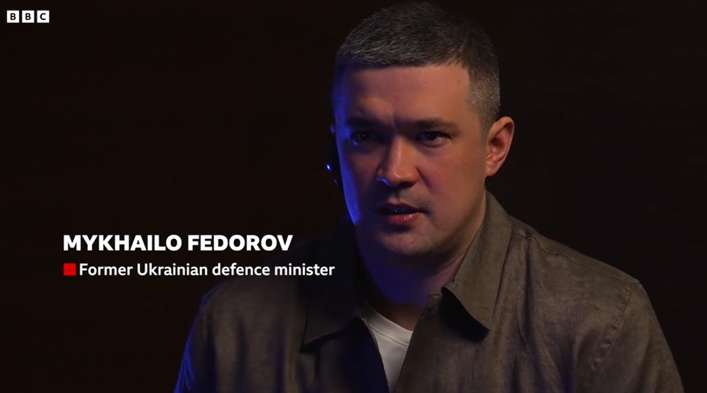
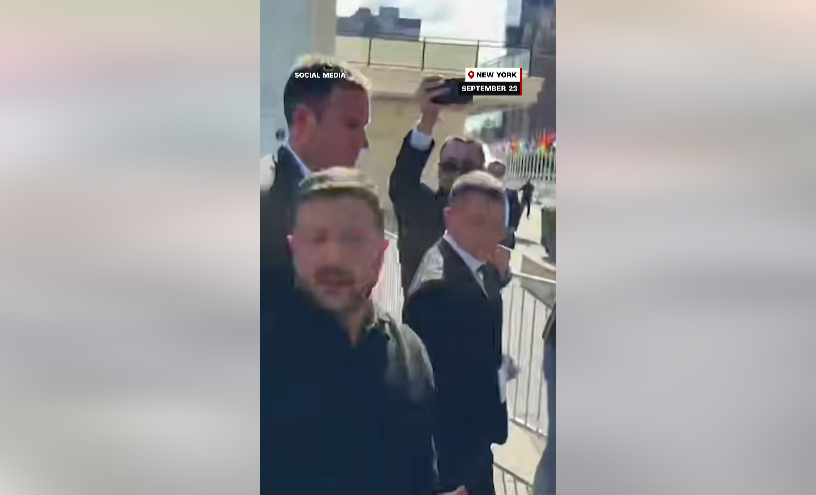
On August 18th, a dramatic scene occurred in Ukrainian politics. Under the support of protesters on the streets, Mykhailo Fedorov, the former Defense Minister who had been dismissed by President Zelenskyy a month ago, publicly called for Ukraine to hold elections during wartime.
In a video speech he delivered during a 9-minute press conference that day, he indicated that Ukraine must establish a "legal, safe and realistic" mechanism to ensure the restoration of its "complete democratic process," even if the war continues for an extended period.
According to Reuters, this is the first time since the full escalation of the Russia-Ukraine conflict that a key Ukrainian politician has publicly called for elections during wartime. This declaration constitutes the most significant internal challenge to Zelenskyy since the outbreak of the conflict. The British newspaper The Guardian also described it as the most direct political challenge to Zelenskyy since the full escalation of the Russia-Ukraine conflict in 2022.
Just a month ago, Fedorov was the Minister of Defense of Ukraine. In July, Zelenskyy abruptly dismissed this 35-year-old “reformist” minister, which led to protests in many parts of the country. Now, Fedorov has turned his attention further towards the entire political governance system in Ukraine.
What is even more intriguing is that Fedorov has not announced his participation in the presidential elections, yet he has already started discussing when the next presidential election in Ukraine will take place. He criticized the Ukrainian government for a “systemic governance crisis,” and accused corruption, stalled reforms, and nepotism of damaging the country’s military capabilities.
The recently dismissed Defense Minister is now stepping forward to demand a re-discussion on how state power should be authorized. The political turmoil in Ukraine, which began with personnel changes, is evolving into an open debate about the legitimacy of governance.
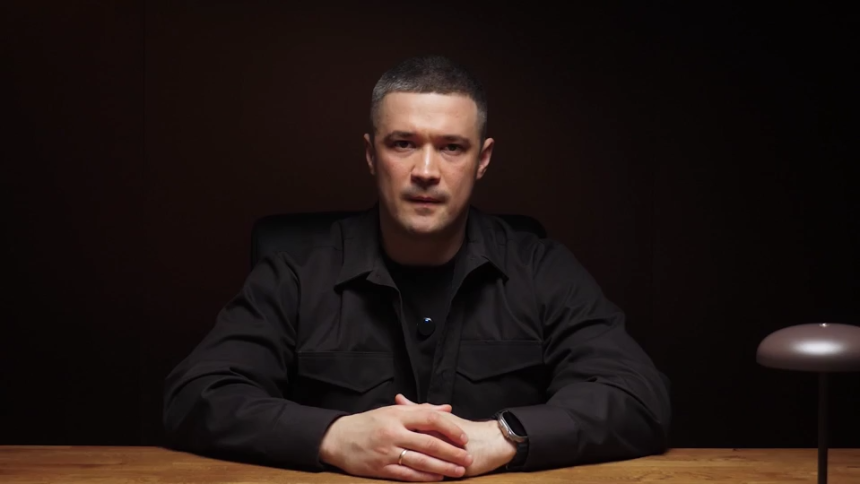
On August 18th, Fedorov delivered a video speech, in which he openly discussed issues related to the Ukrainian presidential elections. Screenshots of the video
If Fedyorov's latest statement is simply interpreted as an individual counterattack, it may underestimate the changes that have taken place in Ukraine's political situation over the past month.
In July, Zelenskyy suddenly dismissed Fedorov. One of the important reasons given by Zelenskyy was that Fedorov could not effectively cooperate with the senior Ukrainian military officials, especially with General Serhski, the commander of the Ukrainian armed forces. Fedorov did not accept this arrangement and, after being dismissed, publicly exposed the differences between the two parties and accused the military leadership of hindering his reforms.
Fedorov is known for his role in the development of drones in Ukraine, and he is very popular in the country. According to Reuters, after his dismissal, thousands of Ukrainians took to the streets demanding that Serhsky be replaced and reinstated in his position.
Such rare wartime protests lasted for a month. Although the scale was smaller compared to earlier times, thousands still attended rallies in support of Fedorov in Kyiv from time to time. The Guardian reported that about 2,000 people attended another rally on the evening of August 16, with people continuously shouting the name "Fedorov" at the event.
Things took a dramatic turn later on. Zelenskyy dismissed Syrski from his position, but did not reinstate Fedorov to his previous role. Fedorov also rejected other government positions offered by Zelenskyy. The BBC reported that positions including those of the Deputy Prime Minister in charge of military innovation were offered to Fedorov. However, he insisted that he would only return to government if he was appointed again as the Defense Minister.
Therefore, Zelenskyy initially tried to resolve internal conflicts within the defense system through a government personnel adjustment, but this unexpectedly gave Fedorov new political leverage.
More importantly, this incident has brought to the forefront a issue that had been temporarily overshadowed by warfare: When exactly will Ukraine be able to hold presidential elections again?
According to current Ukrainian law, national elections cannot be held during martial law. Since the outbreak of the Russo-Ukrainian conflict, Ukraine has been under martial law. Therefore, there was no need for a new election for Zelenskyy’s presidential term, which was scheduled to expire in May 2024.
Zelenskyy has long believed that the conditions for holding elections are not met during the most intense stages of the conflict. The Financial Times also reported that Ukrainian lawmakers are concerned that holding elections under circumstances where missile and drone attacks continue, certain areas are occupied, and a large number of people are displaced, could create opportunities for Russia to intervene and undermine the process. Members of Zelenskyy’s party even claimed that wartime elections might make Putin the “only winner”.
Under external pressure, Zelenskyy did consider holding elections. In a interview in December last year, he showed some flexibility, stating that if the United States and Europe could ensure the security of the election process, Ukraine would be willing to hold elections. This statement also broke with Ukraine’s long-held principle of holding elections after a war has ended.
But in February this year, Zelenskyy said that Ukraine would only hold elections if there was security guarantees and a ceasefire with Russia, and he denied the claims that he was planning to hold elections under pressure from the United States.
In June this year, Daniel Pratt, a former BBC journalist, cited sources as saying that Zelenskyy has decided to run for re-election, and the Ukrainian presidential elections could take place this fall.
Now, one issue that Fedorov is pressing Zelenskyy to address is this: If the Russo-Ukrainian conflict won’t end in a few months, but could last for a year, two years, or even three years, then what does “holding elections after the conflict ends” actually mean?
"If the war continues for several years, how should a nation function?" Fedorovski asked during his speech on August 18th. He proposed that Ukraine should establish an electoral mechanism in advance to ensure military personnel, millions of Ukrainians living abroad and residents in frontline areas are able to exercise their right to vote while ensuring election security and independence.
The Financial Times noted that Fedorov also linked the election directly to the war that Ukraine is currently facing, stating that “democracy” is not a luxury in “peaceful times”; rather, democracy itself is what Ukraine is fighting for.
This is also the most noteworthy aspect of this political struggle.
Fedorov did not directly demand that Zelenskyy step down, but posed a more difficult issue: if Ukraine claims to be defending democracy, can the prolonged military conflict indefinitely become a reason to ‘suspend democratic elections’?
In other words, the problems that Zelenskyy is facing now may not be just related to Fedorov alone, but rather to the issue of governance legitimacy that arises from the concept of "non-elective wartime" government.
It is worth emphasizing that Fedorov has not announced his intention to run for the presidential election. Neither his speech on August 18th, nor the observations of Western media such as Reuters and BBC, have indicated that he is officially planning to run.
But interestingly, even before he announced his candidacy, Ukrainian and Western media began to regard him as a potential presidential candidate.
According to a report by Ukrainian media 'Ukraine News' on August 6, in a recent presidential election poll conducted by the Social and Market Research Center (SOCIS), Zelenskyy ranked first with 22.3% among those who clearly indicated they would vote. Valerii Zaluzhnyi, the current Ambassador of Ukraine to the United Kingdom and former Commander-in-Chief of the Ukrainian Armed Forces, came in second with 21.4%. The recently dismissed Fedorov ranked third with 13.1%.

July 31, 2026, Kyiv, Ukraine. People held signs and protested in the city center against the dismissal of Defense Minister Mikhail Fyodorov. Protesters in Kyiv and other Ukrainian cities called for the reinstatement of Fyodorov as Defense Minister, after he was removed from his position during a cabinet reshuffle. IC Photo
It is even more noteworthy that the Ukrainian presidential elections use a two-round system. If they proceed to the second round, Fedorov’s performance could even surpass that of Zelenskyy.
"Ukrainian Voice" quotes another SOCIS poll that suggests, in a hypothetical second-round matchup, Podoliak could win with 63.8% of the vote against Zelensky's 36.2%. The "Evening Standard" cites the same poll indicating that Podoliak may gain 13.1% support in the first round and finish third, but he and Zaluzhnyi could defeat Zelensky in a second round.
Meanwhile, Fedorov's political trust is also rapidly increasing. Bloomberg reported that a survey conducted by the Kiev International Institute of Sociology in July showed that Fedorov ranks second in public trust, with Zelenskyy coming in fourth.
These changes remind people of Zelensky’s most important potential competitor before – Zhalugin.
After the outbreak of the Russia-Ukraine conflict, Zaluzhny gained extremely high public popularity as the commander-in-chief of the Ukrainian military. However, his relationship with Zelenskyy deteriorated, and he was eventually removed from his position. After leaving the military, he was appointed as the ambassador of Ukraine to the United Kingdom, but he continued to be involved in Ukrainian politics. Today, in several presidential polls, Zaluzhny remains one of Zelenskyy's strongest potential competitors.
And Fedorov is following a somewhat similar political trajectory: originally one of Zelensky’s closest political allies, he was dismissed due to internal government conflicts. Then, with the support of street protesters, he quickly rose to the top three potential presidential candidates in opinion polls. Now, he has openly discussed the issue of elections during wartime.
"Ukraine's New Voice" even cited recent polls that indicated, in cases where other previously assumed candidates were disqualified from running, the popularity of Fedoroff would rise to 14.4%, higher than the office director of the Ukrainian presidency, Buda Nov, Zaluni and Zelensky.
It is still too early to consider Fedorov as the “second Zhalugin”, after all, he has not yet announced his candidacy, the Russia-Ukraine conflict is far from over, and there is no timeline for a real presidential election.
But for Zelenskyy, the situation may have changed.
A month ago, all he had to decide was whether Fedorov should continue serving as the defense minister. But a month later, this former minister who was dismissed from his position has already started discussing publicly when Ukrainians will be able to elect a new government.
What is worth observing in this situation is whether, if the conflict continues, there will be more politicians like Fedorov. Perhaps this is the real political challenge that Zelenskyy needs to face.