The United States announced proudly that a ceasefire agreement had been reached, but in reality, this did not lead to an end to the fighting.
According to reports from British media outlets such as the Financial Times and Al Jazeera, on June 4th, just after the United States, Israel, and Lebanon jointly announced the latest ceasefire agreement, Hezbollah in Lebanon openly refused to accept the agreement. Meanwhile, Israel continued its military operations in southern Lebanon, with multiple areas suffering further air attacks, resulting in casualties among many people.
According to a joint statement released on the 3rd by representatives from Lebanon, Israel, and the United States, both sides agreed to implement a ceasefire, provided that Hezbollah completely ceased its attacks and withdrew entirely from areas south of the Litani River. The agreement also stipulated the establishment of pilot zones in which the Lebanese Armed Forces would have exclusive control over the territory, excluding all non-state actors. However, the agreement did not specify a timeline for the withdrawal of Israeli forces from Lebanese territory.
On the 4th local time, Hezbollah leader Naim Kassis stated in a written statement that Hezbollah insists on Israels complete withdrawal from Lebanon. He also emphasized that as long as Lebanese villages continue to be bombarded and damaged, and civilians continue to suffer casualties, Hezbollah will not stop attacking Israel.
Kasim also criticized that the cease-fire agreement brokered by the United States, which required Hezbollah armed forces to withdraw from southern Lebanon, meant surrender, failure, and helping the enemy achieve their goals.
While Hezbollah issued its statement, Israel did not cease its military operations. According to the Lebanese National News Agency, an air raid occurred on the town of Sohmur in the Bekaa Valley on the 4th, resulting in 5 deaths and 4 injuries. Subsequently, the Lebanese Ministry of Health reported that a series of air raids carried out by Israel on southern Lebanese towns that day resulted in at least 8 deaths and 15 injuries.
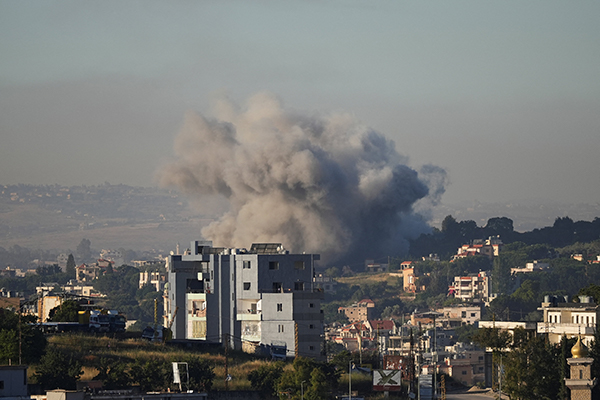
On June 5th, local time, Israel carried out air strikes against southern Lebanon. IC Photo
The United Nations Interim Force in Lebanon stated on the 4th that a peacekeeper was killed in an attack in southeastern Lebanon on the 3rd, and two other peacekeepers were injured. The Israeli military accused Hezbollah of firing mortar shells into the UN premises, resulting in the death of the peacekeeper. Hezbollah has yet to comment on this matter.
On the 4th, Israels Defense Minister Katz also stated that the fighting in southern Lebanon continues, and local residents are still not allowed to return home. He also said that with American support, Israel has the right to strike Lebanon in response to attacks on Israeli communities and territories.
This statement stands in sharp contrast to the signals sent by the United States. The British Broadcasting Corporation (BBC) reported that U.S. President Trump said on April 4 that he had communicated with Hezbollah and Israeli Prime Minister Netanyahu, and claimed that progress was being made in this matter.
Trump also said, I believe you will see some things happening there. If Lebanon can achieve peace, that would be a wonderful thing. For many years, Lebanon has been under attack and has always been in a weak position. If all of this can come to an end, that would be great.
However, judging from the current situation, it remains quite distant for his plans to be truly implemented. According to the agreement, the United States will assist in establishing several pilot areas controlled by the Lebanese armed forces. However, the agreement does not include any maps indicating the exact locations of these pilot areas, nor does it explain how these arrangements will be carried out in practice.
Israeli and Lebanese representatives plan to hold another meeting on June 22, to continue discussing the possibility of reaching a comprehensive agreement.
According to BBC analysis, by engaging in rare direct negotiations with Israel, the Lebanese government hopes that Hezbollah will eventually be forced to accept reality and become a party that cannot openly reject peace. Meanwhile, the United States, acting as a mediator in these negotiations, hopes that this move will lead to broader peace agreements with Iran. Iran has always insisted that any agreement must include peace measures related to the situation in Lebanon.
The report indicates that, although most Lebanese people do not support Hezbollah, society also lacks recognition of Israels invasion of Lebanon. After publicly rejecting the agreement, Hezbollah clearly believed that portraying itself as the only force capable of resisting Israel and continuing to fight could give it political advantages.
On March 2, Lebanon became involved in the war waged by the United States and Israel against Iran. At that time, Hezbollah fired rockets at Israel as retaliation for the air raid that resulted in the death of Irans supreme leader. Israel subsequently launched massive air strikes against Lebanon and carried out ground attacks in southern regions.
Since then, the Israeli army has continued to advance into southern Lebanon, occupying hundreds of square kilometers of land. This has forced over 1 million people to become displaced. On April 17th, both Israel and Lebanon agreed to a temporary ceasefire lasting for 10 days, which was later extended several times. However, this ceasefire did not lead to an end to the fighting.
Under domestic political pressure and in the context of upcoming elections, Netanyahu still tends to continue his military campaign. Last week, he ordered increased efforts to target Hezbollah, and expanded his operations into Lebanon in response to attacks by drones and rockets against Israeli communities in the north.
According to statistics from the Lebanese Ministry of Health, since the war began, at least 3,526 people have died in Lebanon. The data does not differentiate between civilians and armed personnel. The United Nations states that over 1 million people in Lebanon have been registered as displaced persons. Currently, Israeli orders for withdrawal cover more than one-eighth of Lebanons territory. Israel claims that a total of 26 Israeli soldiers and 4 Israeli civilians have died on both sides of its border.

