The United States continues to impose more and more technological restrictions on China. However, from artificial intelligence to electric vehicles, and from batteries to automotive software, Chinese technology is becoming increasingly integrated into the business systems of global companies.
According to a report by the American consumer news and business channel CNBC on August 13, Apple is seeking artificial intelligence support from Alibaba and Baidu in the Chinese market. Ford has introduced battery technology from CATL, and Volkswagen and Xpeng are collaborating to develop intelligent electric vehicles. Stellantis is expanding its cooperation with Loveram Automobile in the production and joint procurement of electric vehicles. Analysts believe that a broader transformation is taking place: Chinese companies are shifting from being "markets" for global companies to becoming increasingly important sources of technology and innovation that cannot be bypassed.
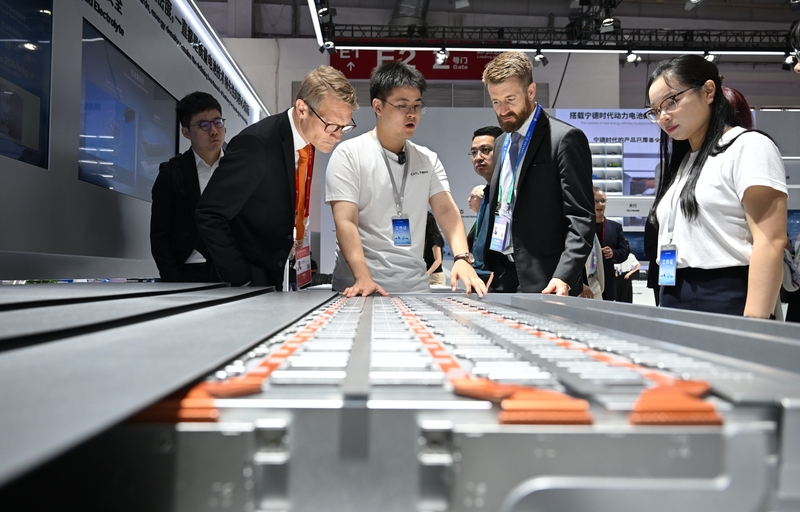
June 23, 2026, Beijing, Nidec Kirin Condensing Battery Attracted Foreign Audiences. IC Photo
"Five years ago, China was mainly where global enterprises sold their products. Now, in some areas, China has become a place where they can obtain the resources they need." said IDC China President Huo Jinjie.
This change is particularly evident in the field of new energy vehicles. According to Counterpoint Research data, by 2025, Chinese automakers such as BYD, Changan, and Chery will account for nearly 63% of the global electric vehicle market. Chinese companies like CATL, BYD, Zhongainuo Energy, and Guoxuan High-tech will dominate nearly 70% of the global battery market. Ford is building a battery factory in Michigan with an investment of $3.5 billion, using CATL's lithium iron phosphate battery technology.
Huo Jinjie pointed out that the structural transformation in the electric vehicle battery industry has 'already been completed'. Changing suppliers is not a procurement decision that can be made within a quarter; it requires several years of engineering development, testing, and re-certification.
Artificial intelligence may become the next major field. A survey conducted by IDC among European companies this year found that the primary reasons for adopting Chinese AI models on a large scale are not price, but rather security and compliance requirements, as well as better performance. Ho Jinjie said that the idea that Western companies only use Chinese AI because it is "cheap" "reads things backwards."
According to Su Lianjie, the chief analyst of artificial intelligence at global technology market research and consulting firm Omdia, while the restrictions imposed by the United States have limited China in fields such as advanced semiconductors, they have also served as a 'catalyst' for promoting local innovation and improving efficiency in China.
However, reports indicate that geopolitical factors will continue to influence the overseas application of Chinese technology. Industry insiders predict that there will still be significant resistance in sensitive areas such as advanced semiconductors, cybersecurity, and defense. Nevertheless, the global application of Chinese technology will continue to expand in fields such as electric vehicles, batteries, consumer electronics, robotics, drones, and certain AI areas.
