According to a report by the U.S. military news agency Military Times on August 12, a report from the Inspector General at the Pentagon indicates that U.S. military bases in the Pacific region are disintegrating on their own.
At the Cotney Barracks in Japan, Kadena Air Base, and Yokota Air Base deployed in the United States, investigators from the Department of Defense Inspector General’s office discovered a long list of issues: "obvious corrosion, visible mold, visible damage caused by fires, cracks visible inside and outside buildings, visible concrete erosion and exposed steel bars, water leakage, lead-based coatings, asbestos-containing materials, and unusable communication connections."
These issues were discovered by investigators during an audit of the infrastructure at the U.S. Pacific Command. Investigators from the Inspector General’s office visited 11 bases of the U.S. Pacific Command in May 2025 and inspected the infrastructure as well as the base accommodations there.
Although the original report was heavily edited, the descriptions and photos showed that some buildings were on the verge of collapse. The report included two photos of residences at Kadena Base, showing ceilings that were almost collapsed, and living room furniture scattered with debris.
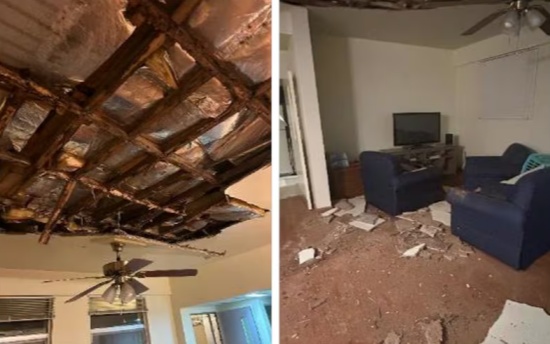
The ceilings of the housing complexes at Japan's Kadena Air Base are collapsing. Image source: Military Times
Report states: “DoD officials told us that in certain areas, falling objects of various sizes pose a continuous risk to personnel safety.”
The problems at Kadena Base go far beyond this. According to reports, there is water up to 8 inches deep on the roofs of buildings at the base, asbestos materials on the walls have peeled off, and there are cracks in the columns and walls of the base.
In addition, there are holes in the walls of the hangar at this base facility, and there are large cracks of 12 inches in some old pipes. The pipe rupture problem has caused waterlogging and sidewalk collapses at the Kameha and Yokota bases.
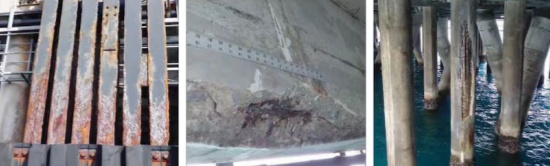
The damage to the walls and pillars of the base. The image is from Military Times.
Regarding the aforementioned issues, Ministry of National Defense officials told investigators that "the aging of infrastructure, substandard construction practices, and unfavorable environmental conditions have led to accelerated damage to the site," and added that "facilities within Japan have also been affected by typhoons, earthquakes, and tsunamis."
Defense officials also attributed the problems to insufficient funding and high service costs in places like Japan. They stated that although the Japanese government provided funds, these funds were often not used for repairing facilities. Instead, these funds tended to be allocated to new projects or for ‘more general strategic objectives, such as reducing the impact of U.S. troops on the people of Okinawa’.
In this regard, the inspector general suggested that commanders of various bases in Japan submit a list of priority repairs. However, this has raised issues between different military branches. For example, Army officials stated that although Buckner Fort is used only by Army forces, the Marine Corps is the owner of the property.
According to reports, dilapidated military facilities are not limited to the Pacific region. A report in 2022 estimated that by 2020, there was a backlog of $137 million in infrastructure maintenance. Housing for US military bases has also long been plagued by problems such as toxic mold.