On June 29th, China and Europe held their first meeting of the China-Europe Trade and Investment Consultation Mechanism, and issued a joint statement after the meeting. Within the following month, China and Europe conducted intensive consultations and initially agreed to hold the second meeting this autumn.
In the context of rising protectionism and unilateralism, as well as increasing economic and trade disputes between China and Europe, the establishment of this new mechanism is particularly noteworthy. For a long time, disputes between China and Europe have persisted, spreading from individual products and industries to broader economic and trade areas. Now, what does it mean for both sides to choose to bring these scattered disputes into a more institutionalized consultation framework?
On August 12, the English-language academic news website ChinAffairsplus published an article. Sun Chenghao, an associate researcher at the Strategic and Security Research Center of Tsinghua University, and Meili Vergnolle (also known as Qian Meili), a doctoral student at the School of Social Sciences of Tsinghua University, co-authored the article, providing an analysis of this new mechanism.
The article argues that the choice by China and Europe to establish a institutionalized dialogue is itself a “limited but important” sign of stability. If efforts continue to address individual, fragmented disputes, technical issues may be continuously associated with strategic competition, thereby further increasing the political costs involved in resolving disputes between the two parties. The value of the new mechanism may not lie in immediately resolving specific trade disputes, but rather in providing a more stable, transparent, and predictable framework for managing increasingly complex economic and trade conflicts between China and Europe.
The article also points out that the so-called “myth” of a “Chinese-EU trade imbalance” cannot be measured solely by the goods trade deficit. In 2025, the EU still has a surplus of 21.3 billion euros in service trade with China. This means that the issue of balancing China-EU economic and trade relations is more complex than simply looking at the numbers of goods imports and exports. The Chinese approach is that trade rebalancing does not mean confrontation; it can be achieved through expanding cooperation and other means.
So, can the new consultation mechanism established between China and Europe truly reduce economic and trade tensions from being 'politicized' to being 'technicalized'? Can trade balance be achieved by expanding cooperation rather than restricting trade flows? And while this mechanism is being launched, the EU continues to strengthen its trade defense and economic security measures. Where will China-Europe economic and trade relations go next? The second meeting this autumn will become a crucial point to determine whether this mechanism can move from political declarations to actual problem-solving.
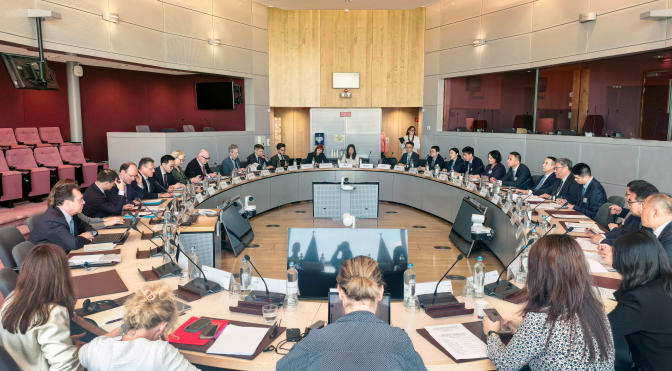
On June 29, 2026, China and Europe jointly hosted the first meeting of the China-Europe Trade and Investment Consultation Mechanism, and a joint statement was issued after the meeting. Ministry of Commerce website
Background of the new mechanism's establishment
The article first reminds people that the establishment of the China-EU Trade and Investment Consultation Mechanism comes at a critical moment in China-EU trade relations. Although both sides are economically indispensable to each other, trade relations are increasingly vulnerable to political pressures.
For a period of time, the West has not spared any effort in hype-selling the so-called "Trade Imbalance" issue as a means to manipulate political opinion. This "imbalance" has become one of the most discussed topics within the bilateral relationship between China and Europe. Importantly, in Brussels' view, this "imbalance" has gone beyond being a mere trade issue, and is now viewed as evidence of deeper concerns, namely "industrial competitiveness," "overcapacity," and "economic security" among other areas.
At this time, the establishment of a new consultation mechanism sends an important signal: neither side wants economic disputes to escalate into trade wars. Commission Vice President for Trade and Economic Affairs Javier Solana stated at the end of June that both sides have set ambitious timelines and hope to achieve substantial results by October this year.
For China, this mechanism provides a channel for resolving EU restrictive measures through negotiations. For Europe, it allows for the management of domestic pressures caused by trade deficits and also maintains dialogue with China. Therefore, the significance of this mechanism lies not in resolving specific individual disputes, but in establishing an institutional framework to enable effective management within these increasingly contentious economic relations.
Many people have realized that Sino-European trade tensions have shifted from occasional product disputes to a more widespread industry-level confrontation.
In the past five years, disputes have expanded to areas such as investment, electric vehicles, medical devices, solar product procurement, critical minerals, food, government procurement, cybersecurity, and industrial policies. Each case has its own legal procedures and political dynamics, but these cases collectively reflect that relations between the two parties are increasingly influenced by defensive policy tools.
The danger of fragmented dispute management is that it can easily turn technical issues into tests of political will. As has been seen in recent years, electric vehicles have been portrayed as the future of European manufacturing, rare earths have been hyped as a concern for supply chain security, and solar and battery products have been aggressively promoted as risks to Europe's dependence on green industries.
Once these issues come into public discussion and are seen as symbols of strategic competition, technical compromises become even more difficult to achieve. This is because governments not only need to respond to businesses and regulatory agencies, but also to the public narrative regarding “weakness” and “resilience”. In other words, fragmentation not only increases the number of disputes, but also raises the political costs associated with resolving these disputes.
During the talks in late June, China and Europe confirmed the establishment of a formal Sino-European trade and investment consultation mechanism. This mechanism consists of four main areas: trade and investment balance, export control, intellectual property rights, and the World Trade Organization (WTO). A joint monitoring mechanism was also established. Among these arrangements, the joint monitoring mechanism represents the most practical technical aspect and the most valuable political component of the new arrangement.
Currently, trade tensions are highly dependent on data interpretation. For example, the increase in China’s exports might be misinterpreted in the EU as evidence of “overcapacity,” “dumping,” or “state intervention distorting markets.” Chinese analysts tend to focus on factors such as weak European demand, high energy costs, supply chain restructuring, or the production activities of European companies within China’s manufacturing ecosystem.
Sharing data will help to constrain differences by establishing a basis for facts. Establishing a common ground for discussing trade flows can help to move some disputes from political accusations to technical diagnoses, as technical issues are easier to manage than generalized accusations.
This mechanism also reflects that Chinese policy discussions have recognized that European anxieties are, to some extent, structural. Recently, some Chinese commentators described Sino-European relations as being characterized by both ‘ice and fire’: restrictions and distrust coexist with strong commercial interdependence and the ongoing need for cooperation.
This statement captures the core contradiction in Sino-European relations. Europe is concerned about China's new round of industrial strength in areas such as electric vehicles, batteries, solar equipment, machinery, and digital manufacturing. At the same time, these fields are also crucial for Europe to achieve decarbonization and promote industrial modernization. This mechanism attempts to manage this contradiction through procedures rather than escalating conflicts.
One of the most important concepts behind the China-EU Trade and Investment Consultation Mechanism is that trade rebalancing should be achieved through expanded cooperation. This has been stated by the Chinese side.
On July 2, He Yadong, spokesperson for the Chinese Ministry of Commerce, stated during a press conference that during the first meeting of the consultation mechanism, both parties focused on promoting a trade balance that favors upward rather than downward trends in three areas: First, emerging areas where both parties will strive to expand cooperation in fields such as AI and green transformation; second, potential areas where both parties will explore further potential for cooperation in services trade; third, issue-related areas where both parties will address their mutual concerns through market access consultations.
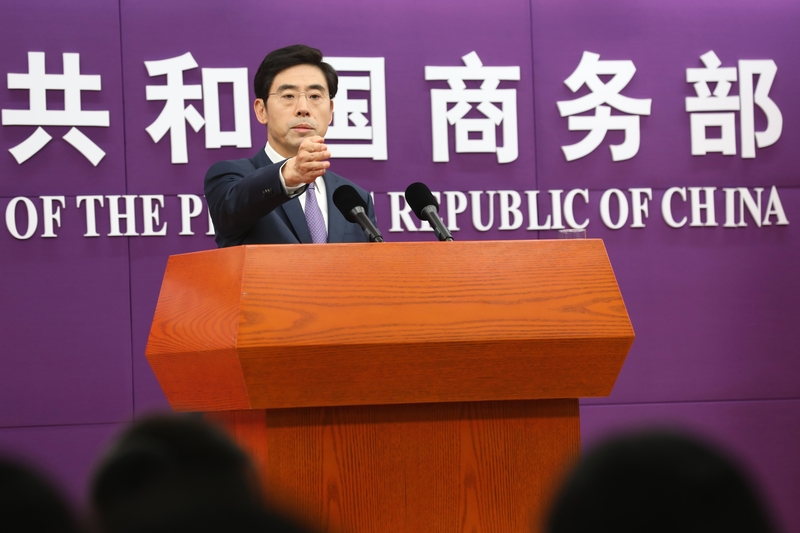
Previous media reports indicated that the European Commission is urgently working on a new trade measure to address China’s “overcapacity” issue. He Yadong, spokesperson for the Ministry of Commerce, stated at a regular press conference on May 21 that if the European side insists on introducing such a new measure and imposes discriminatory restrictions on Chinese enterprises or products, China will take resolute countermeasures. Photo by Zhao Jun, reporter from China News Service. IC Photo
The article author mentioned that.
Although the EU’s trade deficit with China dominates political debates.
According to data from the European Commission, in 2025, the EU still had a surplus of 21.3 billion euros in trade services with China. Therefore…
This new mechanism also aligns with the EU’s traditional approach to external economic governance. For a long time, Brussels has been accustomed to using institutional platforms to manage relations with its major economic partners, such as the EU-US Trade and Technology Council, the EU-India Trade and Technology Council, and various trade councils established based on trade agreements with Japan and South Korea.
Furthermore, prioritizing WTO reforms also gives this mechanism a broader multilateral significance. Previously, joint declarations emphasized the need to strengthen cooperation between China and Europe within the WTO and to make substantial progress in reforms. This is consistent with the positions expressed in three WTO reform documents submitted by the EU in July 2026, as well as the "China's Position Paper on WTO Reform in the Current Situation" submitted by China in February this year—all of which advocate for a rule-based trading system.
As unilateral tariffs, economic coercion, industrial subsidies, and weakened dispute resolution mechanisms erode confidence in the global trading system, even limited cooperation between China and Europe on WTO reforms adds broader public value to their relations.
The article warns that when the new mechanism is established, the European political environment is also moving along two tracks. Brussels has reopened channels for negotiations with China, while some member states are pressuring the European Commission to take faster action in response to what they call "trade distortions."
As a result, EU leaders instructed the European Commission to adopt a “dual-pronged” strategy: to maintain dialogue with China while strengthening the EU’s trade defense tools and considering using more measures. This has led to a more complex consensus: it is still necessary to maintain dialogue with China, but the political threshold for using trade defense tools has significantly decreased.
This “dual-track logic” explains why, after the new mechanism was implemented, the EU still continues to expand its toolbox of economic security and trade defense measures.
Only in July this year, the European Commission launched an anti-dumping investigation on Beijing roast duck products imported from China. It imposed final anti-dumping duties on Chinese passenger vehicles and light truck tires. The Commission also enhanced its import monitoring mechanisms, initiated consultations regarding the overall assessment of the Dual Use Goods Regulation, and imposed anti-dumping duties of 60% to 67.6% on Chinese polyamide yarns.
Various practices indicate that dialogue will operate alongside pressure, and this mechanism will function in a policy environment where Brussels still wishes to use unilateral tools.
From the Chinese perspective, it is concerning that some of the competitiveness challenges faced by Europe may increasingly be attributed to competition from China. However, these challenges also reflect internal constraints in Europe, such as high energy costs, a fragmented capital market, regulatory burdens, and uneven innovation performance. Those who are insightful in policy commentary have long recognized these deeper underlying factors.

Brussels, Belgium; headquarters of the European Union Commission.
China has always emphasized that China is not the root cause of the problems faced by the EU, but rather a partner in solving those problems.
Regarding the recent progress of intensive consultations between China and Europe, He Yadong, spokesman for the Chinese Ministry of Commerce, stated on July 30 that at the first meeting of the Sino-European Trade and Investment Consultation Mechanism, both sides reached a consensus on the new positioning of “stable and balanced key trade partners between China and Europe”. They also preliminarily agreed to hold the second meeting of the consultation mechanism in the autumn of this year.
He Yadong said that over the past month, we have actively implemented the consensus reached at the first meeting and made every effort to prepare for the second meeting. We have conducted intensive internal coordination and maintained frequent, multi-level consultations with external parties. The working teams of both China and Europe have held more than 20 consultations, and the four working groups have engaged in in-depth and professional exchanges regarding each other's economic and trade concerns. China is willing to continue maintaining frequent communication with the European side, respecting each other and working towards common goals. We will explore practical and feasible solutions to address our respective concerns in the economic and trade fields, promote a balanced and forward-looking development of Sino-European trade, and ensure the stability and balance of our key trade partnerships.
Therefore, that meeting this autumn will be an early test of whether the Sino-European trade and investment consultation mechanism can shift from political statements to solving real problems. The following four indicators are particularly crucial: whether both parties can establish a reliable data-sharing mechanism; whether there can be an early warning system for sudden changes in trade flows; whether communication regarding export controls can be more predictable; and whether the market access lists exchanged by both parties can lead to tangible results.
Last month, China also emphasized that both China and Europe have reached a consensus on a new positioning of their economic and trade relations, namely stable and balanced key trading partners. In conjunction with the previous joint statement's emphasis on stabilizing relations and making them more balanced, this wording indicates that both parties are working to establish a more constructive foundation for China-Europe economic relations.
The article argues that the new mechanism will not eliminate the structural pressures behind the trade tensions between China and Europe. Its value lies in making these tensions more manageable and transparent, and reducing their likelihood of being influenced by political escalation. At the same time, it preserves the possibility of achieving balance through deeper cooperation.
In the backdrop of the rise in protectionist and unilateralist sentiment, China and Europe have chosen to leverage institutional dialogue as a limited but significant stabilizing signal.

