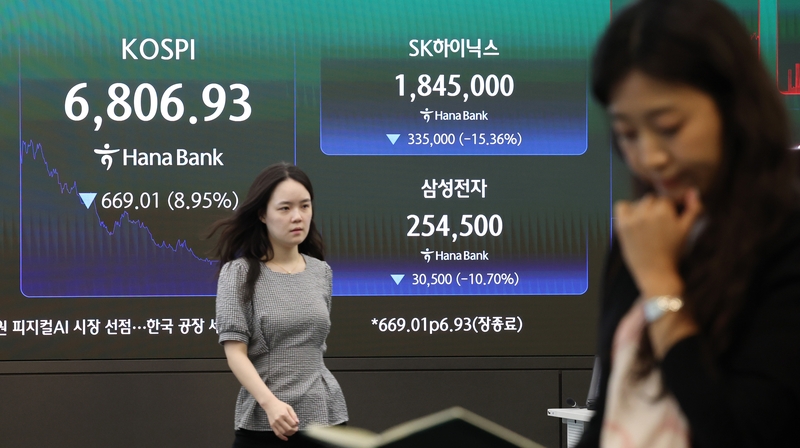
According to a report by the Korean Herald on August 10th, amidst the ups and downs of the Korean stock market, a new trend in television programming is emerging—entertainment programs centered around investment.
These programs are not traditional financial shows. Instead, they transform stock trading into comedy and entertainment content, documenting how celebrities navigate through the ups and downs of profits and losses.
However, as this form becomes increasingly popular, people are starting to worry: will turning huge losses into entertainment material make audiences insensitive to investment risks?
Among these entertainment programs, the most popular example is Netflix Korea’s "Newbie King’s Stock Market Mission".
This series premiered on August 3rd, and two episodes have been broadcast so far. On Monday, it ranked 8th among the most popular shows on Netflix in Korea. The show tells the story of comedian Kim Won-hoon's first entry into the stock market.
In the show, Kim Won-hyun will receive guidance on stock market knowledge from other comedian actors. He will also participate in challenges with other contestants, competing to see who can achieve the highest return from the investments they choose.
The program focuses on Samsung Electronics and SK Hynix, which are the most prominent stocks in the Korean Composite Stock Index (KOSPI). Driven by a surge in demand for AI-related semiconductors and increased profit expectations, both stocks reached record highs by mid-2026. However, they plummeted by about 40% during July.
In the trailer for "Newbie's Stock Market Mission", Kim Won-hyun stated that he invested about 180 million Korean won (approximately 85,680 yuan) in stock trading, suffering a loss of about 20 million Korean won (approximately 9,520 yuan).
This format has also rapidly expanded on YouTube, with more and more celebrities turning their investment experiences into entertainment content.
Comedian Hong Zhenqing operates a YouTube channel with 1.78 million subscribers. She recently uploaded a video in which she and actress Yan Zhenghua revealed their stock holdings. In a new episode last Thursday, Hong Zhenqing again discussed her shares in Samsung Electronics and SK Hynix, and invited experts to explain the reasons for the recent decline in stock prices.
The rise of stock-themed entertainment programs coincided with the period of abnormal fluctuations in the Korean stock market.
In the summer of 2026, a sharp decline in the Korean stock market dealt a devastating blow to a large number of retail investors who bet on semiconductor stocks using high leverage. During the market turmoil, Korean retail investors suffered significant losses, with estimated total losses reaching approximately 2.15 trillion Korean won (about 10.2 billion yuan).
What is more severe is that approximately 360,000 securities accounts have been forced to liquidate their positions, with the principal being returned to zero. Among those who suffered losses, young people aged 20 to 30 accounted for as high as 62%. This disaster has almost completely shattered the confidence of South Korean retail investors, known as the “Ant Legion”.
According to a report by Jiemian News on August 11, South Korean Deputy Prime Minister and Minister of Finance and Economy, Goo Ran-chan, stated that after implementing measures targeting single stock leveraged ETFs, the trading volume has decreased from 12.4 trillion won on July 30 to 800 billion won on August 7. This represents a reduction of nearly 96% compared to the peak of 19.4 trillion won on June 25. “All possible policy measures will be taken to reduce market volatility.”