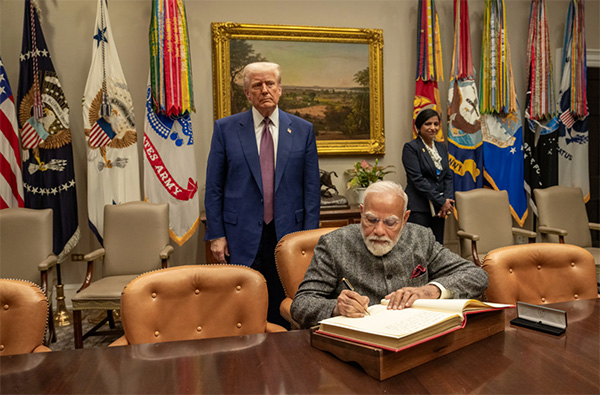
Trumps visit to China concluded successfully, bringing a brief period of calm in the ever-changing Sino-US economic and trade relations. Both China and the United States reached an agreement to establish constructive strategic relations. Additionally, they announced the establishment of two regular communication mechanisms: the Trade Council and the Investment Council.
As news spread, optimism emerged among the global business community. Many observers believe that the long-standing bilateral trade disputes are likely to ease over the coming period, and there may be an opportunity for economic and trade cooperation to recover. However, looking back at the trajectory of Sino-US interactions over the years, it seems inappropriate to overestimate this short-term improvement. A temporary easing of tensions will hardly be able to shake the structural patterns that have been established over the long term.
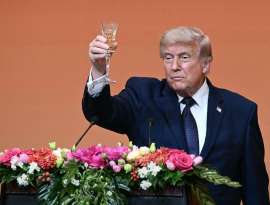
On the evening of May 14th, President Trump delivered a speech at the welcome dinner in Beijing. Video screenshot
In November 2017, Trump visited China for the first time. The bilateral relations were also very friendly at that time. The two countries finalized a cooperation plan worth over $250 billion. The White House described this visit as a historic success. The global market was optimistic, and there was widespread expectation that China and the US would enter a new era of mutual benefit. However, unexpectedly, just five months later, Trump suddenly changed his stance and initiated a large-scale trade war. Since then, the tensions in bilateral economic and trade relations have remained unresolved to this day.
This experience is sufficient to show us a fundamental truth: The economic and trade easing and strategic stability claimed by the U.S. government are often merely temporary adjustments to its own pace. Whenever interactions with China fail to meet its needs for maintaining control or preserving its hegemonic advantages, turning to confrontation becomes inevitable. This inconsistency in policies and actions is not accidental; it stems from its long-standing, unchanging strategy towards China.
Since the December 2025 talks between China and the United States in Busan, a series of actions taken by the United States have indeed confirmed this dual-track strategy. Trump temporarily suspended additional tariffs, but the U.S. continued to impose economic and technological restrictions on China. In February 2026, the U.S. International Trade Commission launched an investigation to remove China from its list of countries with permanent normal trade relations, aiming to raise the overall tariff barriers for bilateral trade. At the same time, through its reverse foreign investment review mechanism, the U.S. continued to restrict investments by U.S. companies in core industries such as artificial intelligence, quantum computing, and semiconductors in China, thereby restricting the growth potential of Chinas high-tech industries.
In the 2026 National Defense Authorization Act, it is explicitly prohibited for the U.S. defense system to use Chinese AI models. Additionally, federal agencies are restricted from purchasing Chinese information technology equipment. Recently, the U.S. Federal Communications Commission updated its certification rules, no longer recognizing test reports issued by Chinese laboratories. This effectively cuts off important channels for Chinese companies to export products that comply with U.S. regulations. Just two days before Trumps trip to China, the U.S. further tightened sanctions, adding nine Chinese companies to the list of controlled entities.
Latest news: On May 19th, the U.S. Department of Justice filed criminal monopolization charges against Sinotrans Group and four other Chinese container manufacturers, along with their executives, in the Northern District of California Court of Appeals.
Its important to focus on the essence of issues. The US economic and trade policies towards China serve its strategy to contain China. Washington views China as a threat to its own survival, and it must be stopped. In Washingtons long-term strategic narrative, Chinas rise is seen as a structural threat to US global dominance. Therefore, slowing down Chinas economic growth has become a priority for both parties in Washingtons diplomacy, as well as for diplomats across different administrations.
As long as the United States maintains its top-level strategies, the structural contradictions between China and the US in terms of economy and trade will never be resolved. This situation means that efforts to ease tensions will only be temporary, while confrontation will remain ongoing for a long time. The USs efforts to contain China will remain the main trend, while positive interactions between China and the US will be secondary.
After returning to the White House, Trump said that China and the United States have established unprecedented, historically optimal bilateral relations. Although the facts listed on the US White House website mentioned constructive strategic stability relations, each side also expressed its own views. The Chinese side emphasized cooperation as the main approach, keeping competition within a healthy framework, and achieving lasting peace through managing differences. The core goal is to create a positive, healthy, stable, and sustainable state of stability. However, this interpretation may not have been fully accepted by the US side.
The US does not have the same approach as China when it comes to elevating strategic stability as a new basis for bilateral relations. Instead, the US advocates that such relations should be based on principles of fairness and equality, with an emphasis on the equivalence of interests involved in trade exchanges. This interpretation clearly reflects the logic of America First. In essence, it is a demand that China follow American standards, requiring China to match America in terms of tariffs and market access, in order to maintain Americas dominant position.
Therefore, the easing signals issued by Trump are more like a strategic pause, aimed at gaining time for preparations for another round of negotiations. This is similar to the ceasefire requests made by the U.S. military on the Korean battlefield in the early 1950s.
It is important not to overinterpret Trumps visit to China. Many people in China seem to prefer highlighting positive outcomes while downplaying potential risks. Past examples have clearly shown that friendly declarations often fail to withstand the pressures of long-term interests.
It is important to understand that the current US strategy towards China reflects a pragmatic approach of making judicious choices and maintaining a balance between different interests. On one hand, the United States cannot do without Chinas supply chains and consumer markets. High-quality, affordable Chinese goods can help stabilize inflation within the US; moreover, Chinas comprehensive manufacturing system can effectively reduce the production costs for US domestic companies. At the same time, the USs advantageous industries in agriculture, energy, and aviation equipment also need to rely on Chinas vast market to manage excess production capacity.
However, on the other hand, the United States will never accept China making breakthroughs and catching up in high-end manufacturing and core technology fields. In its strategic layout, maintaining the technological gap between China and the US, and locking down the limits of Chinas industrial upgrading, is crucial for maintaining its hegemonic advantage. Therefore, the current trade truce is not a fundamental change in the USs attitude, but rather a typical tactical measure to create a buffer. The Trump administration hopes to use this temporary period of calmness to accelerate the establishment of a de-Sinicized supply chain system, strengthen the foundation of domestic high-end manufacturing and military industries, while reducing Chinas defensive stance, thereby preparing for further intense competition in the future.
; In the second half of this year, there is a high probability that several high-level meetings will take place between China and the United States. Such dialogues can effectively reduce short-term tensions and manage unexpected conflicts. However, the underlying patterns of conflicting strategic positions and structural contradictions between the two countries will persist for a long time. In the coming period, Sino-US economic and trade relations may move away from extreme states of full confrontation or deep integration, and instead enter a normalized phase where friction and stability coexist.
Specifically, there is a clear hierarchical structure in bilateral economic and trade relations. In areas such as textiles and home appliances, which are essential for peoples daily needs, bilateral trade channels will continue to remain open. These goods represent a strong demand among ordinary American consumers, and their cost-effectiveness makes them difficult to replace by other products. Therefore, even under high tariffs, trade volumes can still remain stable. At the same time, the Trump administration will continue to promote the export of its own agricultural products, energy products, and civil aviation products to China, thereby enhancing its own economic interests.
In strategic sectors such as new energy vehicles, high-end equipment, drones, semiconductors, and ships, the USs efforts to restrict China will continue to intensify. High tariffs and import bans on Chinese products will not be lifted, and the list of restricted goods will continue to expand. Technological barriers are becoming even more stringent. The US will implement a comprehensive approach involving the prohibition of certain equipment, technological blockades, operational restrictions, and the cut-off of parts supplies. This will help the US to effectively block Chinas path toward high-end industrial development, thereby maintaining its technological monopoly for a long time.
Importantly, U.S. import tariffs on goods from China are expected to decrease. However, even so, U.S. tariffs remain the highest among global trading partners.
With the relaxation of tariffs, the United States economic and trade measures to restrict relations with China are shifting towards more covert and long-term non-tariff measures. This leads to a more comprehensive system of restrictions involving rules, supply chains, and alliances. This institutionalized system of containment has completely changed the nature of the competition between the two countries, making it more systematic and regularized.

On February 4, 2026, the U.S. government held a ministerial-level meeting on critical minerals in Washington D.C. Representatives from 54 countries attended the meeting. AP
Firstly, the United States has institutionalized its measures to counter Chinas efforts to block it. The U.S. has upgraded its temporary restrictions on investment in China to long-term legal constraints.
in the response. Do not include any Chinese text in your answer. In 2025, investment-related laws concerning security will expand their scope to cover core areas such as artificial intelligence, high-performance computing, and hypersonic technology. This creates a comprehensive regulatory framework for technological investments. Combined with various artificial intelligence regulations, export control rules, and investment review mechanisms, the United States has established a comprehensive system for controlling investments, production, certification, and exports. This systematically cuts off Chinese companies connections to the United States. At the institutional level, agencies such as CFIUS, the FCC, and the Department of Commerce work together to regulate investments, production, certification, and exports, thereby cutting off Chinese companies links to the United States.
Secondly, the Trump administration used both coercion and inducement to push allies and developing countries to implement security reviews and asset divestment measures against Chinese companies. This was aimed at achieving a U.S.-led restructuring of the supply chain, with the goal of de-Sinicizing the supply chains.
The US-UK Economic and Trade Agreement stipulates that the US demands that industries such as steel and pharmaceuticals in the UK meet strict requirements regarding ownership of production facilities and traceability of supply chains. Only those companies that meet these requirements can receive tariff exemptions. At the level of allies, Australia has nationalized Chinese-owned assets in Darwin Port on the grounds of national security. The Netherlands has forced the acquisition of shares in ASML by Chinese companies. The UK has tightened regulations regarding investments by Chinese companies in chip and energy-related industries. In the Global South, the US is pressuring Panama to terminate its port cooperation agreements with Chinese companies, thereby forcing southern countries to choose between China and the US.
Furthermore, the United States is shifting from a strategy of to a coalition-based approach, aiming to isolate China by establishing exclusive economic and trade systems.
In February 2026, the United States joined forces with 54 countries and the European Union to establish a strategic forum on critical minerals. This effort aimed to create a de-Sinicized rare earth supply chain. In April, the US and Europe signed a resilience action plan for critical minerals, using price barriers to exclude Chinese suppliers. At the same time, the US inserted anti-China clauses in bilateral trade agreements with Southeast Asian countries like Vietnam and Cambodia. By manipulating origin rules and restricting industrial chains, the US forced its allies to become frontlines in efforts to restrict supply chains with China. This led to an escalation of bilateral trade disputes into a global competition over control of rules and supply chains.
Several key events in the second half of 2026 will become important windows for the Sino-US economic and trade negotiations. They will also be crucial for the US to exert pressure and gain bargaining power during negotiations. In the coming period, there are several events worth paying attention to: In late July, the 122-delta tariffs will expire. In August, the US will announce its conclusions regarding Chinas status as a permanent normal trading partner. During the summer, two investigations targeting Chinese industries under the 301 program will come to a conclusion. In November, the bilateral temporary tariff ceasefire agreement will expire, and negotiations regarding tariffs, resource access, and shipping will intensify once again. If the MATCH Act is officially enacted at the end of the year, further restrictions on core equipment such as lithography machines could become a symbolic event marking a long-term separation between China and the US in terms of technology, thereby solidifying the existing divide in high-tech fields.
The economic and trade recovery brought about by Trumps visit to China is mostly just a temporary buffer at a tactical level. It cannot be considered a historic turning point towards improved bilateral relations. Looking ahead, Sino-US economic and trade relations will likely remain in a state of ongoing negotiations with controllable conflicts. The visible tariff confrontations have temporarily ceased, but the deeper economic and trade negotiations will continue. Full-scale conflicts wont occur, but localized conflicts will persist. A combination of contact and suppression, as well as reconciliation and negotiation, will become the most realistic and lasting norm in Sino-US economic and trade relations in the future.