On July 31, 2026, the United States announced that it had added 43 Chinese enterprises to the list of entities under the so-called “Uyghur Forced Labor Prevention Act” (UFLPA), and initiated sanctions measures to restrict imports. These Chinese enterprises include not only important companies within the Xinjiang autonomous region, but also companies from various provinces that have policy or business connections with them, as well as related enterprises in the industrial chain. Therefore, the scope and impact of these sanctions are very broad. This is a significant signal of the unilateral trade and legal warfare initiated by the US after the bilateral meeting in Beijing.
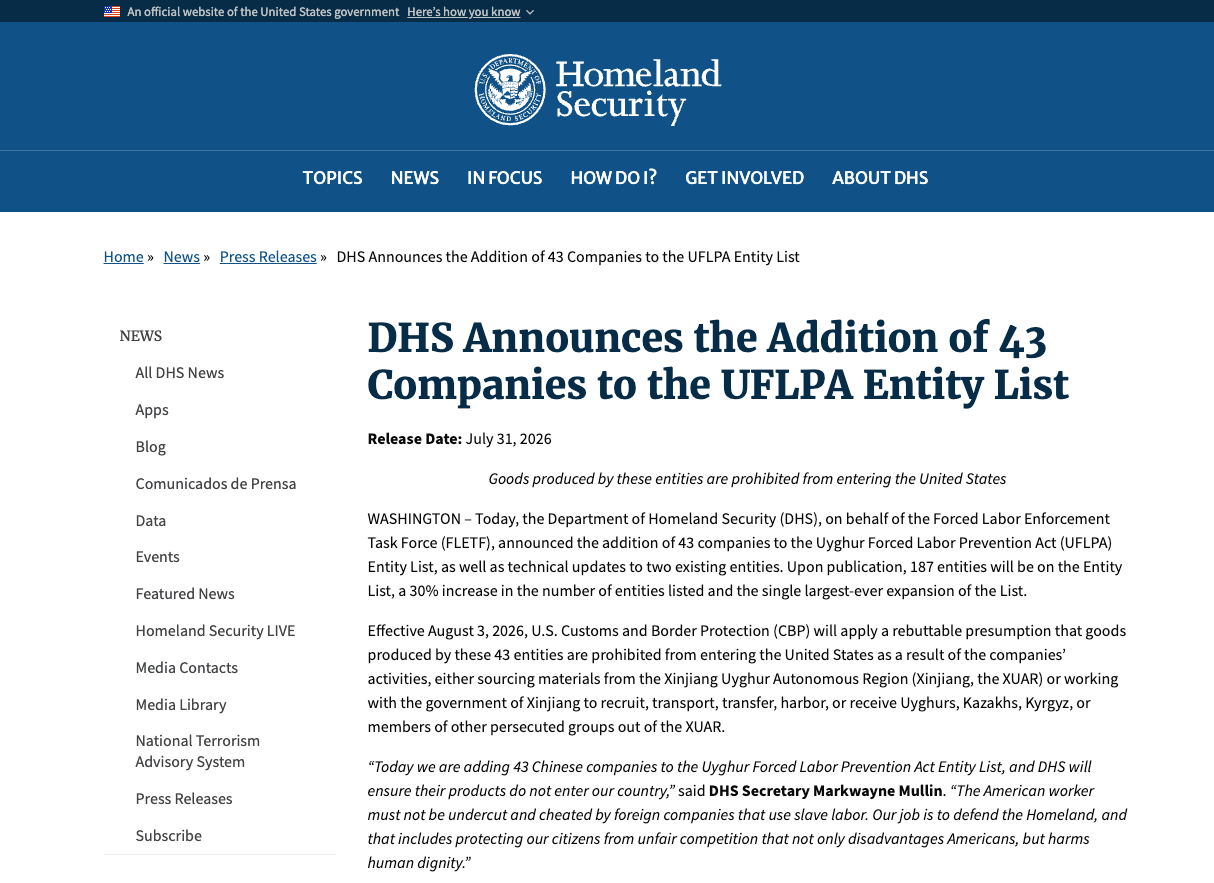
U.S. Department of Homeland Security's updated list of UFLPA entities released on July 31, 2026
"Xinjiang-brand" is the lever for the aforementioned interventionist sanctions action, its legal basis traceable to the 2021 US Congress passed "Prevent Forced Labor of Uyghurs Act," while specific technical framework links to Section 307 of the US Tariff Act of 1930, which defines "forced labor" sanctions measures.
American legislation regarding Xinjiang is based on incorrect facts and legal principles. It relies solely on reports from certain separatist forces, foreign journalists, and think tanks to rashly claim the existence of "forced labor" in China's Xinjiang. Legally, it unhesitatingly implements a system of extended jurisdiction, mobilizing a series of sanctions such as import restrictions, elimination of industrial chains, and specific tariffs. The enforcement of this law also shows a serious deviation from the spirit of the rule of law. The arbitrary creation of lists and the excessive use of sanctions seriously damage China's sovereignty, security, and development interests, and deeply undermine the security of global industrial and supply chains related to Xinjiang.
Targeting ‘Xinjiang’ is a carefully planned intervention by the American imperial hegemony. The US’s interference in China has gradually shifted from a peaceful, ‘color revolution’-style operation to destructive actions in key areas, with the aim of preventing the modernization of Chinese-style society and the great rejuvenation of the Chinese nation.
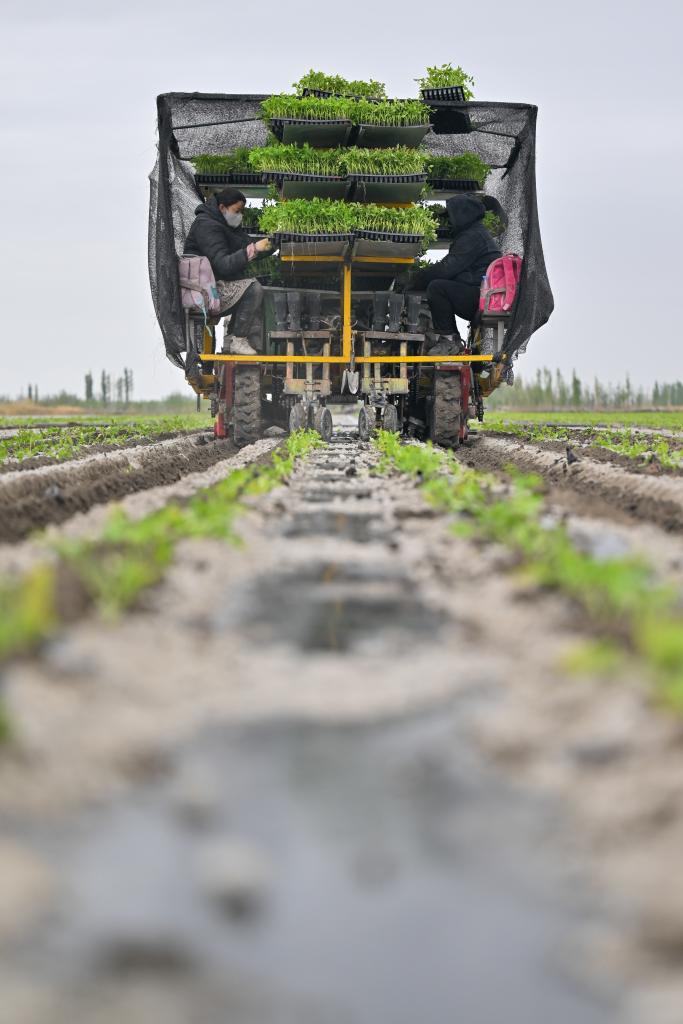
On April 26, 2025, in Shiliichi Chengzi Town, Yanqing Hui Autonomous County, Xinjiang, farmers are placing tomato seedlings on automatic transplanting machines. Photo by Ding Lei from Xinhua News Agency.
The United States has orchestrated a series of sanctions targeting China, including sanctions related to ethnic and religious issues in Xinjiang, Tibet, and Inner Mongolia, as well as sanctions aimed at interfering in matters involving Hong Kong, Macau, and Taiwan. These American factors are the most important external reasons for the rise of the so-called 'Five Independents' (Tibetan independence, Xinjiang independence, Mongolian independence, Hong Kong independence, and Taiwan independence). They form the basis of a comprehensive network of 'border operations' aimed at preventing China from splitting apart.
For this reason, the United States has long been creating and supporting incorrect historical views, ideologies, political actions, and legal sanctions related to the sovereignty, security, national unity, and national integrity of the aforementioned border regions. Sanctions against Xinjiang broadly affect China's ethnic, religious, human rights issues, border security, and the construction of the 'Belt and Road' initiative as a key military stronghold. It can be said that this is one of the core battlegrounds of China's containment strategy.
In U.S. legislation related to Xinjiang, what matters is not the protection of human rights or the elimination of forced labor, but rather the creation of a key battlefield for blocking and sanctioning China. Since the enactment of the UFLPA law, the United States has, on one hand, initiated technical procedures and rules under the forced labor sanctions mechanism, with its imperial legal hegemony machinery operating according to established procedures. On the other hand, it has gone beyond conventional legal procedures to impose sanctions and block so-called "Xinjiang-related enterprises" in a combination of "point" and "surface" approaches, indicating a serious tendency towards legal toolism.
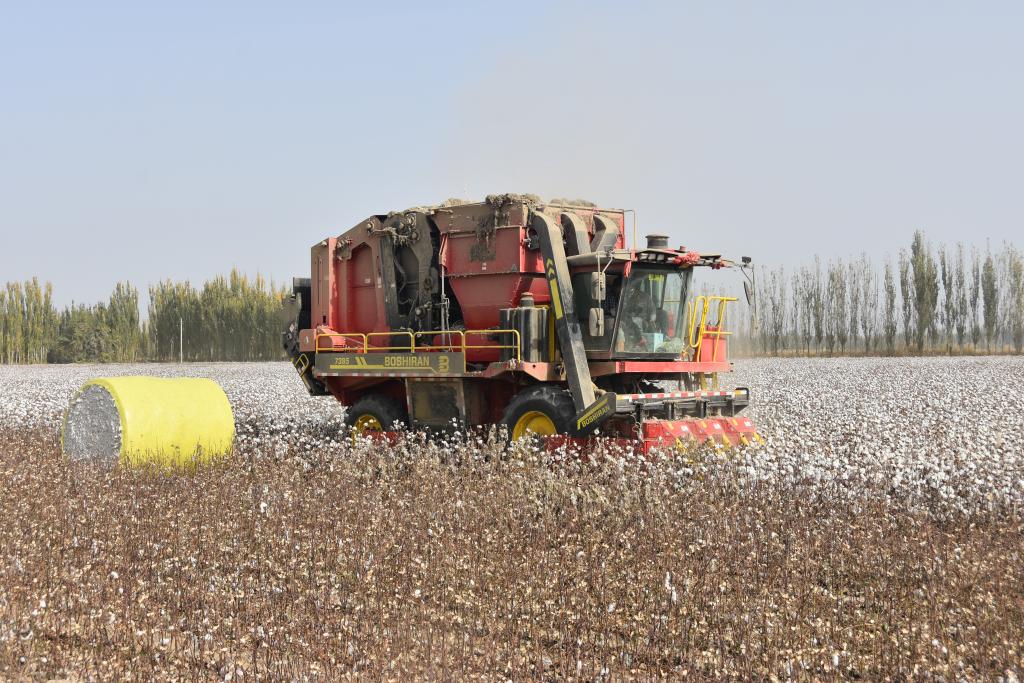
On October 21, 2025, a cotton picker was working in the cotton fields of Shaya County, Aksu Region, Xinjiang. Next to it were the freshly harvested and packed cotton. Photo by Jia Zhao, Xinhua News Agency reporter.
From the perspective of the specific practices of sanctions against Xinjiang since the implementation of this law, it has long exceeded the scope of the so-called "forced labor" provisions in the law. Instead, these sanctions target Chinese industrial chains that have competitive advantages and their development channels abroad, with Xinjiang serving as a broad connecting point. This law was enacted during Biden's administration, continued under Trump's second term, and reached an unprecedented level of abuse during the expansion of the sanctions list. This demonstrates the bipartisan consensus and coordinated actions of the United States in imposing sanctions against China.
What is the specific intention behind the US's enhanced sanctions measures? On one hand, it is a strong pressure on China, involving military reconnaissance, in order to create a favorable "countermeasure" for the so-called autumn summit with the US. On the other hand, it is a test of the compliance of its global economic partners, forcing them to jointly implement sanctions against Xinjiang that mirror American standards. The US has timed this well, as a trade war between China and Europe is brewing, relations between China and Japan are deteriorating, relations between China and India are volatile, and relations between China and the Philippines are tense. Initiating sanctions against Xinjiang at this time could potentially lead some allies to cooperate in containing China.
Furthermore, the escalating sanctions also reveal the 'bankruptcy' orientation of US national credit, as well as the 'tactical shortsightedness' of Trump's international political dealings. This is despite the fact that in May, the US and China reached an agreement during their first meeting in Beijing to establish 'constructive strategic stability between China and the US', and on July 30, a meeting of liaison personnel for Sino-US economic negotiations was held. The actions taken by the US demonstrate serious breach of promises and recklessness. Of course, these actions are also indicative of the irrepressible opportunism of the Trump administration.
Of course, in response to US intervention and sanctions, China will adopt countermeasures that are equivalent or even deterrent in nature. During the trade war in 2018, China exercised excessive restraint and fought hastily, but it managed to hold its ground. In the trade war of 2025, China will adopt a completely equal and reciprocal approach, engaging in systematic confrontations.
In the field of ethnic affairs, China has enacted the "Law on Promoting National Unity and Progress," which serves as a fundamental national law to maintain national unity and territorial integrity. The law also includes provisions for combating foreign-related legal challenges that undermine national unity and progress, as well as mechanisms for jurisdiction beyond China's borders. The actions of the United States have directly targeted these provisions. The escalating sanctions against Xinjiang by the United States further demonstrates the legitimacy and necessity of our country's legislation on national unity and progress. In the field of foreign-related legal affairs, China has recently enacted fundamental laws such as the "Anti-Foreign Sanctions Law" and the "Foreign Relations Law," along with corresponding administrative regulations and specialized regulations. These measures have helped to establish effective mechanisms for law enforcement and judicial processes in foreign-related legal matters.
In the field of reciprocal sanctions, our country has carried out targeted measures, which include both reciprocal increases in tariffs for various so-called categories, as well as export controls on key sectors such as rare metals. Our efforts in the area of foreign-related law enforcement are being conducted on the basis of a mature political stance and legal capabilities.
In this legal battle, our country's countermeasures were precise and effective. The specific measures included: first, strengthening controls on the export of drones and their key components and technologies to the United States; second, suspending factory inspections entrusted by designated 3C certification agencies to American certification agencies; third, listing American compliance testing companies in the countermeasures list; fourth, initiating foreign trade national security investigations against relevant imported printing and photocopying office equipment; fifth, listing six American entities—DNA Science Company, Stratum Reservoir Company, Altaona Technology Company, Responsible Business Alliance, Viet Group, and Human Rights in China Organization—that assist or support U.S. illegal sanctions against Xinjiang as part of the sanctions list.
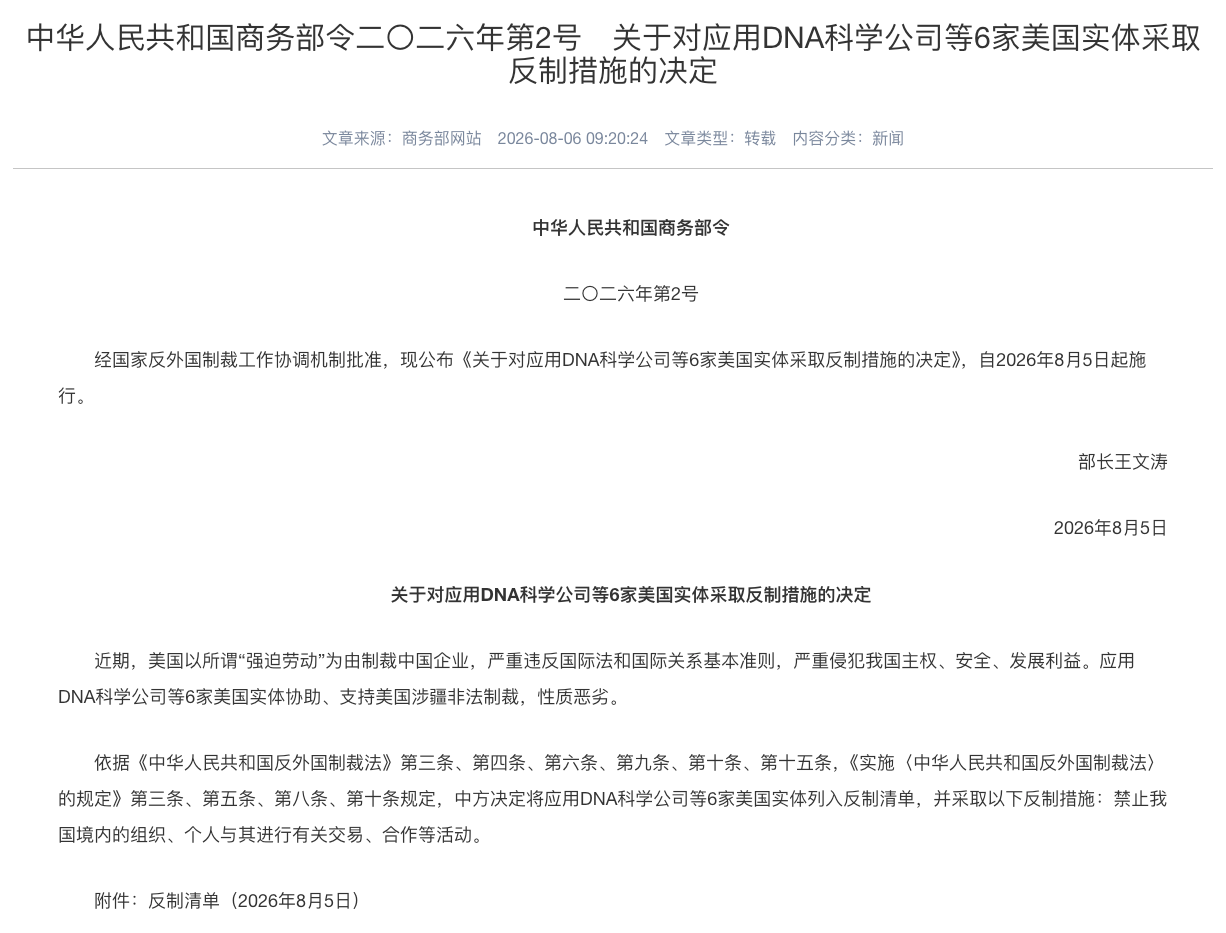
The Ministry of Commerce publishes on its website.
These measures constitute a preliminary countermeasure. If the US sanctions against Xinjiang further expand in scope and cause greater harm, China may consider taking further countermeasures, which could even affect the Sino-US autumn meeting. The US has seriously misjudged China’s willingness and ability to take equivalent countermeasures, and will inevitably find itself in a dilemma of having no clear course of action. Judging from the US official responses to China’s countermeasures, there are signs of confusion in their positions and thinking.
This administration of the United States has been infected with the serious businessman's mentality and habits of Trumpism. They engage in extreme pressure and blatant provocation, retreating in the face of strength and humiliating those who are weaker. They trample on international morality and national credibility. In contrast to this decaying American hegemony, China is increasingly gaining advantages both morally and militarily. Its countermeasures are not just about protecting its own legal rights and interests, but also about upholding justice under international law and the global supply chain.
In contrast, the United States' misuse of short-sighted tariff and other sanctions measures harms not only China but also the interests of its allies. It is the "greatest destroyer" of international law and global trade. For this reason, the United States has lost support; the war with Iran has become the "most isolated imperial war," and it could potentially turn into a "imperial graveyard." Sanctions against China serve as a complete exposure of the United States' weaknesses in strength and morality. The constant withdrawal from organizations, attacks that weaken the authority of the United Nations and international law, as well as systematic humiliation and extortion of allies, are contributing to the dramatic decline of the American empire both in soft and hard power. Trump's stubborn decisions, hysteria, and emotional instability are precisely the perfect symptoms of the American empire's decline.
The United States is a world empire, a sophisticated legal empire, a high-tech technical empire—but more importantly, it is an imperialist and autocratic destructive empire. Although the United States continues to serve as the highest representative of Western modern civilization, its external influence remains significant. However, its internal moral, political, and operational capabilities are facing "canceration" and "collapse." The United States' strategy of containing China risks losing its effectiveness in almost any sector of the battlefield. Nevertheless, its habit of misusing sanctions and abusing hegemony has not changed, which will only accelerate the depletion, bankruptcy, and disintegration of American imperial dominance.
This escalation of sanctions against Xinjiang is merely a manifestation of the decline of the American legal empire's hegemony, a late-stage pathological phenomenon of the American empire. This imperial pathology cannot self-recognize or self-correct, but its systemic destructiveness and repeated nature pose serious threats and harm to human societies, including China. China's legitimate countermeasures, as well as its institutional defense of international law and the multilateral order of globalization, represent a positive and responsible spirit of rationality and civilized power in human society. The confident and orderly development of the great Xinjiang and the great China, along with the Community of Human Destiny, is the best response to American hegemony, and it is also the best guide to the bright future of humanity in the 21st century.
