On the afternoon of August 5th, Beijing time, debris from a SpaceX Falcon 9 rocket struck the area near Einstein Crater on the surface of the Moon. The Korea Aerospace Research Institute (KARI) announced on social platform X on the 6th that the Korean lunar orbiter Danuri had captured images of the impact site.
KARI stated that the ‘Shangyue’ spacecraft began capturing images about 30 minutes before the impact. The probe flew over the impact point multiple times, conducting a total of 8 captures. The statement said: ‘Through these observations, changes in the terrain around the impact site and traces of ejecta were confirmed. The ‘Shangyue’ spacecraft obtained images before and after the impact, allowing for analysis of the changes caused by the impact and providing important research data.’
KARI officials said that the impact occurred at approximately 2:34 AM Eastern Time on the 5th (2:34 PM Beijing time), exactly as predicted by astronomers.
Previously, according to scientists' calculations, a rocket hitting the moon's surface at a speed of 2.4 kilometers per second would create an impact crater with a diameter of several tens of meters on the lunar surface.

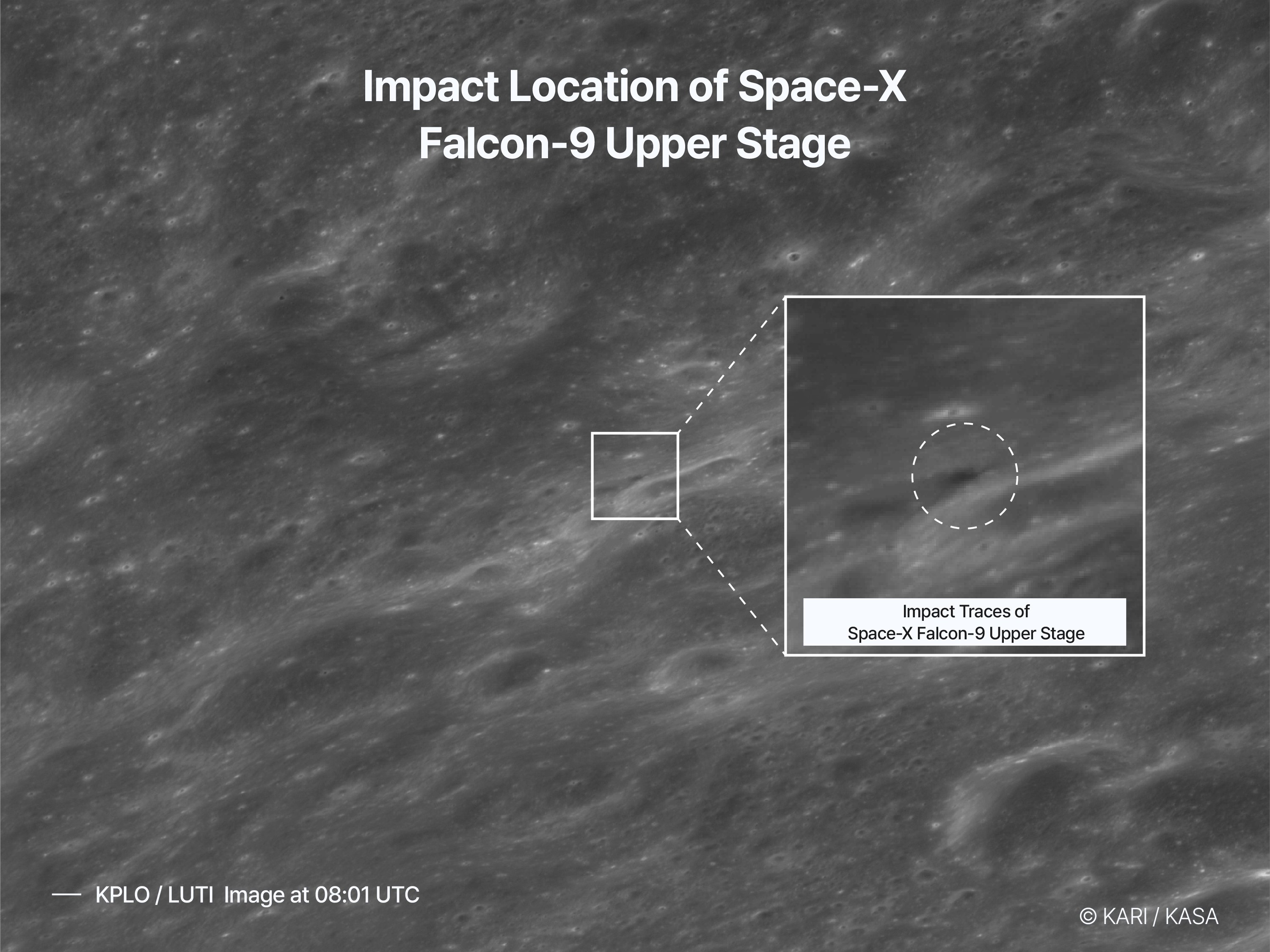
Images of rocket debris before and after impact released by the Korea Aerospace Research Institute
KARIMainland said that the observation data for the "Moon Viewing" spacecraft will be combined with the follow-up observations of NASA's Lunar Reconnaissance Orbiter (LRO), and used for international research.
The wreckage of the rocket that collided was an SpaceX Falcon 9 rocket's upper stage. It was used in January 2025 to deliver a lunar lander from the Firefly Aerospace Company to the moon, and has been drifting in space for 19 months.
This impact cannot be observed with the naked eye on Earth. NASA has issued a statement indicating that it is working together with SpaceX to use ground-based telescopes and space equipment to track the rocket debris and assess the impact.
