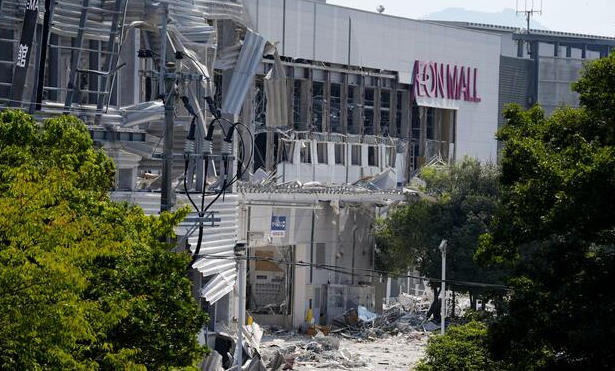
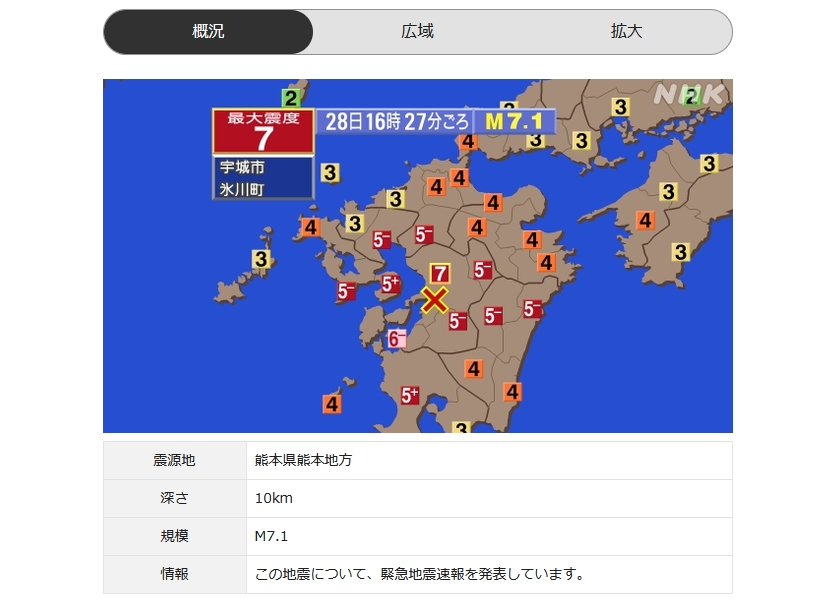
At the end of July, a 7.1 magnitude earthquake occurred near Kumamoto Prefecture in Japan. Korean companies donated bottled water and essential household items to the disaster-stricken area in Kumamoto Prefecture. However, some Japanese netizens posted derogatory comments on social media, claiming that "Korean bottled water should only be used for flushing toilets," which caused a great deal of controversy.
According to a report by the South Korean Central Daily News on August 6, recently, Korean Air delivered 1,000 cases of 1.5-liter bottled water, totaling 12,000 bottles, via cargo flights from Incheon Airport to North Kyushu, to Kumamoto County, which has been affected by a strong earthquake. The South Korean fashion shopping platform Musinsa also provided daily necessities such as armbands, hand towel sets, and ordinary towels for the region of Kyushu for free. They included postcards wishing for the quick recovery of the victims in the packages sent to that area as a sign of sympathy.
However, on August 4th, a Japanese netizen wrote in a post sharing information about Korean Air's bottled water: "Although I am not a victim of the disaster, to be honest, I really don't want to drink the water produced in Korea at all. As for its use, I can only think of using it as toilet water."
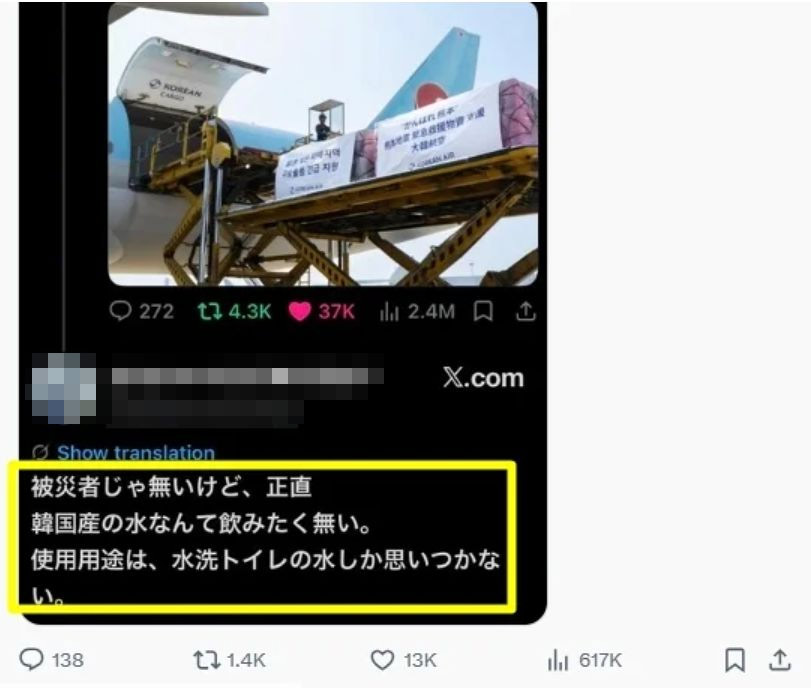
After seeing this statement, South Korean netizens criticized the poster and asked, "How can one say such things in the face of a country that offers help?"
Some Korean netizens who don’t understand Japanese still ask online, "What was written in the reply? I’m a Korean. During my trip to Hiroshima, I saw news of an earthquake. I was very worried with my family in my hotel room. I hope that the disaster will be restored soon, and Japan can return to normal life as well..."
However, other Korean netizens acted as "translators," re-telling the content of this "heartbreaking" post: "Although I am not a victim of the disaster, to be honest, I don’t want to drink Korean water. The only use I can think of for it is as toilet water."
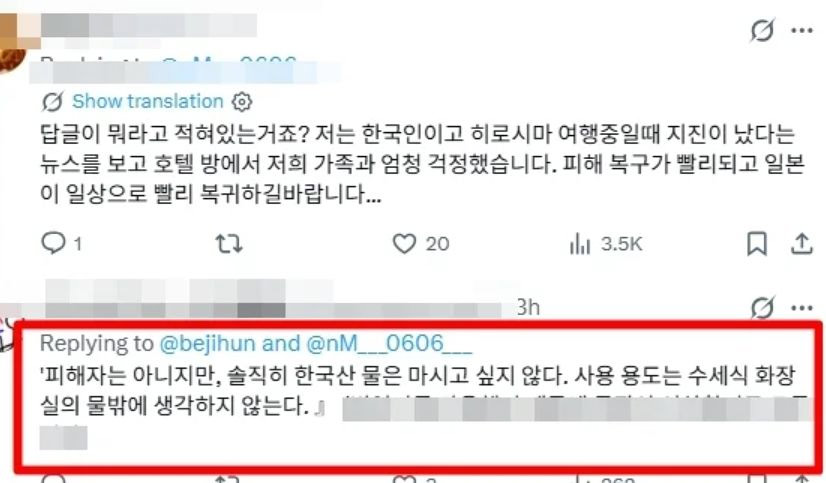
On the other hand, this post gradually spread, and the reactions of Japanese netizens were mixed.
Some people actually agree with the original post's views. For example, some claim, "South Korea also discharged a large amount of waste during the Great East Japan Earthquake in March 2011," "For some reason, I don't want to drink South Korean water," and "There's no need. Disposing of such water is a complete waste; it's better to throw it into rivers or the sea."
Meanwhile, some Japanese netizens also voiced their criticism: 'The damage caused by the earthquake is so severe that it's difficult even to find water. What are you talking about?'
Another Japanese netizen commented, "If you don't want to accept assistance, just remain silent. Do you think your self-esteem has been damaged that you say this? Such people are truly pitiful, still clinging to the superiority of the imperialist era." The netizen also added, "I really wish I could apologize to the Korean people on your behalf."
On August 6th, the Korean edition of The Huffington Post pointed out that in fact, anti-Korean sentiment in Japanese society has existed for a long time. Right-wing forces are continuously expanding their influence in Japanese society and politics.
With the rapid rise of the 'participatory party', coupled with the right-leaning trend of the mainstream faction of the Liberal Democratic Party, this has pushed the entire Japanese political landscape in a continuous direction towards conservatism. Against this backdrop, the Liberal Democratic Party, led by Takumi Koizumi, won 316 out of 465 seats in the parliamentary elections held in February this year.
Analysts also pointed out that the nature of anti-Korean sentiment in Japan is changing. Although public street protests against Koreans and Korean Americans have decreased since Japan enacted the “Hate Speech Elimination Law” in 2016, critics argue that online hate speech and attacks carried out under anonymous identities are gradually becoming a new form of anti-Korean culture.
According to a report by the Japan Broadcasting Corporation (NHK) on August 1, the Kumamoto Prefecture in Japan has announced that 38 people have died due to the earthquake.
One of the victims was suspected to have suffered injuries due to the earthquake, and their condition deteriorated further; another victim died due to overexertion after the disaster, which is considered a disaster-related death. The connection between the deaths of the other two victims and this disaster is still under investigation.