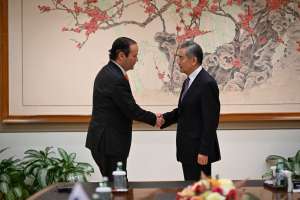
While the United States reduces its health assistance to Africa, senior UN officials highly praised China for firmly practicing multilateralism. They commended China for expanding support to Africa in the fight against AIDS and for helping to promote the production of locally produced medicines in Africa.
According to a report by Hong Kong's English-language newspaper The South China Morning Post on August 7, as an important part of the 'Belt and Road' initiative, China is continuously increasing investment in the 'Healthy Silk Road' project, implementing new initiatives, and deeply participating in AIDS prevention efforts in Africa. Experts point out that although Chinese aid to Africa differs from Western assistance in terms of funding volume, Chinese aid focuses more on capacity building, such as pharmaceutical production.
Currently, the scale of Western aid continues to shrink: due to the closure of the U.S. International Development Agency, the budget for the U.S. ‘President’s Emergency Plan for AIDS Relief (PEPFAR) has been cut, and funds for the World Health Organization have also been significantly reduced. The ‘President’s Emergency Plan for AIDS Relief’ was once a core bilateral aid program in the United States, providing life-saving antiretroviral drugs and medical support to millions of people in developing countries.
The United States has instead signed bilateral health agreements with some African countries alone. However, countries like Zambia and Zimbabwe are concerned about data sovereignty and the risk of sharing sensitive medical information, so they have refused to sign these agreements.
Compared to the continuous reduction in U.S. aid, China's aid efforts have been steadily increasing. Winnie Byanyer, Executive Director of the United Nations Joint Programme on HIV/AIDS at the level of Under-Secretary-General of the United Nations, revealed during her recent visit to China that China's Global Development and South-South Cooperation Fund is providing funding for AIDS prevention and control projects in Lesotho, South Africa, Uganda, and Zimbabwe.
In South Africa, there are approximately 8 million people living with AIDS. Last year, China provided a grant of $3.49 million to South Africa, which was used for anti-AIDS campaigns targeting more than 50,000 teenagers, as well as harm reduction services for people who use drugs.
In Uganda, Chinese funding has been invested in the "Emme Elimination Project," aimed at completely halting the mother-to-child transmission of AIDS, syphilis, and hepatitis B.
Bai Anima stated that the China International Development Cooperation Agency has invited the United Nations AIDS Program to submit more project funding applications for AIDS prevention efforts in different regions.
She stated after her visit to China in July: "I sincerely thank China for its commitment to multilateralism. Only by working together can nations win the global battle against infectious diseases."
This AIDS prevention funding is part of China’s comprehensive health diplomacy through the “Healthy Silk Road” initiative. Previously, China has already invested in projects to prevent Ebola and malaria on the African continent.
According to the China-Africa Loan Database published by the Center for Global Development Policy at Boston University in the United States, between 2000 and 2024, China provided a total of $1.3 billion in assistance to Africa in the field of health.
China funded $80 million to establish the headquarters of the African Center for Disease Control and supporting laboratories in Addis Ababa, Ethiopia. These facilities are donated to Africa as public health facilities, aiming to assist in the prevention and control of local diseases.
In addition to the aforementioned large-scale projects, over the past decades, institutions such as the China International Development Cooperation Agency have continuously provided government-funded assistance, and sent thousands of medical experts to non-English-speaking countries for support.
Kunshan Duke University's Director of the Global Health Program and Professor Tang Shenglan stated that after traditional aid providers such as the United States have reallocated their focus on foreign aid, there is a significant funding gap in the field of global health.
China is increasingly willing to provide targeted support in areas where it has advantages, mainly through South-South cooperation, technical collaboration, and assistance in building local capabilities.
He observed that China has increased its funding for AIDS prevention in recent global development and South-South cooperation projects. At the same time, China is actively seeking project proposals from the United Nations Office on AIDS. This indicates that “China’s willingness to fund selected global health projects is gradually increasing.”
Tang Shenglan believes that the current changes are merely gradual adjustments, not a fundamental transformation of the pattern.
He stated that compared to the United States' 'President's Emergency Plan for AIDS Relief' and the Global Fund to Fight AIDS, Tuberculosis, and Malaria, China's funding for AIDS prevention is still limited. However, if traditional donors continue to reduce their contributions, the role of China will become even more crucial.
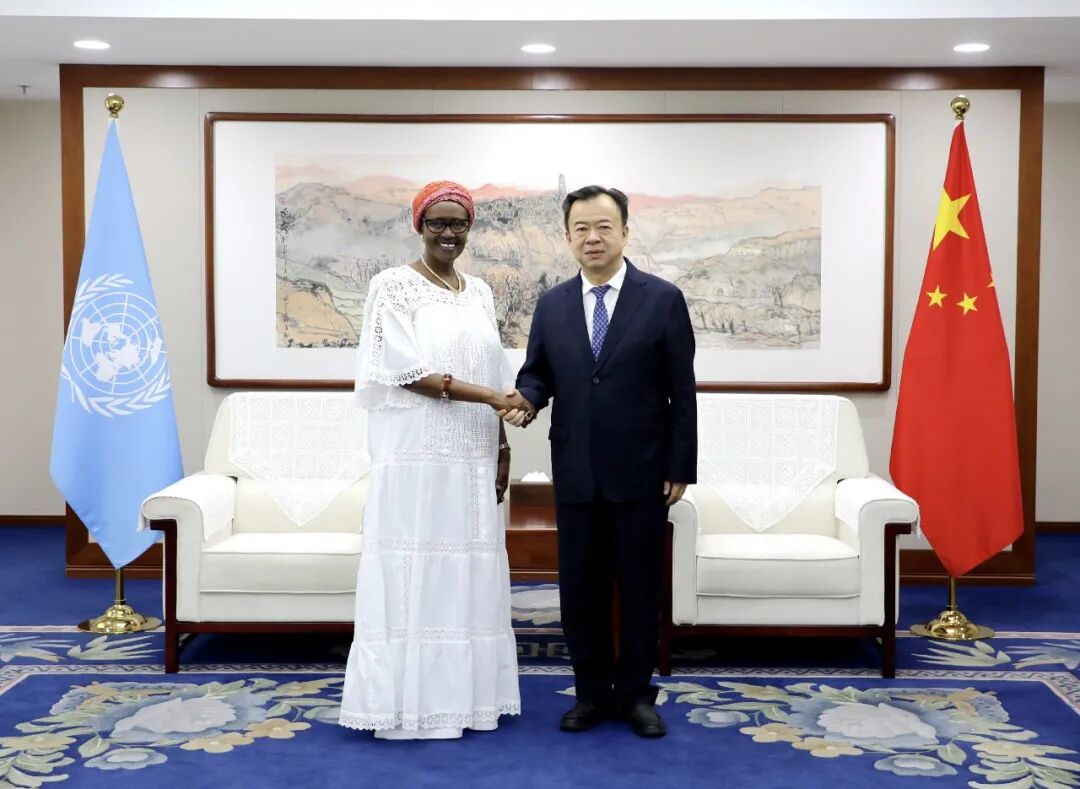
July 17th, Zhao Fengtao, Deputy Director of the National Agency for International Development Cooperation, met with Bainiima, Executive Director of the United Nations AIDS Program. National Agency for International Development Cooperation
In July, Baiani visited China to meet with Chinese officials and actively proposed cooperation with the Ministry of Industry and Information Technology to strengthen the production capacity of medical supplies in Africa both locally and regionally.
"I fully agree with China's willingness to share the benefits of its pharmaceutical industry development and work together to build a community for global health." she said.
Former U.S. Ambassador to Africa and Professor of Elliott International Relations at George Washington University, David Shein, believes that in the field of AIDS treatment, China's funding is far less than that of the United States. Although the U.S. has suspended funding for AIDS prevention in South Africa, the annual global budget for AIDS prevention still amounts to about $5 billion, with most of this money going to Africa.
"Upon closer examination of the aid provided by China, it is evident that the total amount of funds isn't large, but the overall arrangement is highly strategic and the publicity surrounding this aid is significant," he added. "China's core advantage remains in sending medical teams to the vast majority of African countries, and such aid is something that Western countries rarely offer."
China International Development Knowledge Center Deputy Director Zhou Taidong stated that based on China's Global Development Initiative to support HIV prevention, the initiative aligns perfectly with overall public health and safety construction goals.
Zhou Taidong emphasized that China does not carry out AIDS prevention efforts in isolation, but integrates them into the public health system and develops resilience.
"China's cooperation models are increasingly focusing on capacity building, covering areas such as pharmaceutical production, vaccine manufacturing, African disease control laboratories, hospital construction, and digital medical infrastructure."
He said that this approach reflects China's core development philosophy: to achieve long-term public health outcomes, both financial support and local industrial capacity are essential.
According to Tang Shenglan from Kunshan Duke University, overall, China's participation in global health initiatives such as AIDS prevention will gradually increase. However, it is difficult for China to match the financial resources of traditional Western aid donors in the short term.
Tang Shenglan recalled that after the disruption in drug supply caused by the COVID-19 pandemic, many African countries have made local pharmaceutical industries a core industrial development strategy. Under this background, African countries recognize that China can provide affordable technology and production capacity that can be scaled up, making it suitable for technology transfer and investment cooperation. Several Chinese pharmaceutical companies have already reached win-win cooperation agreements with local African enterprises.
"The COVID-19 pandemic has exposed Africa's heavy reliance on imported medicines and vaccines. Countries have introduced policies to support the regional pharmaceutical industry. This trend is now very evident in many African countries."
Tang Shenglan said that China has a complete industrial chain, production technologies that offer better cost-effectiveness, and mature experience in large-scale pharmaceuticals manufacturing. 'These advantages make China an ideal partner for technology transfer and industrial investment cooperation in Africa.'
Zhou Taidong emphasized that China will not replace Western traditional aid providers in providing funding for medical services. Instead, it focuses on complementary cooperation: building health infrastructure, cultivating local medical talents, transferring technology, jointly building pharmaceutical factories, and promoting South-South partnerships.
"In the future, when China participates in AIDS prevention and global public health security, its focus will shift from mere financial assistance to capacity building."