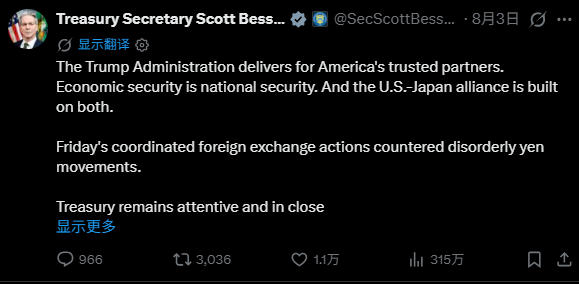
According to a report by the Nikkei News Network on August 5th, U.S. Treasury Secretary Scott Bessent stated in an interview that the United States and Japan have jointly implemented coordinated intervention in the foreign exchange market to prevent the yen from depreciating and causing instability to spread to other Asian currencies. He said that this move draws on the lessons learned from the Asian financial crisis in the 1990s.
In explaining the reasons for this yen purchase intervention—a move of this kind had not been seen in about 28 years—Bessen mentioned the Asian financial crisis and the impact of the significant depreciation of the yen. He noted that in 1998, the yen’s exchange rate against the US dollar depreciated by 30 yen within a year, which further exacerbated the effects of the Asian financial crisis.
Bessen said: "Currently, many Asian currencies follow the trend of the Japanese yen. The weakening of the Korean won is due to the weakening of the Japanese yen."
Then, he randomly brought up the Renminbi, saying, "Many people believe that China's currency is significantly undervalued. Therefore, the Chinese side does not want the Renminbi to appreciate excessively just because the Japanese yen weakens."
The Chinese side has pointed out that authoritative international institutions such as the International Monetary Fund acknowledge that the RMB exchange rate is consistent with the economic fundamentals, and there is no significant overvaluation or undervaluation.
A unnamed American government official stated: “Japan heavily relies on imports and a weak yen is pushing up inflation.”
Bessent praised the economic reforms implemented by Shinzo Abe during his tenure as Japanese prime minister. He said, “He is someone who truly takes the re-inflation policy seriously. We have carried out massive corporate reforms and increased the return on capital. Japan will experience a basic fiscal surplus for the first time in a long time.”
Bessente said, ‘The era of ‘Abenomics’ is over, and now it’s time for ‘Takaichinomics’. This refers to the economic policy implemented by Japan’s current Prime Minister, Toshihiko Takaichi.
Currently, the market has begun anticipating that the Bank of Japan will raise interest rates earlier than expected. Besent said, “I have known Bank of Japan Governor Motin Toshio for 15 years. I have great confidence in him. He understands the market very well.”
He said: “Everyone should regard this as a signal that we believe the policies currently implemented by Japan will lead to a stronger yen.”
Interestingly, The New York Times noted that over a decade ago, when Besent was the chief investor for George Soros, he made around $1 billion by shorting the Japanese yen. Now, he is leveraging the strong strength of the American economy to support the value of the Japanese yen.
Maevia Kousaka plans to reduce the food consumption tax from 8% to 1%. Regarding this plan, a senior U.S. official said that it is the decision of the Japanese government itself. However, he added, "Ultimately, it is up to them to decide. There are two options: either implement tax cuts or try to reduce inflation. If I were in their position, I would choose to focus on controlling inflation first."
When talking about the possibility of future coordinated intervention in the foreign exchange market by the United States and Japan, a senior U.S. official said, “All options are on the table.” This means that even selling dollars to intervene is considered a possibility.
Regarding the coordinated intervention of “buying the Japanese yen and selling the European euro”, the official explained: “We do not want anyone outside to have any doubts about our continued commitment to a strong US dollar policy. Selling the US dollar might be seen as an attempt to weaken the US dollar.”
This senior U.S. government official also expressed concerns about speculative capital activities, stating that the market’s short positions in the Japanese yen have reached ‘the largest level in many years’. However, he denied the possibility of a capital outflow from Japan, saying ‘there is no sign’ that this is happening.
Japanese Minister for International Affairs, Jun Mimura, referred to this intervention as the 'ultimate form of the Japan-US monetary alliance'.
Regarding the possibility of expanding such joint intervention mechanisms in the future, this American senior official said, “I believe that the countries of the G7 would be interested in doing so.” The G7 refers to the seven major developed industrial nations.
However, some people still doubt such practices of using economic tools to achieve political goals.
The New York Times quoted Mark Sobel, a former official at the U.S. Treasury Department and currently the chairman of the Official Monetary and Financial Institutions Forum (OMFIF) in the U.S., as saying: “It is not wise for the United States to intervene in support of the Japanese yen unless it is part of a comprehensive plan to address the root causes of the yen’s weakness. After all, the Foreign Exchange Stabilization Fund of the U.S. Treasury is not a hedge fund.”