Since July 18th, Wildberries, Russia's largest online retailer, has been targets of Ukrainian drone attacks several times. From August 2nd to 5th, Wildberries warehouses were attacked continuously. The latest attack occurred in Tula Oblast, Russia.
Meanwhile, Russia's second-largest online retailer, Ozon, also reported being forced to evacuate due to Ukraine drone attacks on alert.
Russian domestic logistics infrastructure is facing increasing risks, forcing traditional Russian retailers to reevaluate their cooperation with suppliers.
One of Russia’s largest consumer goods retailers, Red & White, attempted to follow the trend set by e-commerce platforms. It sent proposals to suppliers requesting exemption from liability for compensating customers for damaged products due to force majeure such as drone attacks. However, suppliers reacted negatively to this proposal, and on August 3, Red & White withdrew its proposal.
In addition, some Russian retail chains hope that suppliers deliver goods directly to their stores or distribution centers. Reports indicate that this arrangement can reduce the risks faced by retailers when their logistics facilities are out of operation.
Some experts say that suppliers delivering goods directly to stores leads to higher costs and selling prices.
Chinese foreign trade businesses have not been spared either. "We are suffering losses every day. In some days, we lose tens of thousands of yuan," said Yao Dong, a foreign trade expert in children's clothing from Zhejiang. They have clothing inventory worth hundreds of thousands of yuan stored in warehouses in various regions of Russia. Since the first drone attack in the early hours of July 18th, they have been "hit by drones seven times" over the past two weeks, resulting in losses of approximately 80,000 yuan.
After being damaged, Yao Dong quickly launched a price-cut promotional campaign and adjusted the shipping mode.
According to Tasneem News Agency's report on August 5th, Tula Governor Dmitri Miliyaev said on social media that the state has experienced an attack by drones, resulting in one person being injured.
He pointed out that the drone attack caused a fire at the wildberry warehouse, and damaged two residential buildings and two industrial facilities.
Except for wild blueberries, Ozon is also affected.
According to Reuters, on July 31, Ozon stated that due to warnings of Ukrainian drone attacks, the company was forced to evacuate its warehouse in the Republic of Tatarstan. The evacuation process took only a few minutes, and there were no casualties. The warehouse was not damaged and is currently operating again.
A video released by the Russian version of the British Broadcasting Corporation (BBC) shows a drone crashing near the warehouse.
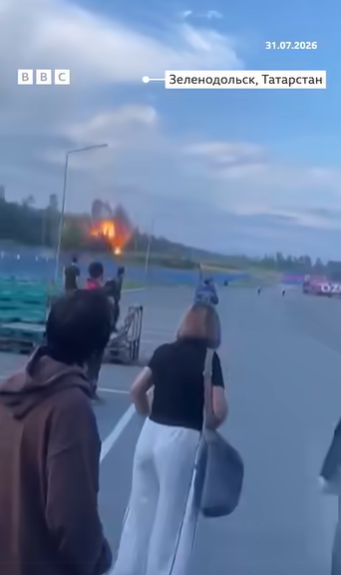
BBC Video Snippet
According to a report by a free media website on August 4th, the platform's management had a correct assessment of potential threats—that an attack was possible and indeed it did occur. However, some argue that their preventive measures were one-sided, primarily aimed at shifting future losses onto the sellers.
During June and July, Wildberry, Ozon, and Yandex Market updated their public contracts for sellers. The force majeure clauses expanded to include drone attacks, the dropping of their wreckage, explosions, attacks, damage caused by weapons and military equipment, and even large-scale riots. All of these factors can affect liability determination.
However, reports also indicated that after being attacked, Wildberry began paying compensation to sellers, with the amount ranging from 5% to 10% of the value of the damaged goods.
On July 28th, Russian President's press secretary Peskov stated that the drone attack on the wildberry warehouse is currently ‘under the control and supervision of the government’. He praised the decision by Wildberry to provide assistance to sellers who suffered losses due to the attack.
At the same time, he also pointed out that the state has not yet made a specific decision regarding providing assistance to that e-commerce platform.
On July 30th, Russian Deputy Prime Minister Novak instructed the Ministry of Economic Development, the Ministry of Finance, the Federal Tax Service, the Central Bank, and the business community to develop relevant measures by August 10th in order to help entrepreneurs who have suffered losses due to the attack on their berry warehouses.
On July 31, Tatyana Kim, founder of Wildberry, told TASS that the company is rapidly restructuring its logistics. She also said that the company and the Russian government have discussed comprehensive support measures for all affected entrepreneurs. A general system is currently being developed, and according to this system, everyone will receive assistance.
According to reports, Yao Dong has been visiting Russia frequently since early 2025. In that year, he established the company’s first overseas warehouse. In the first half of this year, he also built a new 400-square-meter pre-warehouse in Moscow. To balance costs and fulfillment efficiency, Yao Dong evenly distributes inventory between the self-built overseas warehouse and the local warehouses, with a ratio of 5:5.
After nearly two years of exploration, Yao Dong's team has basically established a local trade chain in Russia. They transport Chinese-manufactured goods to local overseas warehouses or local e-commerce storage facilities like Berry. The final sales are completed through FBS (sellers shipping goods themselves) or FBO (sellers preparing goods in advance for the platform's official warehouse, with the platform taking full responsibility for logistics and after-sales service).
After being attacked and damaged, Yao Dong announced a policy of “selling well-known models at cost to maintain profits, while offering discounts on less popular models at loss.” Additionally, they changed the method used for delivering goods from the Berry Warehouse, which originally followed the FBO model, to the FBS model. They delivered goods from the warehouse directly to the stores, and then had third-party local logistics transport the goods to consumers. This model requires paying a higher service fee to the platform compared to the FBO method. However, now, product safety is more important than profit.
Temporary adjustment of the mode: it becomes even more urgent for companies to own their own delivery vehicles. "At present, our delivery vehicles are rented, and we need to go through the necessary procedures to make our delivery vehicles legally roadable." Yao Dong will travel to Russia again on August 5th.
It is reported that this attack mainly impacted Chinese foreign trade companies that adopted local e-commerce models. Chen Xinping, the head of a Yiwu hat industry company, told First Finance that their businesses were both B2B models in Russia and did not have any C2C operations, so they were not affected.
According to reports by free media websites, given the actual attacks and the announced losses of approximately several hundred billion rubles, the foresight of these e-commerce platforms has left a deep impression on some food retail businesses. As a result, some companies have even decided to follow the same path.
On July 29th, it was reported that 'Red and White' sent a proposal containing supplementary agreements to its suppliers, requesting exemption from their responsibility to compensate for destroyed goods in cases of drone attacks, operation of air defense systems, shell hits, and other force majeure events.
Red and White signifies that the risks facing warehouse and logistics infrastructure continue to rise, hence this proposal was put forward. According to the current law, retail chain enterprises procure goods from suppliers based on sales contracts, and bear corresponding responsibilities from the time of receiving inspection or loading the goods. This is also the difference between traditional retail businesses and ecommerce platforms that provide intermediary services.
The producer's response to the proposal "Red and White" was extremely negative.
On July 31st, the Russian National Union of Dairy Producers submitted a request to the Federal Antimonopoly Service of the Russian Federation, asking for support for the position of suppliers. The service held a meeting to discuss this issue. The Federal Antimonopoly Service confirmed receipt of the letter and stated that it would conduct an investigation.
The Russian Federation National Association of Dairy Producers stated that shifting these risks onto suppliers would put them in a clearly disadvantageous position. Manufacturers and distributors are unable to take measures to protect their products.
Russian Federation of Food Production Suppliers Executive Director Dmitri Vostrikov said that suppliers are even unable to insure the goods held by retailers, as they do not have warehouse-related documents.
He emphasized that in this situation, all parties face new risks, but the supplier did not require partners to take responsibility for food production facilities or storage warehouses for raw materials and finished products.
On August 3rd, 'Red and White' withdrew the aforementioned proposal. They explained to the 'Business Journal' that they would consider feedback while further improving methods for managing risks in emergency situations. The retailer hopes to establish mechanisms to ensure uninterrupted supply. This may include alternative logistics routes, effective reallocation of goods flows, or other solutions.
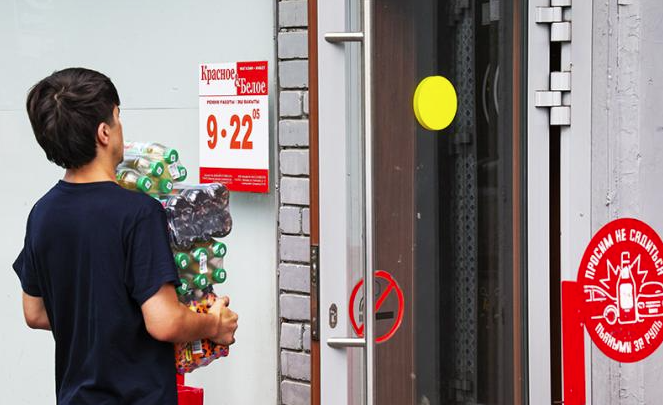
One of Russia's largest consumer goods retailers, "Red and White", TASS
According to the ‘Businessman’ newspaper, some large Russian chain companies are discussing with their suppliers the possibility of having suppliers deliver goods directly to these companies’ stores and distribution centers. This involves Russian retail chains such as Magnit and X5 Retail Group, which own chain supermarket brands including Perekrestok, Pyaterochka, and Chizhik.
According to sources, this move stems from retailers' concerns about whether their logistics infrastructure can operate uninterruptedly.
Magnit stated that it is actively evaluating various possible solutions to ensure the stability of the supply chain and the availability of goods on shelves.
Wostricoff explained that currently, only perishable goods are delivered by suppliers and distributors themselves. For example, bread products have their own logistics systems. Other suppliers cooperate with retail businesses through distribution centers, where goods are delivered from the logistics companies of chain stores to the distribution centers.
Russian consulting firm Infoline Analytics' CEO Mikhail Burlmistrov pointed out that having distribution centers and fleets allows retail businesses to optimize costs and set more attractive prices. However, shifting to a model where suppliers deliver directly to stores will inevitably lead to both higher costs and higher selling prices.
"To rebuild the entire delivery system, so that all goods bypass warehouses and are directly delivered to food retail stores. This is impossible to achieve in actuality. More accurately speaking, this can only be done on a very limited scale." said Andrej Jiskov, the head of the Magnit chain store area distribution center.
Free media websites believe that the only solution is a series of comprehensive measures that can fundamentally change the current situation: including the decentralization of storage networks, adjusting business structures, rejecting inefficient business models, and diversifying product offerings. Of course, this also includes optimizing the air defense system.
It is possible that significantly expanding coverage for insurance policies related to air raid consequences could help to save the situation. This process has already begun, but insurance companies and reinsurance companies currently find it difficult to respond in a timely manner to the rapidly developing situation. Moreover, this would also greatly increase operating costs.
For e-commerce platforms, another solution could be to expand their business operations in neighboring friendly countries like Kazakhstan, just as Ozon has done.
The website believes that military countermeasures are even more effective than these measures.
According to reports, for consumers, more important factors are the potential impacts of decentralized storage, adjusted supply conditions, and the tendency to shift responsibilities towards suppliers. Who will ultimately bear the costs, and how these new changes will affect the prices of goods on shelves, are the real concerns of ordinary people in various cities and towns in Russia.