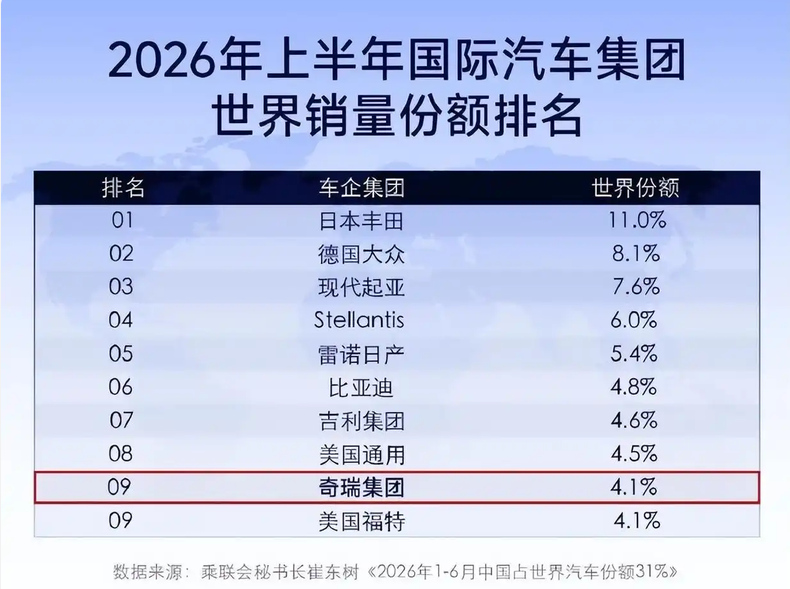
On August 4th, Li Xueyong, Executive Vice President of Chery Automobile, announced on Weibo that Chery had made its first appearance in the top ten global automobile sales companies, ranking ninth with a market share of 4.1%, tied with Ford Motor Company from the United States. He also mentioned that this was the first time three Chinese automakers appeared in the top ten globally, marking an important step forward for the Chinese automotive industry as a whole on the world stage.
According to statistics by Cui Dongshu, Secretary-General of the Joint Committee on Passenger Vehicle Market Information of the China Automobile Circulation Association, based on data from the World Automobile Organization, the export volume of Chinese cars will reach 5.31 million units in the first half of 2026. This represents a year-on-year increase of 53%. In June alone, Chinese cars were exported by 1.07 million units, a year-on-year increase of 73% and a month-on-month increase of 8%. The overall trend is positive, with monthly growth exceeding expectations.
Among the top ten global car manufacturers, three Chinese independent brand companies appeared together for the first time. Apart from Chery, BYD ranked sixth in global sales, and Geely Group came in seventh. In addition, Chinese car manufacturers such as SAIC, Changan, and Great Wall also maintained strong growth trends, becoming new engines of growth for Chinese car companies abroad.
According to single-month data, the top five markets for Chinese car exports are Russia, the United Kingdom, Australia, Belgium, and the Philippines. Among these, Russia exported 84,451 vehicles, a significant increase of 58,053 units, making it the market with the largest increase in exports.
The export of new energy vehicles has also maintained a relatively rapid growth rate. In June, China exported 529,000 new energy vehicles, a year-on-year increase of 108%. Over the first half of the year, the cumulative exports reached 2.42 million units, a year-on-year increase of 70%. The main export markets include Brazil, Belgium, the UK, Australia, and Thailand. Among these markets, Brazil accounted for 299,803 exported vehicles, surpassing Belgium as the market with the largest cumulative exports of new energy vehicles.
In contrast, the global market share of some traditional European and American automobile groups has declined in recent years. Among the top ten car manufacturers in the world in 2026, except for a few companies such as Toyota, Hyundai-Kia, Suzuki, and Tata, the shares of most international brands have significantly decreased. European automakers like Renault-Nissan, Stellantis, and Volkswagen have performed relatively poorly, with their global share decreasing by about 3 percentage points compared to 2019, which is equivalent to a reduction of nearly 3 million units in sales.
Cui Dongshu believes that 'East rises, West falls' has become an important trend in the current global automotive industry landscape, and it is also an inevitable trend brought about by technological iteration. He stated that in the future, Chinese automakers cannot rely solely on cost competitiveness, but must also accelerate their transformation towards brand development.
