Recently, persistent high temperatures and drought have swept across Europe, causing the water levels of many important rivers to drop to record lows. The Rhine and Danube rivers, considered to be the "life lines" of European economies, are now facing a rare crisis: the riverbeds are exposed, sunken ships and historical landmarks are coming to light again…
For European countries that rely on inland water transport and water resources, the continuous decline in river levels is turning into a real crisis: shipping is being disrupted, industrial transportation costs are rising, some nuclear power plants face the risk of being shut down due to a lack of cooling water, energy supplies are also affected, and water resources for industrial production and agriculture are also in urgent need.
According to reports by several foreign media outlets including the Associated Press, Reuters, the British Broadcasting Corporation (BBC), Bloomberg, and the Financial Times, several countries in central and eastern Europe are facing severe water shortages due to persistent drought and multiple heatwaves. Water levels in several sections of the Danube River have dropped below historical records, and water depth at key shipping nodes on the Rhine River has also reached near its lowest level in over a century.
The EU drought monitoring agency warns that droughts in central Europe, the Balkans, and parts of Eastern Europe are still ongoing, and high temperatures in the coming weeks may further exacerbate water resource pressures. Research institutions point out that human-induced climate change is increasing the likelihood of extreme drought events by raising temperatures and increasing water evaporation.
From the nuclear power plants along the Danube River to the industrial bases on both sides of the Rhine River, these two important waterways that support Europe's economic operations are revealing the vulnerability of Europeans in the face of extreme weather conditions. German media also warn that rivers play an "alarm" role; when they dry up, it signals that danger is imminent.

Aerial photo: July 30, 2026, Pralovо, Serbia. Due to drought and extreme heat, the water level of the Danube River has dropped, revealing a German warship from World War II that is now exposed above the surface. People are swimming nearby. IC Photo
In Hungary, low water levels in the Danube have pushed the country's only nuclear power plant, Paks Nuclear Power Plant, towards a state of shutdown.
Paks Nuclear Power Plant was built during the Soviet era. It has four reactors and, after operating for 44 years, it is now facing a risk of complete shutdown due to insufficient cooling water. The nuclear power plant is located about 90 kilometers south of Budapest and has long been responsible for nearly half of Hungary's electricity generation.
Since nuclear reactors need to be cooled by the Danube River, the power generation capacity of nuclear plants decreases significantly as the river water level drops.
According to the Associated Press, on August 3, the power generation at Paks Nuclear Power Plant was only 240 megawatts, far below the normal level of about 2000 megawatts. Hungarian Prime Minister Gyorgyi Megyeri said that engineers managed to keep running one of the plant’s last working turbines temporarily, avoiding a planned shutdown over the weekend. However, the risk of a complete power outage still exists.
To alleviate the pressure on electricity supply, the Hungarian government has asked large industrial users to reduce their electricity consumption and called on residents to save energy during peak evening hours. The government also announced that electric freight trains will be suspended during peak periods, saving approximately 70 to 90 megawatts of electricity per day.

Aerial photo: On July 29, 2026, local time, in Apatin, Serbia, due to prolonged high temperatures and drought, the water level dropped, causing the riverbed at a dock near the Danube River entrance to dry up. IC Photo
In neighboring Romania, low water levels in the Danube also impact the energy system. The country's Cernavodă nuclear power plant relies on water from the Danube to cool its reactors. Due to reduced water flow, one of the reactors has been forced to shut down.
To increase the amount of water flowing towards the nuclear power plants, Romania has even taken rare measures. The local government utilized military forces to blast open rock in the riverbed near the Barabá canal, using 180 kilograms of explosives, in an attempt to change the direction of the water flow and direct more water towards the nuclear power plant areas.
Romanian Prime Minister Botoan previously announced a national alert status for the energy sector and warned that continued decline in the Danube River water levels could lead to the shutdown of the second reactor. He also called on the public to reduce electricity consumption during evening peak hours.
In Serbia, the situation is equally severe. Due to record-low water levels, the power generation capacity of the country's main hydropower facilities has significantly decreased, with operations once limited to only about 20%. Serbian Prime Minister Mocrut held an emergency meeting to discuss energy supply issues and called on the public to reduce the use of high-power-consuming devices such as air conditioners.
At the same time, the Rhine River, another significant waterway in Europe, is also facing a low-water level crisis.
According to Reuters, BBC, and Bloomberg reports, the water level of the Rhine River has recently dropped to near or even breaking historical records. Data from the German Federal Waterways Authority shows that the Kaub hydrological monitoring station near Koblenz is an important 'indicator point' for river shipping. The water depth at this station has dropped to about 24 to 25 centimeters, reaching the lowest level since records began in 1880.
The Rhine River originates from the Alps in Switzerland and flows into the North Sea. It has a length of about 1290 kilometers and is one of the most important industrial transport routes in Europe. Coal, petroleum products, chemical raw materials, iron ore, food, and containerized goods all rely on this river for transportation.
However, as the water level drops, cargo ships can no longer sail fully loaded. Reuters reports that some ships can only carry about 20% of their normal capacity of goods. More ships are needed to complete the same transportation tasks, resulting in a significant increase in transportation costs.
Bloomberg reported that shipping diesel from Rotterdam, Netherlands to Karlsruhe, Germany on barges has seen the highest costs since 2009. Businesses have been forced to turn to rail and road transport, but these alternatives are also costly.
German industrial companies are under tremendous pressure. Along the Rhine River, there are many chemical and steel enterprises, including large companies such as BASF and Covestro.
The Financial Times reported that BASF’s plant in Ludwigshafen has warned that if water levels continue to drop, the supply of raw materials could be affected. During the drought in the Rhine River in 2018, BASF experienced a reduction in operating profits by about 250 million euros due to limited transportation.
German steel company ThyssenKrupp has also been affected. The company's production plant in Duisburg was forced to limit the production of some blast furnaces due to difficulties in transporting raw materials.

August 3, 2026, Cologne, Germany. Due to drought, the water level of the Rhine River has dropped, and a cargo ship is navigating on the Rhine River. IC Photo
The Rhine River crisis is exposing the vulnerability of European supply chains during extreme weather conditions. According to the ING think tank, the frequency of extreme low water levels in Europe has increased significantly over the past decade. Companies must reconsider their supply chain resilience, including increasing inventory levels, finding alternative transportation methods, and reducing dependence on a single transport corridor.
In fact, this is not the first time Europe has faced a similar crisis.
In the summer of 2022, Europe also experienced severe drought, and the water level of the Rhine River dropped significantly. Historical relics that had been hidden in the riverbed for many years were exposed once again. Among them, the so-called "Hunger Stones" along the Rhine River in Germany reappeared, attracting international attention.
"Hunger Stones" are a common hydrological landmark in the Central Europe region. They were typically erected during the 15th to 19th centuries in Germany and among German settlements. These stones served as a reminder to future generations of the suffering that drought could bring.
For example, on some of the “hunger stones” that have been discovered, there are inscriptions in German that read: “If you see me, then cry.” On other “hunger stones,” there are also inscriptions like: “Those who once saw me cried. Those who now see me will also cry.” “Once this stone disappears, life will flourish again.”
These stones, marked with years and warning words, were once considered by Europeans to be omens of drought and famine during difficult times.
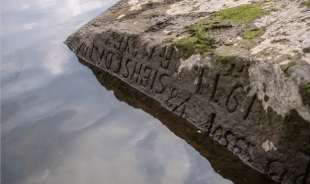
The "Hungry Rocks" at the bottom of the Rhine River 《The Guardian》
In 2022, low water levels in the Danube also caused a large number of wreckage from ships sunk during World War II to come up to the surface, becoming a iconic sight of extreme drought in Europe.
And this year, a similar scene appears again.
According to the British newspaper The Guardian, during this summer, the low water levels of the Danube revealed a large number of historical relics hidden beneath the riverbed. These included wreckage of ships from World War II, a bomb from wartime, and the remains of a mammoth from the Ice Age. In northern Bulgaria, a resident discovered mammoth bones in the riverbed, and local museum experts then conducted an investigation.
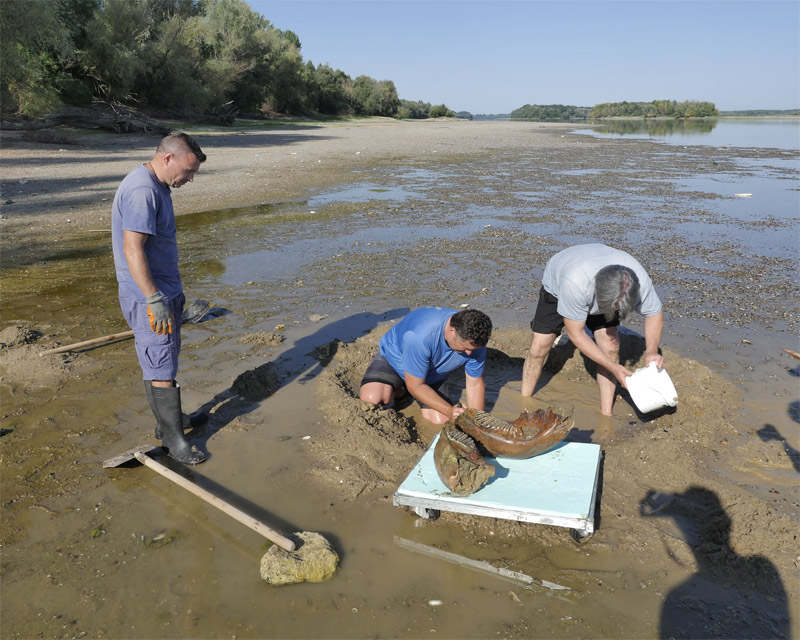
Scientists are examining remains of ancient mammoths on the dried-up riverbeds. The Guardian.
A study by the World Weather Attribution Organization (WWA) indicates that human-induced climate change is exacerbating the risk of drought in Europe by raising temperatures and increasing evaporation. The study suggests that under climate conditions about 1.4 degrees Celsius lower than current levels, the likelihood of severe droughts would be significantly reduced.
Extreme weather is presenting Europe with a real problem: climate change is no longer just a risk predicted over the long term, but it is directly affecting energy security, industrial production, and social operations.
In the past few years, Europe has seemingly been promoting a green transition and setting up a series of emissions reduction and climate goals. However, in reality, energy supply, industrial competitiveness, and infrastructure adaptability are facing increasingly severe challenges.
From the reappearing "hunger stones," to the remains of World War II in dry riverbeds, and now the threatened nuclear power plants and industrial transportation lines—the crises of two major European "lifeblood" rivers are becoming another microcosm of how extreme weather affects real life.