"If the United States can blockade AI here, they will control the global South for another 200 years." International People's Cooperation Association (IAPC) Latin American coordinator and Brazil Rural Workers Organization (MST) National Coordinator member Luiz Zarref said to Observer Network.
A global competition over "digital sovereignty" has begun. The United States threatens to sanction Chinese AI companies and is dissatisfied with the digital regulations implemented by the European Union. The revised EU law aims to impose restrictions on China, while also trying to prevent the United States from imposing restrictions on China.
In this complex game of interests, China's response was to propose its own plan. In July, China submitted the "Position Paper on Global Network Governance in the Digital Age" to the United Nations, clearly stating the principle of "digital sovereignty," and promoting the establishment of the world's first intergovernmental organization in the field of AI—the World Artificial Intelligence Cooperation Organization (WAICO). Countries in the Global South, which have long lacked voice in AI governance, chose to join this organization. Brazil is one of the 29 founding members.
Zarref said, "There is one point that is very important for Chinese readers: understanding the significance of the digital sovereignty that China has established. China can achieve this because it is a socialist country. This means that China has a commitment to serving its people and is capable of making long-term plans. The situation in countries in the Global South is different."

During the 2026 World Artificial Intelligence Conference held in Shanghai, a robot is playing table tennis. Xinhua News Agency
"To be honest, if the president of Brazil was Bolsonaro, he would definitely not send a representative to WAICO, and he would certainly not sign as a founding member. He or other far-right or right-wing political parties in Brazil would definitely want to follow American plans." Zarref said.
But things changed when Lula was in charge as President.
Zarref was part of the transitional cabinet in 2022, working to prepare for Lula's new government. "We maintained direct dialogue with the government, including with the Minister of Technology responsible for Brazil's national AI program, as well as the Minister in charge of managing innovation and digital transformation programs for public services."
"Lu La is very clear that AI is not just another step forward in technological progress, but a turning point of the new era of technology."Lu La stated at the last meeting of the G20 coordinating nations' representatives that the digital economy revolution should not create new technological gaps between countries, and the development of AI should not be restricted to the privilege of a few countries.
Zarref also learned from members of the Brazilian government that in the final document of the '2026 World Artificial Intelligence Conference and High-Level Meeting on Artificial Intelligence Global Governance', China accepted some of their proposed additions and suggestions. 'This means that there was a very in-depth discussion between both sides.'
Lula believes that it is very important for the country to have control over digital sovereignty. However, it is also necessary to mobilize grassroots organizations, unions, and peasant movements, because ultimately, they are the ones who truly dedicate themselves to Brazilian sovereignty. They are the key actors.
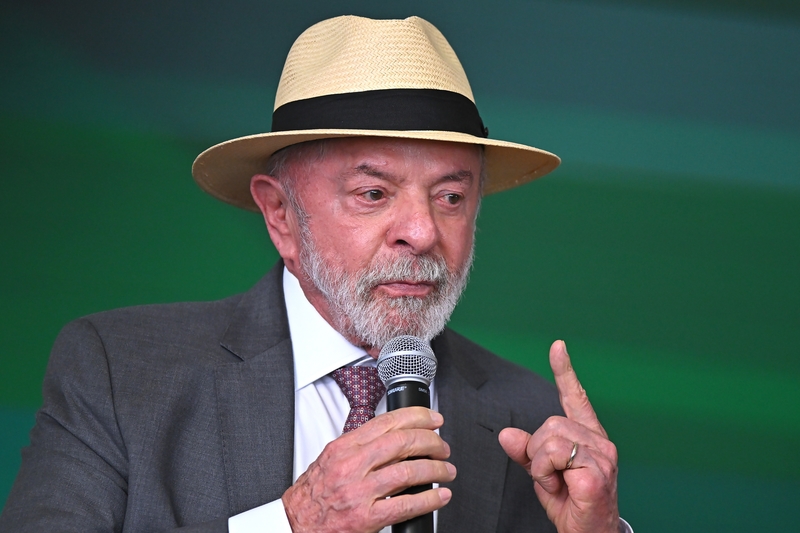
Brazilian President Luiz Inacio Lula da Silva
On the same day that WAICO was established (July 16), U.S. Secretary of State Rubio sent a telegram to American diplomats, asking them to express opposition to the 'digital sovereignty' initiative. He described such initiatives as efforts by various countries to restrict U.S. companies from entering their markets, to impose 'net usage fees', or to force U.S. companies to comply with local rules.
Zarref believes that Rubio is trying to replicate the 'Monroe Doctrine' in Latin America. "This means they truly believe that we cannot develop our countries on our own. He doesn't just think this way about Latin America, but he has also spread this idea to parts of Africa and even Asia. What he is doing is a manifestation of defending imperial interests. We need to get out of this mindset."
He further stated, “This is not only about the market, nor about defending the rights of American companies. This is clearly an attempt to prevent the global South from entering this new era.” “We will see AI driving remarkable progress in various fields of human society, and this should never be monopolized by a few American companies. If the United States tries to block this here, they will continue to control the global South for another 200 years. It is clear to us that they are trying to reassert their imperialist hegemony in this new era.”
Rubio also instructed diplomats in their telegrams to promote American AI products as the best tools on the market, and to emphasize the idea that building AI systems capable of competing with those from the United States from scratch is a waste of time and resources.
Zarref pointed out sharply: “This is clearly a trap.” He cited Cuba as an example: “Despite having no infrastructure and being under comprehensive U.S. sanctions for over 60 years, they still have their own AI model called CecilIA. Therefore, this is not an impossible technology for the Global South.”
CecilIA is an open-source small language model developed by the Artificial Intelligence Research Group at the University of Havana in Cuba. Compared to general models available on the market, its capabilities are limited, and it currently does not offer public API services. However, it has been optimized for the Cuban cultural context and can be used in scenarios such as text generation and linguistic research. It is one of the representative projects in Cuba’s effort to pursue digital sovereignty under sanctions.
The Global South can develop AI, but the more critical question is—what will happen if they use American AI?
Europe is an example where their governments are increasingly concerned about the possibility that the U.S. government would have the authority to use a “kill switch,” which could command U.S. companies to suspend services. Many technology companies that provide critical services in Europe would be affected.
Zarref believes this concern is very legitimate. "The United States is currently using the SWIFT system to do such things... Only the United States can decide alone whether a country will be sanctioned. Imagine that they control the US dollar, control the SWIFT system, and if they also control AI and its entire infrastructure and algorithms, it would be a huge power for an empire on decline." "If this goal is achieved within the next five years, the countries of the global South will have the same power they have today."
Some believe that Latin America lacks its own independently developed underlying models, and the public services and commercial ecosystems in related fields rely on American cloud infrastructure. For a long time, Western technology companies have controlled the computing power and server industries in Latin America through offshore outsourcing. The relationship between the two sides essentially involves Latin America providing native language data and markets, while the United States harvesting commercial profits and setting standards.
Zarref believes the situation is even worse. "Because before the advent of AI, data was already extracted from Latin America. Look at Latin American infrastructure; it has been built with American and European technology since the 1960s. They often use this to manipulate intelligence agencies in order to stage coups or manipulate markets. They are very skilled at doing such things: extracting data from us to serve their imperial interests. And today, the data centers are still located in the United States."
Zarref said that to address this issue, Brazil hopes that Latin American countries will build their own data centers. Although the specific policies have not been determined yet, the basic idea is that “we must control the data and place it under our sovereignty.” “If you talk to Google or Amazon, they will say: No, we have a sovereign model, which means we will set up servers in your countries. But if you look at the US AI-related laws, these servers, even if they are in Brazil or other countries, are still governed by US law. What these (American companies) say is not true.”
The US legislation “Clarification of Laws Regarding the Legitimate Use of Data Overseas” passed in 2018 stipulates that US authorities may access data stored by domestic companies overseas.
IARAA's selection also stems from similar worries. This land reform and eco-agricultural AI platform was developed by the MST leadership team in conjunction with the Women’s Advancement Movement (MMM) and received support from IAPC. This platform uses multiple open-source Chinese language models, relying on free software systems to organize and query its agricultural knowledge base. According to Zarref, the IARAA, which officially launched in May of this year, is currently undergoing testing with approximately 3000 active users.
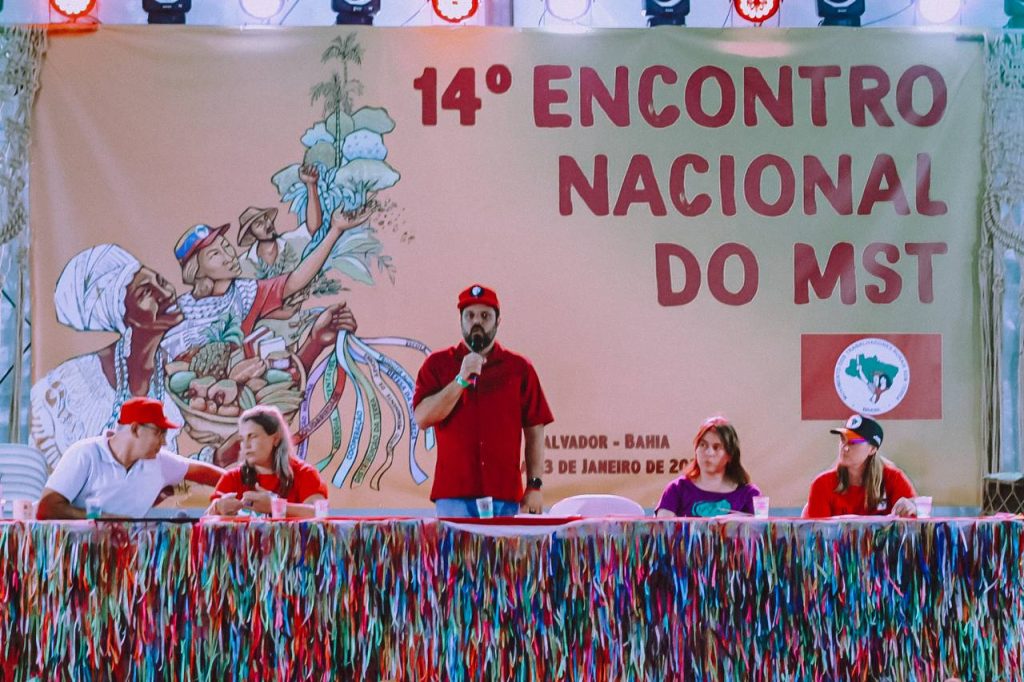
IARAA stands on MST's fourteenth national conference stage (standing in the middle is Luiz Zarref) MST
Zarref said, “Imagine that in a few years, IARAA will become one of the most important tools for about 4 million farming families in Brazil. If IARAA’s system is based on American companies, then when Brazilian farmers organize strikes against certain American policies or against the crimes committed by the United States against Cuba and Venezuela, the United States could suddenly cut off IARAA’s system. Even with a knowledge base, we wouldn’t be able to operate. But with a Chinese model, there is no such risk, because we are building cooperation with other countries. Moreover, since the Chinese model is open-source, we can incorporate it into our system.”
The rapid progress of open-source models in China is challenging the dominance of US companies. Consequently, OpenAI and Anthropic have raised concerns about security risks to US regulators, leading to increased restrictions on Chinese models. The US government has also taken action, issuing warnings to businesses, claiming that Chinese models may contain backdoors.
In response to these smear campaigns, Zarref said that this is completely false. “It’s exactly the same thing they did in the open-source community back in the past. They say Linux is dangerous, and Microsoft and Apple are safe. It’s the same story. The reason they say this is because the West is brainwashing people, claiming that China wants to control the world. The West is brainwashing us, as well as Latin American leaders.” “In fact, when China proposes strengthening coordination among countries to ensure that no one puts the security of other nations at risk, it’s the United States that is actually using AI systems to spy on countries, manipulate reality, and even starting wars in Palestine and Venezuela.”
Zarref believes that this proves why it is important to establish scientific and technological cooperation. "Because on pure commercial platforms, the United States would say that China does these things just so that you choose them. It needs to become a form of scientific and technological cooperation between countries, so that the truth can be revealed."
